
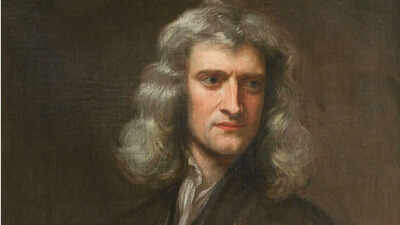
We often assume the smartest answer must be the most complicated one. Big words, tangled explanations, layers upon layers of detail. Surely anything that sounds this complex must be deep. Isaac Newton, one of the greatest minds in history, believed almost the opposite. Truth is ever to be found in simplicity, he wrote, and not in the multiplicity and confusion of things. Coming from the man who unlocked the laws of the universe, that’s worth pausing on. Newton spent his life untangling some of the hardest puzzles there are, the motion of the planets, the pull of gravity, the behaviour of light. And what he found, over and over, was that beneath the apparent chaos lay something startlingly simple. To him, confusion was a sign that you hadn’t reached the truth yet. Real understanding, when it finally arrived, was clean.
Quote of the day by Isaac Newton
“Truth is ever to be found in simplicity, and not in the multiplicity and confusion of things.”
Who was Isaac Newton
Isaac Newton was an English physicist and mathematician, born in 1642, and he is often ranked among the most influential scientists who ever lived. He worked out the three laws of motion and the law of universal gravitation, showing that the same force pulling an apple to the ground also keeps the moon locked in its orbit.He helped invent calculus, made groundbreaking discoveries about light and colour, and laid much of the foundation for modern physics. His great book, usually known simply as the Principia, transformed how humanity understood the physical world. Quiet, intense and famously single-minded, Newton could hold a single problem in his head for years until it finally gave up its secret.
Simplicity as Newton’s guiding rule
This particular line actually comes from Newton’s religious writings, a manuscript on interpreting prophecy. Many people forget that alongside his science, Newton wrote vast amounts on theology and even alchemy. But the same instinct runs through all of it. He trusted simplicity wherever he went looking for truth.It shows up just as plainly in his science. In the Principia, he laid out rules for reasoning about nature, and the very first is that we should admit no more causes than are actually needed to explain what we see. Nature, he wrote elsewhere, is pleased with simplicity. His whole method was to take a messy problem and strip it back until only the essential, simple core remained. That instinct is precisely what allowed him to reduce the tangled motions of the heavens to a mere handful of clean equations.
Understand the meaning of the quote by Isaac Newton
Newton is making a claim about where truth tends to live. When something is genuinely true, he’s saying, it usually turns out to be simple at its heart. When an explanation is a sprawling mess of exceptions, patches and confusion, that is often a sign it’s wrong, or at the very least unfinished.This doesn’t mean reality is easy, or that hard things are somehow fake. Newton’s own work was brutally difficult. The point is about the destination, not the journey. You may have to wade through enormous complexity to get there, but the truth waiting at the end has a kind of elegance and economy to it. If your final answer is still a tangled knot, the odds are you haven’t quite found it yet.
Why this quote is relevant
It’s easy to be impressed by complication. A dense report, a jargon-stuffed speech, a convoluted plan can all seem clever simply because they’re hard to follow. Newton’s line is a handy filter against that. Genuine understanding usually makes things clearer, not murkier.Think of the best teacher you ever had. They probably took something baffling and made it simple, rather than the reverse. People who truly grasp a subject can explain it plainly. People who hide behind complexity often don’t understand it themselves, or have something they’d rather dress up. In a world drowning in noise and clutter, the ability to find the simple core of things is rarer, and more valuable, than ever.
How to apply this quote in daily life
You can borrow Newton’s instinct for simplicity in all sorts of everyday ways.
- Distrust needless complexity. If an explanation, a deal or a plan seems tangled and confusing, don’t assume it must be clever. Ask whether the confusion is hiding a weak idea.
- Aim to explain things simply. If you can’t say it plainly, you may not understand it as well as you think. Simplicity is a quiet test of real understanding.
- Look for the core. Faced with a messy problem, ask what the one or two things that truly matter are. Strip away the rest and see what is actually left.
- Be suspicious of clutter. Whether it’s your schedule, your money or your work, a tangled mess is often a sign that something needs simplifying, not adding to.
Other famous quotes by Isaac Newton
- “Nature is pleased with simplicity, and affects not the pomp of superfluous causes.”
- “If I have seen further it is by standing on the shoulders of giants.”
- “Plato is my friend, Aristotle is my friend, but my greatest friend is truth.”
- “I seem to have been only like a boy playing on the seashore… whilst the great ocean of truth lay all undiscovered before me.”
There’s a quiet humility in Newton’s words. The man who explained the heavens still believed that truth, at its core, is simple, and that confusion is only a stage we pass through on the way to it. So the next time something feels needlessly complicated, take it as a clue rather than a conclusion. The simplest true answer is usually the one still waiting to be found.