

Parenting today is dominated by one constant concern- “Should children be given the liberty to use screens?” Many parents spend time worrying about things like- “Is one hour of gaming too much?” or “Should I allow my toddler to watch cartoons?.” While the questions come from a place of concern and care, there’s another screen that deserves just as much attention, and it is the one in parents’ hands.Psychology says the phone habits parents portray in front of their kids can affect the child’s behavior and family bond.
6 Jul 2026 | 14:01
What factors did you consider, or would consider, before choosing the right school for your child?
Checking a work email while your child is talking. Replying to a WhatsApp message during dinner. Scrolling through social media while pushing a swing in the park. These moments seem insignificant because they last only a few seconds. Yet, when repeated several times a day, they can quietly interrupt one of the most important ingredients of healthy child development: responsive attention. This phenomenon is called Technoference.

Image: Canva
What is Technoference?
In simple words, Technoference comes from two separate words- technology and interference. We see how in almost every family, phones have become a constant companion. For example, phones and other devices are becoming a constant companion during meals or playtime.
Why technoference impacts children
Technoference is basically how often technology disrupts face-to-face relationships. While smartphones themselves are not the enemy, psychologists say how and when parents use them matters. While each of the technological interference between a child and his parents’ interaction may last for a few seconds, over time, it reduces meaningful interaction between the two. Researchers believe these interruptions matter because children develop through thousands of everyday conversations, shared smiles, eye contact and moments of joint attention.
What does research say?
One of the landmark studies on this topic was conducted by researchers at the University of Michigan. The research was published in the Child Development journal. The study suggested that about half of parents reported that technology interrupted time with their children three or more times on a typical day. Even in low amounts, interruptions to parent-child time caused by digital technology are associated with greater child behavior problems such as sulking, frustration, and whining.
Why attention matters so much in childhood
Think of how a baby responds when a parent smiles at him- The baby smiles again. In another situation, think of a toddler excitedly showing her parents a butterfly, and the parents look in that direction and say “Yes! Isn’t it beautiful?” While these simple conversations look ordinary, they’re an important part of brain development. Developmental psychologists often describe such healthy parent-child communication as “serve-and-return” interactions. According to the Center on the Developing Child at Harvard University, serve-and-return interactions help build neural connections responsible for language, emotional regulation, learning and social skills. Frequent interruptions reduce the quality of these interactions as attention becomes divided.
Research from China points in the same direction
Studies published in Computers in Human Behavior have also explored what researchers call parental phubbing- a combination of the words “phone” and “snubbing.” Parental phubbing refers to parents paying more attention to their phones than to the people physically present with them.Several studies involving Chinese families have found that higher levels of parental phone dependence are associated with increased anxiety, loneliness, emotional difficulties and behavioural problems in children and adolescents.
Simple changes can provide solution
Parents don’t need dramatic digital detoxes to improve family interactions. Instead, small, intentional habits can make a meaningful difference. Many child psychologists recommend creating predictable “phone-free” moments throughout the day.
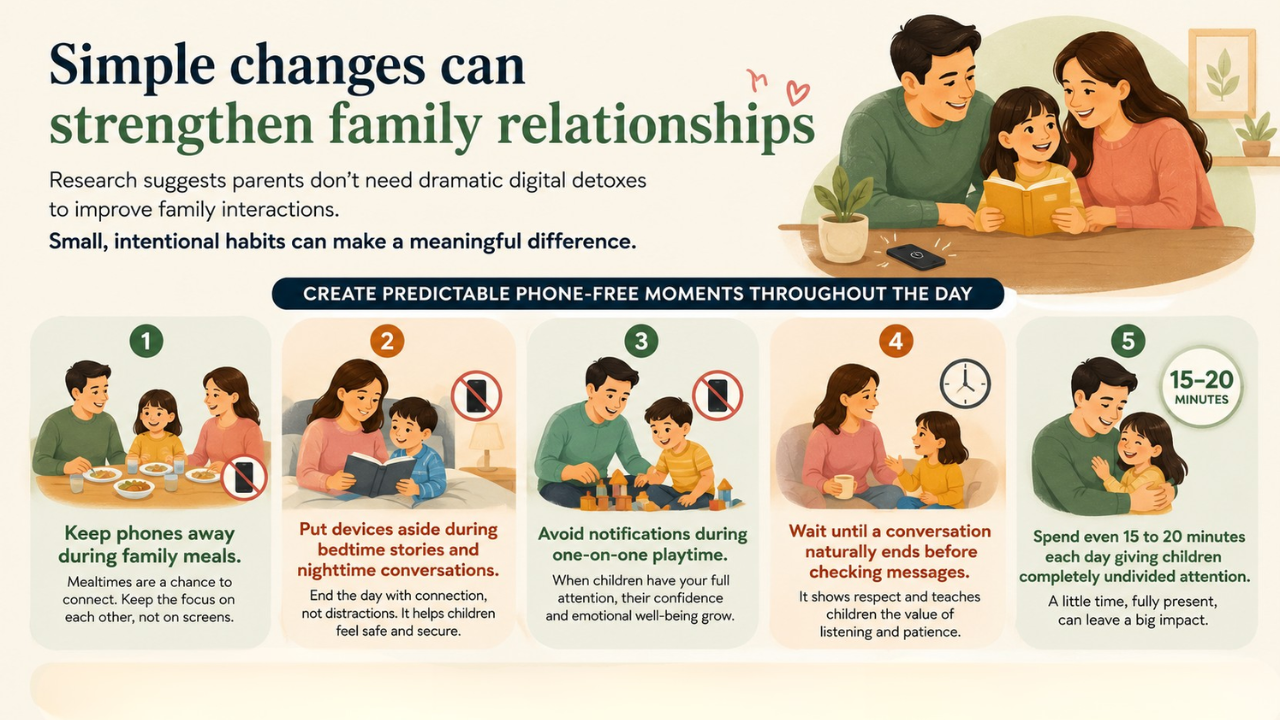
What parents can do
No parent can be fully present every minute of every day, and psychology doesn’t expect perfection. The broader message is that children don’t simply count the hours they spend with their parents- they experience the quality of those hours.