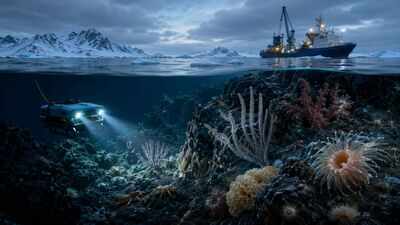
Far below the Arctic Ocean surface, beyond the reach of sunlight and largely untouched by human observation, a month-long expedition has been documenting a world that few people have ever seen. Scientists working aboard a Greenpeace research mission used remotely operated vehicles to explore seamounts, hydrothermal vents and deep seabed habitats off Norway’s coast, recording marine life living at depths of up to 3,000 metres.The footage gathered during the voyage arrives at a time when Norway remains at the centre of an international debate over deep-sea mining. While exploration plans have been paused until at least 2029, the waters surveyed during the expedition sit within an area that Norway previously opened for potential mineral exploration. The mission’s scientists say the images and biological samples collected may help fill some of the significant knowledge gaps surrounding one of the planet’s least understood ecosystems.
Arctic deep-sea expedition reveals rare marine life and undiscovered Species
pc: Canva
The Arctic deep sea covers an immense area, yet much of it remains scientifically undocumented. During the expedition, remotely operated vehicles travelled across underwater mountains and vent systems, capturing images of species rarely observed in their natural environment.Among the animals filmed was a Dumbo octopus, a deep-sea species recognised by its ear-like fins. According to Euronews, the expedition also collected hundreds of sponge specimens, while researchers indicated that some of the organisms encountered may represent species not yet formally described by science. What makes these environments particularly challenging to study is their remoteness. Unlike coastal ecosystems that can be monitored more regularly, deep-ocean habitats often require specialised vessels, robotic equipment and extensive logistical planning simply to obtain basic observations.According to the WWF Global Arctic Programme, scientists currently possess only a fraction of the knowledge needed to make fully science-based decisions regarding deep-sea mining. The organisation states that understanding of many deep-ocean ecosystems, including mineral-rich seabed regions, is still at an early stage.
Why Arctic deep-sea ecosystems are vulnerable to mining and climate change
The expedition’s participants argue that the slow pace of life in the deep ocean creates unique vulnerabilities.Anne Helene Tandberg of the University of Bergen, who took part in the Arctic mission, said many deep-sea organisms grow slowly, live for long periods and produce relatively few offspring. According to Euronews, this means populations may struggle to recover if habitats are damaged or disrupted.She also pointed to the growing influence of climate change on deep-water ecosystems. Speaking during the expedition, Tandberg noted that many invertebrates depend on stable cold-water conditions and calcium-based structures, both of which can be affected by ocean warming and acidification. “The deep sea, even though it’s far away from us, is already now suffering a lot of problems,” she said, according to Euronews.As per WWF warns that Arctic deep-sea habitats already face pressure from changing ocean conditions, pollution and industrial activity. The organisation argues that adding mining operations to ecosystems that are still poorly understood could increase risks to biodiversity and ecological processes that scientists have not yet fully mapped.
Why deep-sea mining is seen as a source of critical minerals for clean energy
Interest in deep-sea mining has grown alongside efforts to expand clean-energy technologies. Supporters of seabed extraction point to deposits containing materials such as cobalt, nickel and rare earth elements that are used in batteries, electric vehicles and other technologies associated with lower-carbon energy systems. Norway has cited access to these resources as one factor behind its interest in exploring domestic seabed mineral reserves.The discussion extends well beyond Norway. International negotiations under the International Seabed Authority continue as governments, industry representatives and environmental organisations debate how seabed resources should be managed.Environmental groups maintain that mineral demand should not automatically justify opening new extraction frontiers, and that greater recycling, longer product lifespans and circular-economy measures could substantially reduce future demand for several critical minerals. The organisation points to research suggesting that technological changes and improved resource recovery could lower requirements for key minerals without relying on commercial deep-sea mining.
Why Norway’s Arctic seabed mining proposal remains controversial
Norway became one of the first countries to move towards opening parts of its seabed for mineral exploration when parliament approved plans covering large areas of Arctic waters. The decision immediately attracted criticism from conservation organisations, marine scientists and fishing interests.Although exploration activity has since been paused until at least 2029, opposition has not faded. Legal action against the Norwegian government, arguing that the environmental consequences have not been adequately assessed. The organisation says significant scientific uncertainties remain regarding the effects that industrial activity could have on deep-sea ecosystems.The issue has also attracted attention internationally. Several countries have called for precautionary pauses, moratoriums or outright bans on deep-sea mining while more scientific evidence is gathered. Critics contend that decisions involving ecosystems that remain largely unexplored should proceed slowly until environmental risks can be better understood.For now, the material collected during the Arctic expedition will undergo further analysis. Scientists expect the samples, imagery and ecological observations to contribute to future research and potentially inform proposals for marine protected areas in Norwegian waters.