
An office worker wakes up to an alarm at six in the morning, sits in two hours of traffic, and spends eight hours entering data into a spreadsheet. The next day, the alarm rings at six again, and the exact same cycle repeats. This routine can continue for forty years. It is easy to look at this loop and feel a sense of emptiness, wondering what the point of it all is when the work is never truly finished.This regular human experience is why a single line from a mid-twentieth-century French essay continues to strike a chord with people today: “One must imagine Sisyphus happy.”The phrase changes how we view difficult, repetitive tasks. Instead of telling us to wait for a prize at the end of our lives, it suggests that the value is in the struggle itself. It shows that even when life feels repetitive or meaningless, we can still choose to take control of our own happiness.
A message written during the dark days of war
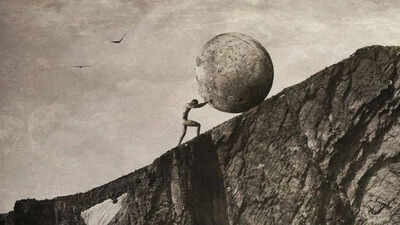
Albert Camus wrote this line in his philosophical essay The Myth of Sisyphus, published in 1942. At the time, France was under Nazi occupation during the Second World War. Camus was living in a world where regular life had been completely disrupted by violence, censorship, and fear. For many people living through that era, the future seemed entirely out of their hands, and daily survival felt like a repetitive, exhausting struggle against a giant weight.To explain this feeling, Camus turned to an old Greek myth. Sisyphus was a clever king who managed to cheat death twice by tricking the gods of the underworld. When the gods finally caught him, they decided to punish him for his arrogance. They did not just kill him. Instead, they gave him a punishment designed to break his spirit through sheer boredom and uselessness.Sisyphus was forced to push a massive boulder up a steep mountain. Every time he neared the very top, the weight of the stone would overcome him, and it would roll all the way back down to the valley. He had to walk back down the hill and start over, knowing that his work would never end, never succeed, and never mean anything to the world.
The short walk back down the mountain
The core of Camus’ philosophy rests on what happens during the walk back down the hill. When the stone rolls away, Sisyphus is temporarily free from the physical labor. As he walks down to the valley to reach the stone again, he is fully aware of his situation. He knows the gods want him to feel miserable, but by accepting the rock as his own, he takes away their power to torture him.This perspective connects to a school of thought called absurdism. Camus argued that humans have a deep, natural desire for meaning, order, and purpose. However, the universe is silent and cold, offering no clear answers to our questions. This clash between our search for meaning and the silent universe is what Camus called “the absurd.”Instead of turning to false hope or giving up entirely when faced with this reality, Camus believed we should rebel against it. Sisyphus rebels by choosing to push the rock anyway. He does not look back at his past life as a king, nor does he dream of a magical day when the rock will stay at the top. The rock belongs to him, the mountain belongs to him, and the effort itself is enough to fill his heart.
Pushing the boulder in modern life
This old myth applies directly to how people navigate their careers, education, and personal goals. The modern world often tells people that happiness only happens when they reach a specific finish line, such as getting a promotion, buying a house, or hitting a specific financial target. The problem with this mindset is that once the goal is achieved, the boulder simply rolls back down, and a new target takes its place, leaving people on a never-ending treadmill.In creative fields and long-term research, workers frequently face this loop. An animator might spend hundreds of hours drawing frames for a short scene that flashes on screen for three seconds, only to immediately start on the next clip. A scientist might spend years running laboratory trials that end in failure, forcing them to clean their equipment and start the next experiment from scratch.By applying the philosophy of the stone, these individuals find purpose not in the final product, but in the masterclass of the process. They find identity in the act of problem-solving, the rhythm of the work, and the personal growth that happens while pushing against the weight.When we stop viewing the repetitive parts of life as a punishment, the nature of the daily grind shifts. The spreadsheet, the daily chores, and the long commutes stop being obstacles to a happy life and simply become the terrain we choose to walk. By focusing on our own choices and efforts in the present moment, we take ownership of our personal mountains, making it entirely possible to look at the endless hill ahead and smile.