
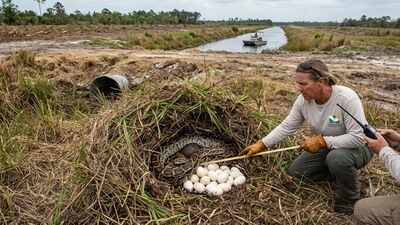
For years, efforts to track invasive Burmese pythons in Florida have centred on the Everglades, where the giant snakes have become one of the state’s most persistent wildlife problems. That picture is beginning to change. Wildlife officials now say a separate breeding population has become established farther north along Florida’s Gulf Coast, suggesting the species has gained another foothold beyond its long-recognised range. The discovery has renewed concerns among conservationists because isolated colonies can become difficult to contain once they begin reproducing. While Burmese pythons have already transformed parts of South Florida’s ecosystems, scientists fear similar changes could gradually emerge in places that until recently were considered outside the snake’s main stronghold.
Florida confirms Burmese python population outside the Everglades
The Florida Fish and Wildlife Conservation Commission (FWC) has confirmed that Burmese pythons are now established in part of western Charlotte County. The area lies north of Naples and Fort Myers and represents a distinct population outside the species’ long-recognised core range.For decades, established populations were largely associated with Everglades National Park before spreading across much of South Florida, stretching between Lake Okeechobee, Key Largo and western parts of Broward and Collier counties. The Charlotte County colony sits beyond that familiar distribution, making it a separate area of concern rather than simply another sighting. Officials began noticing a steady rise in reports from local communities several years ago. Sightings increased around Rotonda West, Placida, Englewood East and South Gulf Cove, prompting closer monitoring before biologists concluded that breeding animals were present.“This is a generalist apex predator, and this is the why we’re so interested in removing them from the ecosystem,” Ian Bartoszek, a wildlife biologist and science coordinator at the Conservancy of Southwest Florida in Naples, as reported by ABC News.
Why the snakes appeared there
Wildlife specialists do not believe the Charlotte County population developed through a slow northward movement from existing Everglades populations. Instead, the available evidence points towards escaped or deliberately released captive snakes. Burmese pythons were widely imported into the United States through the exotic pet trade for decades, and accidental escapes as well as intentional releases have been linked to the species’ establishment in Florida. Biologists studying the new colony say its characteristics match what they would expect from a satellite population created by human introduction rather than natural expansion across the landscape.
How their feeding habits help them spread
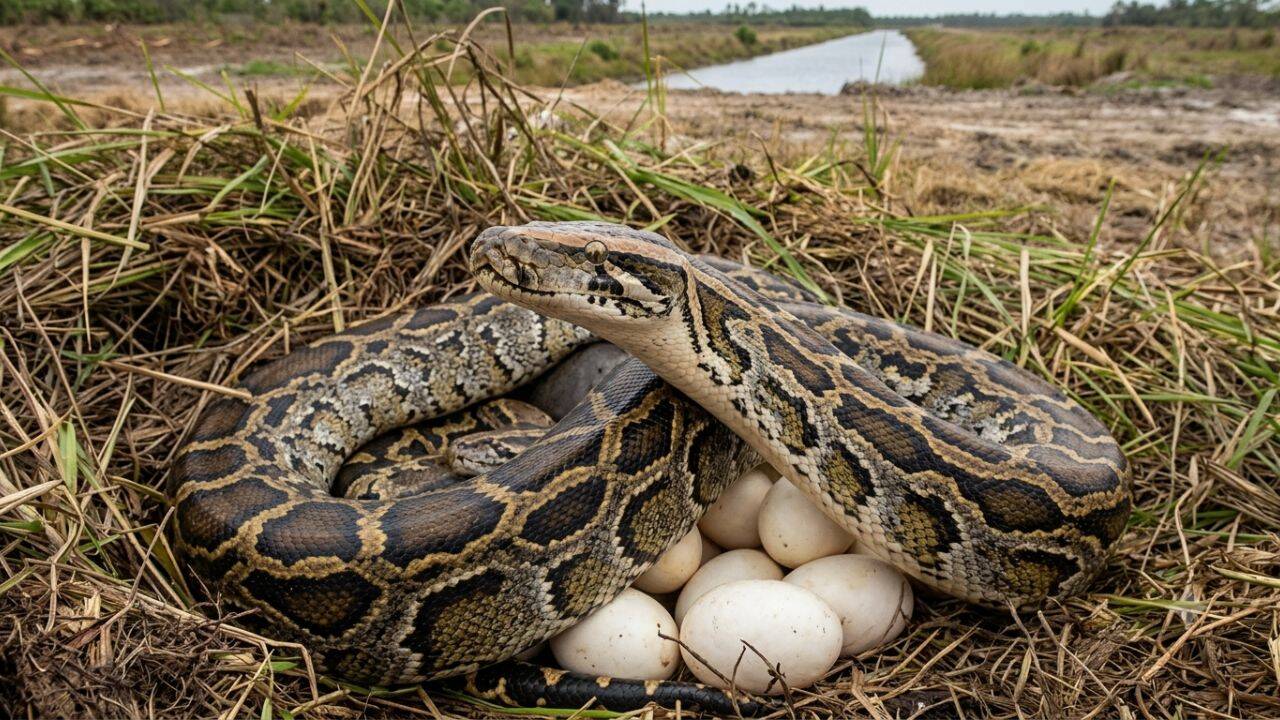
Large Burmese pythons are capable of feeding on an unusually broad range of animals. Their diet includes raccoons, opossums, birds, bobcats and alligators, and they have even been documented consuming prey larger than many people would expect a snake to handle.That flexibility is one reason wildlife managers regard them as especially difficult to control. Rather than depending on a single food source, the snakes can shift between different prey as opportunities change, allowing them to survive in a variety of habitats.Conservation workers involved in python removal describe them as apex predators that can reshape local ecosystems once populations become established.
What happens to native wildlife
The impact extends well beyond the loss of individual animals. Ecologists studying areas where pythons have been present for years have documented steep declines in many native mammal populations.As larger mammals disappear, ecosystems can gradually become less diverse. Scientists describe these altered environments as simplified systems where rodents and other invasive species may become relatively more common while many native animals become scarce.Researchers say this pattern has repeated itself across parts of South Florida, and preventing similar ecological changes elsewhere remains an ongoing challenge.
Why most Burmese pythons go undetected
Estimating the number of Burmese pythons living in Florida remains remarkably difficult.The snakes spend much of their time concealed in dense vegetation, wetlands and waterways, making them exceptionally hard to locate even during organised surveys. Research suggests that survey teams may detect only around one to three snakes for every hundred believed to be present within a search area.Even inside Everglades National Park, where specialist teams regularly search for pythons, finding one often requires many hours of fieldwork. That low detection rate means confirmed sightings probably represent only a small fraction of the animals actually living across the landscape.
How Burmese pythons took hold in Florida
The Burmese python invasion has developed over several decades. Federal wildlife records indicate that roughly 180,000 of the snakes entered the United States between 1975 and 2018, largely through the pet trade.By around 2000, breeding populations had already become firmly established in South Florida. Since then, wildlife agencies have relied on public reports, organised removal programmes and scientific surveys in an attempt to slow their spread.Those efforts continue as officials monitor Charlotte and neighbouring Lee County for additional snakes. Detecting breeding groups early offers the best chance of limiting further expansion, although biologists acknowledge that managing an invasive predator of this size remains one of Florida’s most demanding wildlife challenges.