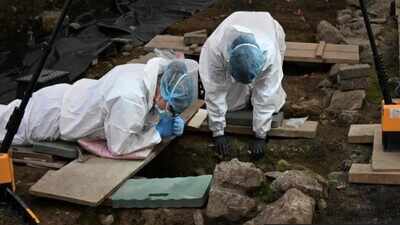
Ireland has now recovered the remains of 99 infants and children from the site of the former Tuam mother and baby home in County Galway, a place that has become a symbol of one of the darkest chapters in the country’s institutional history. The new discoveries, announced in a recent update, are part of an ongoing forensic excavation that is slowly bringing to light what happened to hundreds of babies who died there, and may, through DNA analysis, finally restore some of their names and identities, as per reports.The institution, officially known as the Tuam Mother and Baby Institution, was owned by Galway County Council and run by the Bon Secours Sisters, an order of Catholic nuns, between 1925 and 1961. It housed unmarried mothers and their children at a time when pregnancy outside marriage was heavily stigmatized in Ireland. For decades, what happened behind its walls remained largely hidden. That changed in 2014, when local historian Catherine Corless painstakingly uncovered 796 death certificates for infants and young children who died at the home but no corresponding burial records. Her research raised a haunting question: where were the children buried?Test excavations carried out in 2017 found “significant quantities” of human remains in underground chambers at the site, confirming that many children had been buried there. Those findings shocked the country and the wider world, prompting apologies from both the Bon Secours order and Galway County Council, and paving the way for a formal, state-authorised excavation. In 2025, the Irish government established the Office of the Director of Authorised Intervention, Tuam (ODAIT), and began a full forensic dig.In its latest update, ODAIT confirmed that a further 22 sets of infant remains had been recovered between 1 June and 15 July of this year, bringing the total number of individuals found so far to 99. All of these remains were discovered in coffins, in an area on the south‑western edge of the site identified in historical records as a “burial ground”, reports suggest. The area, once covered in asphalt and gravel and used as a driveway for vehicles, had no surface markers to indicate that children lay buried beneath. Earlier work in the same zone had already uncovered the remains of 77 babies, with some older historic burials beneath them, suggesting that the ground had been used as a burial site over an extended period.The remains are now being transferred to a newly prepared mortuary and laboratory facility at Toghermore in Tuam, set up specifically for this intervention. There, a team of forensic experts will carefully clean, dry and examine them. The work will include radiology and 3D scanning, with the goal of reconstructing basic details of each child’s life and death: their age, sex and, where possible, clues to their health and how they died. These scientific details cannot tell the whole story, but they can narrow down the list of possible matches when compared with surviving records and family information.A key part of the process is DNA analysis. So far, 62 people have provided DNA samples in the hope of finding a genetic match to relatives who were born in Tuam and never came home. The samples will be compared with DNA extracted from the remains, as part of a formal Identification Programme. Authorities have encouraged anyone who believes they may have a family member buried at the site to come forward. Each new sample widens the possibility that at least some of these children may be identified, their names restored, and their families given a measure of long‑delayed truth and acknowledgement, reports suggest.The scientific work has evolved as the excavation has progressed. Legislation is being updated to allow not only parents and siblings but also first cousins of the children to participate in the DNA programme, reflecting advances in forensic genetics that make meaningful matches possible even with more distant relatives. For families whose parents and grandparents have died, this could be crucial. It may be their last realistic chance to connect a family story, often carried in whispers and fragments, to a specific child buried at Tuam.The excavation itself is expected to continue until at least 2027, with follow‑up work extending beyond that. So far, the 99 sets of remains have been uncovered in a relatively concentrated area, and experts have said it is possible that hundreds more could yet be found. The section of the site that holds a memorial garden, where earlier investigations revealed underground chambers filled with remains, has not yet been fully excavated under the current programme. As that work moves ahead, the number of children recovered is likely to rise.For many in Ireland, Tuam represents both personal grief and national reckoning. Women who passed through the institution, relatives of children who died there, and survivors of other mother and baby homes see the excavation as a long‑awaited act of recognition. It is, in a sense, the state finally digging into its own past. The Bon Secours Sisters, who once ran the home, have acknowledged that children were “buried in a disrespectful and unacceptable way” and apologised. The order has contributed funding towards the excavation costs, while Galway County Council has apologised for “failing mothers and children”.Yet even as bones are recovered and studied, the story of Tuam is about much more than a burial site. It is about how unmarried mothers were treated, how their babies were recorded and then seemingly erased, and how communities looked away. The death certificates that Catherine Corless uncovered showed that hundreds of children died in Tuam, often of illnesses associated with poverty, overcrowding and poor sanitation. The absence of burial records spoke to the disregard in which their lives and deaths were held.The current forensic effort cannot undo that history, but it can do something profoundly important: treat the dead with dignity, offer clarity where possible, and provide families with answers instead of silence. As the remains are brought up from the earth and into the light of the laboratory, each small fragment becomes part of a larger act of remembrance. The scientific instruments – scanners, radiology machines, DNA sequencers – become tools not only of investigation, but of belated respect.Ireland’s work at Tuam is painstaking, slow and emotionally heavy. It will take years to complete, and there are no guarantees that all, or even most, of the children buried there will be identified. But the recovery of 99 infants so far, and the ongoing DNA analysis, signal a commitment to facing this painful history with more honesty than previous generations allowed. In doing so, the country is not just uncovering remains; it is also acknowledging lives that were once hidden and making space, at last, for their stories to be told.