
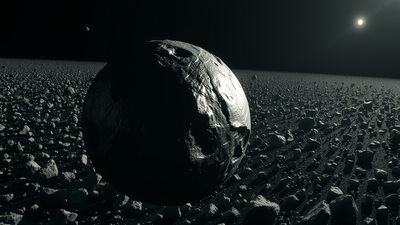
Most asteroids drifting through our solar system are made of rock or ice, but one stands out as strikingly different. Known as Psyche, or 16 Psyche, this metal-rich asteroid orbits the Sun between Mars and Jupiter, and scientists believe it could actually be the exposed core of a small planet that broke apart billions of years ago, early in the solar system’s formation. If that theory holds, Psyche could offer a rare, indirect look at what lies deep inside rocky planets like Earth, whose own core sits thousands of kilometres underground and remains impossible to study directly. Nasa has already sent a spacecraft on a multi-year journey to investigate the asteroid up close. If confirmed, Psyche’s core-like composition could reshape scientists’ understanding of planetary formation more broadly, since a directly observable analog for Earth’s own inaccessible core has never before been available for close study.
What makes asteroid Psyche so different from its neighbours
Psyche sits within the main asteroid belt, the wide region between Mars and Jupiter where most of the solar system’s asteroids orbit the sun. According to Nasa’s official Psyche mission page, scientists believe the asteroid has an unusually high metal content and may represent the partial core of a planetesimal, an early building block of a rocky planet. Earlier assumptions that Psyche was made almost entirely of metal have since been revised, with more recent studies suggesting it is a mix of metal and silicate rock, the same material found in sand and glass, based on radar observations and measurements of how the asteroid heats and cools in sunlight.
Why scientists think Psyche may be a planet’s leftover core
The theory behind Psyche’s origin rests on how early rocky bodies, called planetesimals, formed within the young solar system. As these bodies collided and grew hot inside, heavy metals such as iron and nickel sank toward their centres, forming metallic cores in much the same way Earth’s own core formed. According to Nasa, scientists suspect Psyche may have started out as one such planetesimal, but rather than growing into a full planet, it was repeatedly struck by other space rocks, collisions violent enough to strip away its outer rocky layers and leave only its dense, metal-rich centre behind.
How Nasa’s spacecraft is travelling toward the asteroid
Nasa’s Psyche spacecraft launched from Kennedy Space Centre in October 2023 and uses solar electric propulsion, drawing power from the sun to slowly and efficiently accelerate through space over its long journey. According to Nasa’s Jet Propulsion Laboratory, the spacecraft is expected to reach the asteroid in August 2029, after a journey of roughly 2.2 billion miles, and will then orbit Psyche for at least 26 months to carry out its science mission.
A recent flyby of Mars gave the mission a critical boost
On 15 May 2026, the spacecraft carried out a close flyby of Mars, using the planet’s gravity to gain speed and adjust its trajectory without spending any of its onboard fuel. According to Nasa’s Jet Propulsion Laboratory, the spacecraft passed within about 4,609 kilometres of the Martian surface during the encounter. Bob Mase, the mission’s project manager at Nasa’s Jet Propulsion Laboratory, said the flyby had been years in the making and that the navigation team had placed the spacecraft on exactly the trajectory needed to reach Psyche in the summer of 2029.
Testing the spacecraft’s instruments using Mars as a stand-in
The Mars flyby also doubled as a valuable rehearsal for the science still to come. According to Nasa’s Jet Propulsion Laboratory, the spacecraft’s multispectral imager, gamma ray and neutron spectrometer, and magnetometer were all put to work studying Mars, treating the planet as a practical stand-in for the asteroid ahead. The imager captured detailed views of Martian surface features, including wind-sculpted craters and the large double-ringed Huygens crater, while the gamma ray and neutron spectrometer, designed to help identify Psyche’s surface elements, was tested by measuring how cosmic rays striking Mars caused its surface to emit neutrons and gamma rays.
What the mission hopes to confirm once it reaches Psyche
Once in orbit around the asteroid, the spacecraft will rely on four key instruments: the multispectral imager for detailed pictures, the gamma ray and neutron spectrometer to determine surface composition, a magnetometer to check for any remaining magnetic field, and a radio instrument to measure the asteroid’s gravity field. According to Nasa, the central goal of the mission is to determine whether Psyche truly is the exposed core of an ancient planetesimal or something else entirely, a question scientists expect to resolve only once the spacecraft begins its close, sustained study of the asteroid from orbit in 2029.