
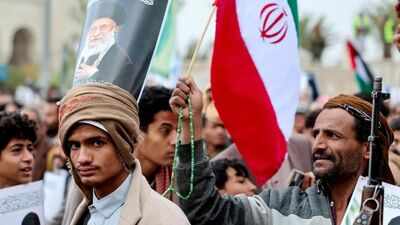
The US-Iran conflict has expanded beyond direct military strikes between the two sides, with Iranian-aligned militants in Yemen targeting shipping routes in the Red Sea. The development comes as Washington and Tehran continue to escalate military pressure, fuelling concerns that neither side can secure a decisive military advantage through force.The conflict widened this week after Houthi militants in Yemen began striking ships passing through the Bab al-Mandeb Strait, a key Red Sea chokepoint linking the Red Sea and the Indian Ocean. The attacks helped push oil prices above $100 a barrel for the first time in two months on Thursday.The US has also intensified its bombing campaign in Iran, carrying out strikes across the country during the most intense phase of fighting since US President Donald Trump and Israel launched military action against Tehran in late February.
Houthi blockade raises global trade concerns
On Monday, Yemen’s Iran-backed Houthi rebels announced an immediate maritime embargo against Saudi Arabia, saying they would block Saudi-linked shipping through the Bab al-Mandeb Strait in retaliation for the kingdom’s blockade of Yemen and a recent attack on Sana’a International Airport.The move threatens a critical route Saudi Arabia uses to bypass disruptions in the Strait of Hormuz by exporting crude through its East-West Pipeline to a Red Sea port. The Bab al-Mandeb Strait carries around 12 per cent of global trade, including nearly a quarter of the world’s container traffic moving through the Suez Canal.Any prolonged disruption could force vessels to reroute around South Africa’s Cape of Good Hope, adding about 2,700 miles (4,345 km) to voyages between Saudi Arabia and the US, according to the US government.According to The Wall Street Journal, President Trump and senior administration officials have warned that the US could further expand its military campaign, including strikes on a suspected Iranian nuclear facility at Pickaxe Mountain or attacks on Iranian infrastructure in response to Iranian actions in the Strait of Hormuz. Political analyst Abdel-Bari Taher told the Associated Press that Yemen’s internal divisions make it especially vulnerable to being drawn deeper into the regional conflict, increasing the risk of a wider war.
Rubio warns of rising costs
US secretary of state Marco Rubio earlier said pressure on Tehran would continue, referring to Iranian Foreign Minister Abbas Araghchi’s description of Iran’s approach as “an eye for an eye.”“The price will continue to get higher every single night until they come to their senses,” Rubio told reporters on Thursday at a summit in Manila.“The president’s policy is a head for an eye,” Rubio said. “I mean, honestly, that is what it is going to be.” He added that president Trump would decide in the coming days whether to escalate military action further.The conflict is also imposing a mounting financial burden on the US. On Wednesday, US secretary of defense Pete Hegseth said the cost of the ongoing conflict with Iran had reached $37.5 billion, including projected operations and maintenance expenses through the end of the current fiscal year. Speaking before the senate appropriations committee, Hegseth said the estimate was about $8 billion higher than the $29 billion figure cited by the Trump administration in May.Analysts told The Wall Street Journal that while both Washington and Tehran have shown a willingness to intensify the confrontation, neither appears capable of achieving its broader strategic objectives through military means alone.“There is an escalatory dynamic now,” Alan Eyre, a former senior US diplomat who participated in negotiations with Iran, told The Wall Street Journal. “I don’t think the United States administration really has a clear strategic concept of what it is trying to do.”