
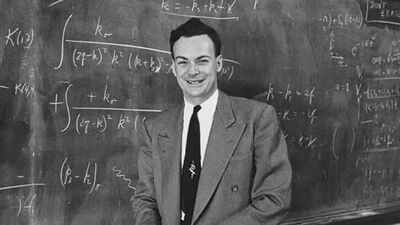
Richard Feynman’s most enduring quote was never intended as a memorable slogan. It came from his 1974 commencement address at the California Institute of Technology, where the Nobel Prize-winning physicist spoke about the principles that should guide scientific research. Among his remarks, one sentence has outlived the rest: “The first principle is that you must not fool yourself and you are the easiest person to fool.” Although addressed to future scientists, its message extends far beyond laboratories. The quote highlights a common human tendency to accept ideas that fit existing beliefs while overlooking evidence that challenges them. These words have been resonating even today more than half a century later, in a world that is influenced by the advent of social media, artificial intelligence and continuous influx of information. The era in which opinions have become viral faster than any facts, confirmation bias is becoming easier than ever, Feynman’s words are as relevant as ever. His main lesson is rather simple and yet challenging.
Quote of the day by Richard Feynman
“The first principle is that you must not fool yourself and you are the easiest person to fool.”
What is the meaning of today’s quote
The line comes from Feynman’s 1974 commencement address at the California Institute of Technology, later known as Cargo Cult Science. In that speech, he argued that honesty with oneself is the foundation of genuine inquiry. Before convincing anyone else, a person must first be willing to test their own assumptions and accept evidence that challenges them.People are prone to seek some kind of patterns, tend to keep in mind information that proves their beliefs and ignore everything else that may cause any kind of inconvenience. This is normal human behaviour and not lying.
Why Feynman believed evidence should always come before belief
Science depends on evidence, but evidence only has value if someone is prepared to follow it wherever it leads. That was the standard Feynman expected from scientists, and he believed the same approach could help in everyday life.Imagine someone who strongly believes a new investment will succeed. They may pay attention to encouraging news while dismissing warning signs. A sports supporter may remember every referee’s mistake against their team while forgetting favourable decisions. A student may feel certain an exam went well because the familiar questions stand out in memory, only to discover later that several difficult ones were overlooked.None of these examples involve intentional deception. They illustrate how easily confidence can replace careful judgement. Feynman’s quote reminds us that certainty should never become a substitute for checking the facts.
Who was Richard Feynman
Richard Feynman was an American theoretical physicist who played an instrumental role in modern quantum electrodynamics, which explains the interaction between light and matter. The efforts of Richard Feynman were recognised by the Nobel Committee in Physics as he received the Nobel Prize in Physics in 1965 along with Julian Schwinger and Shin’ichirō Tomonaga.Beyond academic circles, Feynman was famous for his personality. Feynman’s personality traits included his ability to explain complicated theories using simple language and his interest in science rather than formalism. Feynman’s lectures, books, and interviews provided popular audiences with complex theories.Feynman also served as part of the Rogers Commission investigating the 1986 Space Shuttle Challenger accident. In the investigation, Feynman demonstrated the principles expressed in the above quotation through his demonstrations and insistence on evidence.
Why the quote still matters
Even though Feynman uttered these words many years ago, his statement is still true for various modern contexts.People receive a constant flow of information via social media, news portals, and other kinds of internet resources. News often spreads fast and becomes widely distributed before people even have a chance to verify them. Algorithms usually tend to promote only those views that users prefer to see and which agree with their current beliefs.Thus, it is very important to have the capacity to question one’s own opinions. It is not about doubting everything but rather about being aware of the fact that certainty does not always mean correctness. This rule is also applicable to working places, educational institutions and personal life of people.
Practical lessons from Feynman’s philosophy
The quotation suggests several practical habits rather than a single rule:
- Pause before accepting information simply because it confirms existing beliefs.
- Look for evidence that challenges your own conclusions, not only evidence that supports them.
- Be comfortable saying, “I don’t know,” when the facts are incomplete.
- Separate confidence from certainty; they are not the same thing.
- Treat mistakes as opportunities to improve judgement rather than as personal failures.
These habits do not eliminate error, but they make it less likely that people will become trapped by their own assumptions.
A common misunderstanding
Some readers interpret the quotation as a reason to doubt themselves constantly. That misses Feynman’s point.He was not encouraging insecurity or endless scepticism. His concern was intellectual honesty. Confidence built on careful evidence is entirely different from confidence built on unchecked assumptions.Questioning yourself does not mean rejecting every belief. It means being willing to revise those beliefs when stronger evidence appears.