
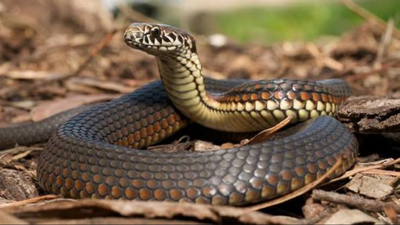
By measuring every vertebra along the bodies of 13 native Australian snakes, evolutionary biologists have discovered that a snake’s spine is much more organized than previously believed. Instead of being one long, uniform structure, it contains five distinct anatomical regions, including a surprisingly short neck made up of just 7 to 12 vertebrae.The study, published in the Journal of Morphology, challenges the long-standing idea that limbless reptiles have simple backbones that gradually change shape along a single continuous pattern.Researchers closely examined three venomous Australian species: The eastern brown snake (Pseudonaja textilis), the copperhead (Austrelaps superbus), and the tiger snake (Notechis scutatus).By carefully measuring the shape and size of every vertebra from head to tail, the researchers identified clear transition points where one section of the spine changes into the next.
Moving beyond the ‘Simple Noodle’ view of snake anatomy
To the human eye, snakes appear to have a simple body consisting of a head attached to a long, flexible tube. While their specialised heads, with venom-delivering fangs and flexible jaws that allow them to swallow large prey, are well known, scientists long believed that the rest of the body had a relatively simple internal structure.Human spines, in comparison, have three clearly defined regions. The cervical region, or neck, supports the head and allows it to move. The thoracic region contains ribs that protect internal organs, while the lower lumbar region supports much of the body’s weight. The vertebrae in each of these regions have different shapes suited to their specific functions.For many years, scientists debated whether snake spines had similar divisions. Early anatomical studies suggested that losing limbs led to a simplified backbone with a gradual, uniform change from one end to the other.That view began to change in 2015, when a landmark study published in Nature identified four separate spinal regions in snakes: the cervical, anterior thoracic, posterior thoracic, and lumbar regions.The new study in the Journal of Morphology builds on that work by identifying a fifth spinal region and providing a more detailed understanding of how snake spines evolved.
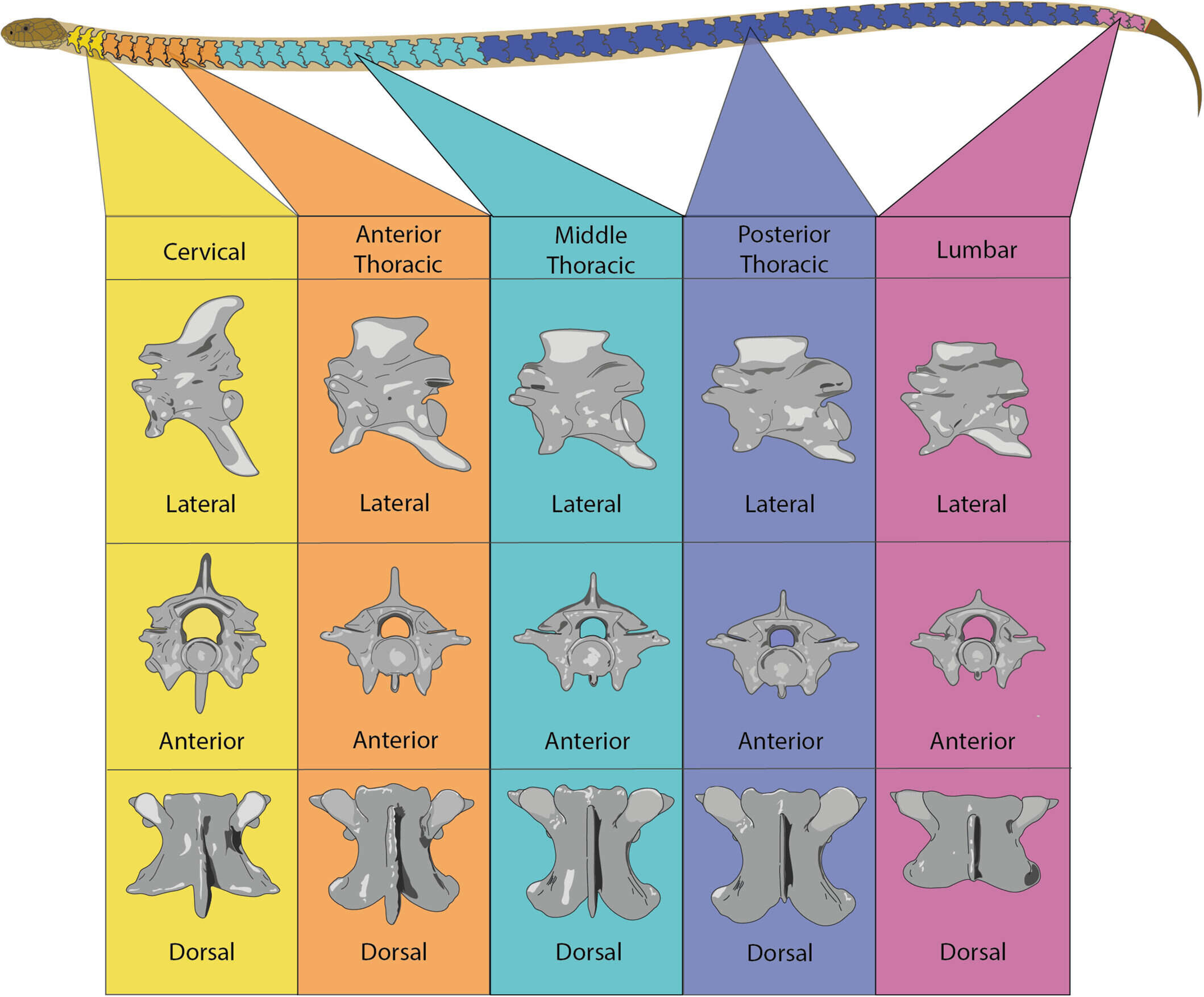
Mean vertebral shape for a tiger snake. Credit: Journal of Morphology (2026)
Surprisingly short necks reflect ancient lizard origins
The new analysis shows that snake vertebrae do not change shape in one smooth, continuous pattern. Instead, they are grouped into stable regions with similar shapes, separated by clear and rapid changes, showing a high level of structural specialization.Most importantly, the study found that snake necks are much shorter than scientists previously believed.Earlier research estimated that the neck made up as much as 15 per cent of a snake’s total body length. The new measurements show that the true cervical region accounts for only about 5 per cent of the body.In simple terms, a snake’s neck contains only 7 to 12 vertebrae.This closely matches the neck size of typical lizards with limbs. The similarity suggests that although snakes evolved much longer bodies over millions of years, they retained the same basic neck structure as their lizard ancestors instead of lengthening it with the rest of the body.The researchers believe this happened because the neck still needs to perform essential functions, such as supporting head movement and protecting important nerves that connect to the brain. These vital roles may have limited how much the neck could change during evolution.
Newly identified middle thoracic region shows evolutionary adaptation
Along with redefining the neck, the researchers also discovered a previously unknown section of the spine located between the front and rear chest regions.They named this newly identified section the middle thoracic region. This brings the total number of recognised spinal regions in snakes to five: the cervical, anterior thoracic, middle thoracic, posterior thoracic, and lumbar regions.The discovery of this fifth region shows how snakes have adapted to different environments despite lacking legs, arms, or shoulder girdles. Instead of relying on limbs, they use different parts of their spine to burrow, swim, climb, and strike effectively.Each spinal region performs a different mechanical role. The anterior thoracic region, located near the head, works with the neck during hunting and striking. The middle and posterior thoracic regions generate the side-to-side movements that help snakes move across rough ground or through thick vegetation.Rather than being simple, uniform animals, snakes have evolved highly specialised backbones that perform different functions along the length of the body.Instead of simplifying their skeleton after losing their limbs, snakes reorganised their backbone into several specialised regions. By keeping the short neck inherited from their lizard ancestors while reshaping the rest of the spine, they evolved an anatomical design that is even more complex than that of many four-legged reptiles.