
Three teenagers in Indore had watched their parents, all of whom worked in medicine, struggle with a problem that had nothing to do with treatment and everything to do with logistics: how do you keep a vaccine cold when there is no electricity for miles.Dhruv Chaudhary, Mithran Ladhania, and Mridul Jain built an answer. They called it ‘Thermavault’, an insulated cooling box that needs no outlet, no battery, and no ice. It runs on salt.The invention won the trio the 2025 Earth Prize, an award for teenagers working on environmental projects, given to one winner from each world region. Chaudhary, Ladhania, and Jain took the prize for Asia. The recognition came with $12,500, which the boys said they planned to use to build 200 units of Thermavault and send them to 120 hospitals for testing.The idea began, like many during that period, with the coronavirus disease 2019 (COVID-19) pandemic. The three boys kept hearing the same story from their parents: vaccines were ready, but rural areas without power had no way to keep them at the right temperature long enough to matter. That gap between having a cure and being able to deliver it was what the teens set out to close.
How the search for the right salt played out
The science behind Thermavault relied on a basic chemical reaction. Some salts, when dissolved in water, pull apart into charged particles called ions. That separation takes energy, and the salt draws that energy from its surroundings, cooling the water around it in the process.Chaudhary, Ladhania, and Jain started where most teenagers start: the internet. They compiled a list of roughly 150 salts that seemed promising, then narrowed it to about 20 candidates worth testing further. They borrowed lab space at the Indian Institutes of Technology (IIT) to run the experiments.None of the salts cooled the water enough.It was their teacher, not a search engine, who pointed them towards the answer. Barium hydroxide octahydrate and ammonium chloride, two compounds sitting quietly in a ninth-grade science textbook, turned out to be the ones that worked.“While we did scour through the entire internet to find the best salt possible, we kind of just ended up back to our ninth-grade science textbook,” Chaudhary said, according to Business Insider.Ammonium chloride alone held temperatures between 2 and 6 degrees Celsius (about 35 to 43 degrees Fahrenheit), a range suited to many vaccines. Adding barium hydroxide octahydrate pushed the mixture to subzero temperatures, useful for other vaccines and, the teens hoped, for organ transport as well. Three months after landing on the formula, they had a working prototype and were testing it in hospitals around Indore.
What is actually inside Thermavault
The device itself was simple by design. An outer shell of insulated plastic held a copper lining on the inside, where vaccines or organs would sit. Between the plastic and the copper, the teens poured a cooling solution made by dissolving the salts in water.
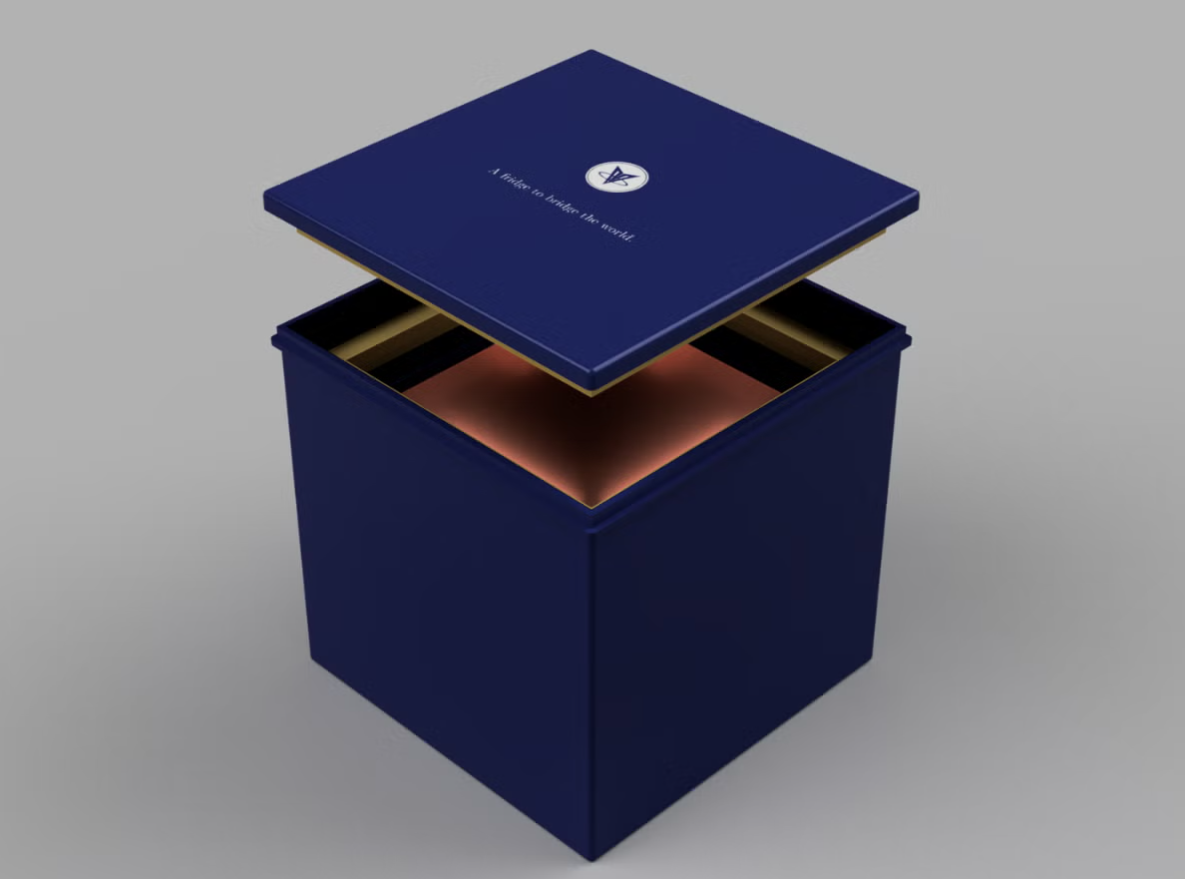
A visual mock-up of the Thermavault prototype design. (Taken from theearthprize.org)
Cold boxes and coolant packs already existed for exactly this purpose, and most relied on ice packs to stay cold. The advantage the teens pointed to was reusability. Ammonium chloride, unlike ice, did not need a freezer to reset. Once the saltwater in the box warmed up, a health worker could boil away the water, collect the salt in solid form, and dissolve it in fresh water to start the cooling cycle again, all without electricity.Dr. Pritesh Vyas, an orthopedic surgeon who tested the device at V One hospital in Indore, described the results in a video posted on the Thermavault website. “We have been able to keep the vaccines inside the Thermavault for almost 10 to 12 hours,” he said. He added that with a few refinements, such as a built-in temperature monitor, the device would be useful in remote villages.
Where the prize money was headed next
Winning the Earth Prize gave the teens more than funding. Jain said they intended to use part of the money to pursue a Performance, Quality and Safety (PQS) certification through the World Health Organization (WHO), a step that would let them pitch Thermavault to Gavi, the international alliance responsible for distributing vaccines worldwide.The Earth Prize programme also connected winners with a volunteer who could help them file a patent, a spokesperson for the organisation said.For three teenagers from Indore, the project had started as a response to something they watched their own parents struggle with during the pandemic. By 2025, it had become a small plastic box with a copper lining, built from a textbook formula, that they hoped could reach the villages the modern cold chain still could not.