
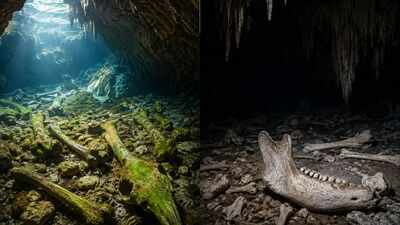
Animal bones resting on the floors of South Australia’s underwater caves are revealing far more than the identity of the creatures they once belonged to. According to a new study published in PLOS One, the cave environment itself leaves distinct “fingerprints” on bones, helping scientists reconstruct how they were deposited, the environmental conditions they experienced after deposition, and the processes that affected their preservation over time. Researchers found that bones located near cave entrances, where sunlight penetrates the water, bore traces left by algae and other aquatic organisms, while bones from the caves’ permanently dark zones remained exceptionally well preserved with minimal evidence of biological alteration. The findings could provide archaeologists and paleontologists with a valuable new framework for interpreting ancient fossil deposits in underwater cave systems worldwide.
Light and darkness leave different signatures on bones
The research was led by Griffith University scientists, who examined animal bones recovered from two underwater cave systems, Green Waterhole and Gouldens Sinkhole, near Mount Gambier in South Australia. Rather than focusing only on the age of the remains, the team investigated how different cave environments altered the bones after they were deposited.To do this, the researchers studied the bones at multiple scales, from their overall distribution within the caves to microscopic structures, chemical composition and proteins preserved inside ancient bone cells. Radiocarbon dating of 41 specimens enabled the team to place the remains within a timeline spanning decades to centuries, making it possible to connect specific patterns of preservation with different environmental conditions.One of the clearest discoveries involved the role of light. Bones located in cave areas illuminated by natural light showed evidence of algae, aquatic plants and biofilms growing across their surfaces. These organisms produced visible black staining, chemical corrosion and distinctive circular etching patterns that effectively acted as environmental signatures.In contrast, bones recovered from the caves’ “midnight zones,” where sunlight never reaches and plant life cannot survive, lacked these biological marks. Their surfaces remained remarkably intact, preserving fine structural details that would normally deteriorate over time. According to the researchers, the absence of light limits photosynthetic organisms such as algae and cyanobacteria, helping preserve the bones’ surfaces.
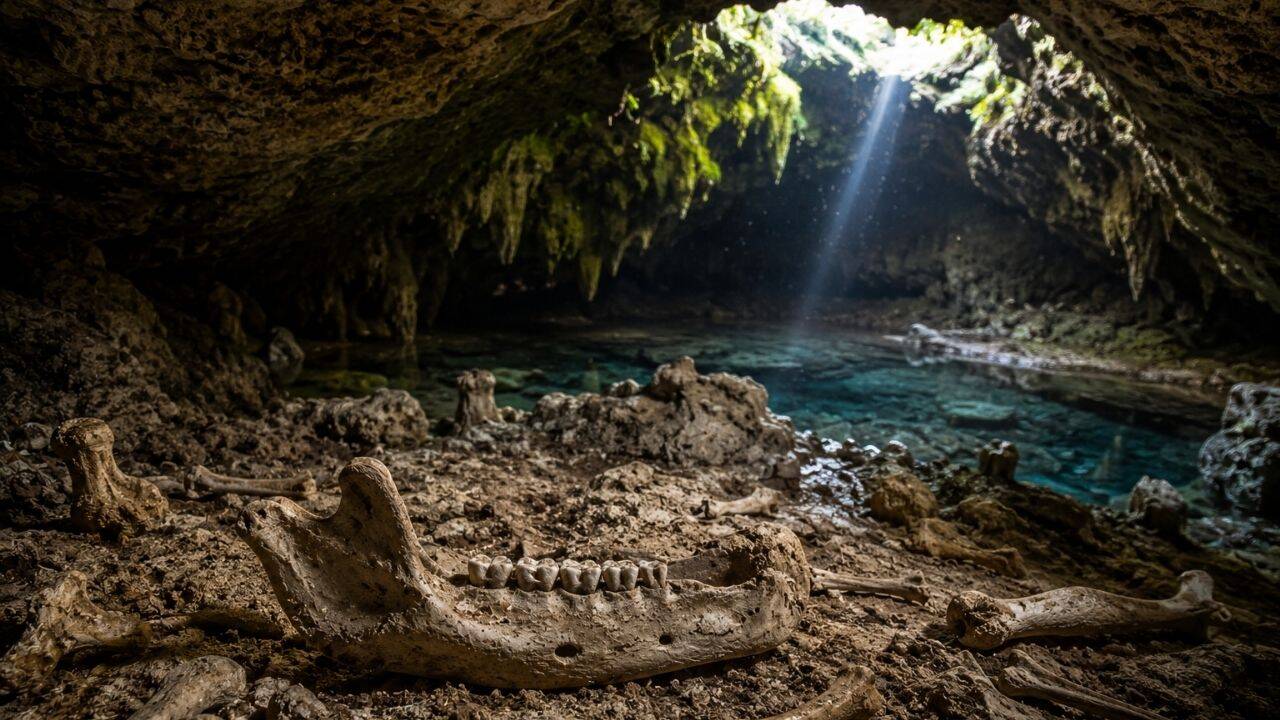
Representative Image (AI-generated)
Underwater caves preserve bones differently from dry caves
The team also compared submerged bones with skeletal remains recovered from dry cave environments. The researchers found clear differences between the two environments. Bones from underwater settings generally retained better surface preservation, better-preserved microstructure and a more complete elemental composition than those exposed to dry conditions. However, underwater preservation did not mean the bones remained unchanged. Instead, aquatic environments produced their own distinctive alterations, including chemical corrosion, biological staining and microscopic tunnels created by cyanobacteria around the outer portions of the bone.Dry cave bones told a very different story. Rather than showing aquatic signatures, they exhibited damage caused by land-based bacteria and long grooves produced by plant roots. Microscopic analysis revealed tunnelling patterns associated with terrestrial microorganisms throughout the bone cortex, indicating that dry environments expose skeletal remains to very different biological processes than submerged caves.The researchers concluded that these contrasting preservation patterns are closely linked to differences in light availability, which influences the types of organisms living within different parts of the cave. As biological communities change from bright cave entrances to completely dark interiors, so do the marks they leave behind on bones.
A new tool for studying ancient megafauna
The bones analysed in the study belonged to a wide range of native and introduced animals, including kangaroos, emus, dingoes, rabbits, possums, quolls, swamp rats, cows, sheep and pigs. Some of the domesticated animal remains likely date back to the earliest years of European settlement around Mount Gambier during the 1840s, providing researchers with well-dated material for testing how bones change through time in underwater environments.Although the study focused on relatively recent animal remains, its broader goal was to improve scientists’ understanding of much older fossils, particularly the extinct Australian megafauna that are also preserved in underwater cave systems. Until now, researchers had limited methods for determining whether fossil bones entered caves before or after flooding, or how they were modified once submerged.By identifying characteristic preservation “fingerprints” associated with wet and dry cave conditions, the new framework offers a way to reconstruct the depositional history of fossil assemblages with greater confidence. It also helps distinguish environmental changes that occurred before burial from those that happened afterward, improving interpretations of ancient ecosystems.According to the researchers, this work is the first benchmark dataset for interpreting vertebrate site formation and post-depositional changes in submerged cave environments. They say the approach could help archaeologists and paleontologists better interpret fossil assemblages and reconstruct past environments preserved in underwater cave systems.