
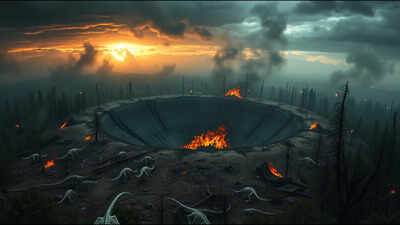
Sixty-six million years ago, an asteroid roughly 10 kilometres wide slammed into what is now Mexico’s Yucatan Peninsula, gouging out the Chicxulub crater and triggering the most devastating mass extinction event in the history of complex life on Earth. Non-avian dinosaurs, the towering, scaled animals that had dominated the planet for more than 150 million years, were wiped out entirely. Their closest living relatives, birds, came remarkably close to the same fate. Roughly three-quarters of all plant and animal species on the planet went extinct in the aftermath, and according to a landmark study led by palaeontologist Daniel Field, nearly every bird species that depended on trees for survival disappeared along with them, leaving only a small number of hardy, ground-dwelling survivors to eventually give rise to the more than 10,000 bird species alive today.
Why the asteroid strike hit tree-dwelling birds so much harder
According to reporting from Audubon on the study, published in the journal Current Biology and led by Field, titled Early Evolution of Modern Birds Structured by Global Forest Collapse at the End-Cretaceous Mass Extinction, a vertebrate palaeontologist at the University of Bath, the Chicxulub impact devastated forests across the entire planet through a combination of immediate wildfires and the years of darkened skies and freezing temperatures that followed. Because the impact effectively destroyed global plant life for an extended period, the researchers concluded that birds relying on trees for food, shelter and nesting simply had nowhere left to live.Field and his colleagues pieced this conclusion together using multiple independent lines of evidence, according to Smithsonian Magazine, combining statistical analysis of the bird fossil record with data documenting the disappearance and eventual recovery of ancient forests. That combined evidence painted a consistent picture: birds capable of living and feeding on the ground had drastically better odds of survival than birds that depended on tree canopies, since ground-dwelling species could still find food among the surviving vegetation and were not entirely dependent on the mature forest structure the impact had removed.
How ground-dwelling survivors gave rise to today’s bird diversity
The birds that made it through this bottleneck bore little resemblance to the astonishing range of species alive today. The same research, birds with sturdier legs suited to life on the ground, comparable in some ways to modern ostriches, were essentially the only avian lineages to survive the extinction event, while species built for a life spent primarily among tree branches were eliminated almost entirely.It was only once mature forests began recovering, a process the researchers estimate could have taken thousands of years, that surviving bird lineages were able to diversify back into the trees. Field noted that of the many ancestral bird lineages present before the extinction, only a small handful survived to become the founders of essentially all modern bird diversity, meaning every one of the roughly 11,000 bird species alive today, from hummingbirds to ostriches, traces its ancestry back to this narrow surviving population.
Why the extinction reshaped bird evolution at the genetic level
More recent research has extended this picture down to the level of bird DNA itself. According to the University of Michigan News, a study published in the journal Science Advances and co-authored by Field found that the mass extinction event did not just eliminate species; it appears to have directly accelerated how quickly surviving bird genomes evolved in its aftermath. Field explained that mass extinction events are known to reshape biodiversity and ecology, but this research suggests the Chicxulub extinction went further, actually altering the pace at which bird genomes themselves changed over time.This genomic evidence lines up closely with the physical fossil evidence gathered separately, reinforcing the broader conclusion that the extinction event functioned as a genuine evolutionary reset for birds, clearing out most existing diversity and creating open ecological space that surviving lineages then rapidly expanded to fill.
Why fossil evidence from this period remains genuinely scarce
Despite the strength of this combined evidence, directly confirming exactly how this rapid post-extinction diversification played out remains difficult. According to Scientific American, much of the story of how early Paleogene birds diversified after the extinction is currently inferred mainly from DNA and evolutionary family trees rather than from a rich fossil record, since these early birds were generally small, fragile animals that did not fossilise easily. Researchers have identified a small handful of confirmed fossils from this critical period, but finding significantly more remains a genuine ongoing challenge for palaeontologists studying this stretch of bird evolutionary history.
What this extinction reveals about how mass die-offs reshape life
Taken together, this body of research offers a striking illustration of how a single catastrophic event can permanently reshape an entire branch of the tree of life. Rather than birds simply surviving the extinction that claimed their dinosaur relatives, the evidence suggests they came startlingly close to disappearing alongside them, saved specifically by a small number of ground-dwelling species that happened to be suited to an environment where forests, at least for a time, had ceased to exist. The eventual explosion of bird diversity that followed, one of the more successful evolutionary recoveries in the history of life on Earth, only became possible once those forests slowly grew back, underscoring just how directly the fate of an entire class of animals was tied to the health of the ecosystems they depended on.