
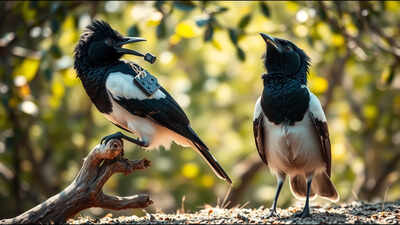
Researchers in Queensland fitted five Australian magpies with tiny GPS trackers, hoping to map their movements and understand how age, sex or rank affected the way the flock behaved. The birds had other plans. Within about ten minutes, an untagged adult female was using her beak to work at the harness fitted on a juvenile, and the tracker came off. Nearby, another magpie was helping free a second tagged bird that had fallen from a powerline mid-rescue. Devices built to stay attached for weeks vanished within minutes to days, as flockmates worked together to strip them off one another. What began as a straightforward tracking exercise turned into an unplanned but striking demonstration of cooperation among wild birds.
Why the tracking harnesses were designed with a weak point
The team behind the pilot study, made up of researchers Joel Crampton, Celine Frere and Dominique Potvin, worked with a social group of magpies at Pacific Paradise on Queensland’s Sunshine Coast. They spent weeks habituating the birds to a feeding station before trapping five of them in a single morning, made up of one adult male, two adult females and two juveniles of unknown sex. Each bird was fitted with a GPS logger and harness weighing about 2.7 grams in total, along with identification leg bands. The harness carried a deliberately engineered weak point, designed so a magnet could trigger a release once a tagged bird returned to the feeding station, allowing researchers to recover the tracker without having to recapture the animal. Before deployment, the design had already passed strength testing, meaning a bird trying to remove it without the magnet would need to locate that one vulnerable section and apply a sharp, targeted force.
How the magpies removed each other’s trackers within hours
The researchers observed tagged birds pecking at their own harnesses, but the clearest removals came with help from untagged flockmates. One juvenile first tried to reach its own tracker before a second juvenile approached and pecked at the harness without success. An adult female then worked at several points on the harness until the device came free, roughly ten minutes after she began and within an hour of the tracker being fitted in the first place. At the same time, a different adult magpie was working to free another tagged bird perched on a powerline, and the pair fell together during the attempt before moving to a nearby tree to continue. By the following day, only two of the five birds were still wearing trackers, and on later visits, banded birds that researchers could identify individually had returned with no tracker at all. The study, titled Australian Magpies Gymnorhina tibicen cooperate to remove tracking devices and published in the journal Australian Field Ornithology, recorded four magpies directly participating in removal attempts, though the researchers did not witness every final release or establish whether one especially skilled bird was responsible for most of the work.
Why scientists are cautious about calling this behaviour altruistic
The tagged birds could not easily reach the harness section positioned on their own backs, giving a flockmate a clear physical advantage in helping. The helper birds appeared to receive no immediate food or other obvious reward for stepping in, and the tagged bird had to tolerate another animal working closely against its body throughout the process. The researchers behind the study described this as evidence of cooperation and a moderate level of problem solving, and raised the possibility of what scientists call rescue behaviour, where one animal helps another out of apparent distress without gaining any immediate benefit itself. Even so, the study stopped short of claiming the birds acted with conscious altruistic intent, since the researchers could not measure what the helper birds actually understood, whether the harness caused genuine distress, or whether removing an unfamiliar object from another bird is simply part of ordinary social grooming behaviour among magpies.
What earlier research says about magpie intelligence and group living
The Queensland findings sit alongside earlier research into how social living shapes magpie cognition more broadly. A study titled Cognitive performance is linked to group size and affects fitness in Australian magpies, published in the journal Nature and led by Benjamin Ashton, tested wild Western Australian magpies on inhibitory control, associative learning, reversal learning and spatial memory. The study found that birds living in larger social groups performed consistently better across all four cognitive tasks, and that this gap emerged as the birds developed from juveniles into adults. While that earlier research does not directly explain why the Queensland magpies cooperated to remove each other’s trackers, it offers useful context for a species whose intelligence appears closely tied to the size and complexity of the social groups it lives within.
Why a failed tracking trial still produced a useful result
Wildlife tracking has turned animal movements once invisible to scientists into precise, measurable data, but attaching a device to a highly social species introduces a challenge that solitary animals do not present. Researchers are not simply placing equipment on an isolated subject; they are introducing a new object into a group of animals capable of examining, understanding, and even removing it collectively. Because this was designed as a small pilot study involving just five tagged birds rather than a large controlled trial, its failure to keep the trackers attached was not a wasted step. It stopped a flawed harness design from being scaled up into a larger study, and showed researchers that a device surviving laboratory strength tests is not the same as a device surviving contact with an intelligent, cooperative flock. The original questions about where the magpies travelled and how age or rank shaped their movements went unanswered, but the birds replaced them with a more unexpected finding about how far they will go to help one another.