The eclipse happening today, August 12, will pull the moon’s shadow across Iceland, Greenland and northern Spain, the first time mainland Europe has seen totality since 1999. And everyone’s telling you to watch the sky. But some of the strangest parts of an eclipse happen closer to the ground, and most people miss them because they’re staring straight up.
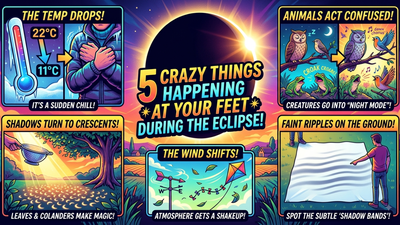
The temperature actually drops
During the 2017 US eclipse, CBS News reported that Douglas, Wyoming recorded an 11-degree drop, while Kansas City cooled by over 4 degrees. Ahead of today’s eclipse, Space.com noted that viewers should expect a noticeable chill along with a subtle darkening of the sky in the half hour before totality even hits. “During totality, the sky darkens significantly, temperatures drop and bright stars and planets can even become visible. Observers can also catch a glimpse of the sun’s outer atmosphere, known as the corona, glowing around the silhouetted moon,” it says. It genuinely feels like someone fast-forwarded straight to evening, except it happened in minutes instead of hours.
Animals start acting confused
Birds and other creatures don’t know it’s temporary. National Geographic reported that birds often go quiet mid-eclipse and then suddenly break into a full dawn chorus once the sun reappears, as if their internal clocks got tricked into thinking morning had arrived twice in one day. During 2024’s eclipse over North America, Al Jazeera documented crowds at a campground in Illinois hearing frogs start croaking and birds chirping the moment totality hit, exactly the sounds you’d expect at dusk.
Shadows turn into tiny crescents
Here’s a weirdly beautiful one. As the moon covers more and more of the sun, any small gap of light, through leaves, through a colander, through your fingers laced together, starts projecting little crescent shapes instead of round dots of sunlight. Space.com described this happening through pinpricks of light like a colander or the gaps in tree leaves, creating what they called a kaleidoscope of tiny bright crescents scattered across the ground. You don’t need glasses for this part. Just look down at the shadows.
Faint ripples move across the ground
Right before and after totality, some viewers spot shadow bands, thin wavy stripes of light and shadow drifting across flat, light-colored surfaces like a sheet or a pale wall. CNN spoke to eclipse chaser Gordon Telepun, who’s caught them at five of the seven eclipses he’s witnessed and says you need a smooth, light background to spot them since they won’t show up on grass or asphalt. They’re subtle, and easy to miss if you don’t know to look.
The wind can shift
It sounds like a stretch until you’re standing in it. The sudden drop in sunlight cools the air fast enough to change local wind patterns for a few minutes, part of the same atmospheric shakeup that produces the temperature swing. So if there’s suddenly a slight breeze where there wasn’t one, that’s not your imagination.None of this needs a telescope. Half the show today is happening at your feet.