
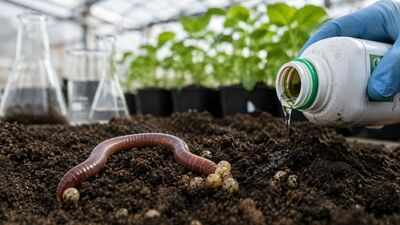
Across the United States, glyphosate is applied across an enormous area of farmland each year. According to the US Environmental Protection Agency, an average of 298 million acres of cropland receives glyphosate applications annually, giving a sense of how routinely the herbicide enters agricultural landscapes. Much of the attention around glyphosate has centred on weeds and crop production, but what happens below the surface is harder to see.Earthworms are part of that hidden system. They move through soil, process organic material and create channels that affect how water and nutrients move underground. A greenhouse experiment published in Scientific Reports, part of the Nature Portfolio, titled ‘Glyphosate-based herbicides reduce the activity and reproduction of earthworms and lead to increased soil nutrient concentrations’, examined the effects of applying a glyphosate-based herbicide to soil containing two common earthworm species. The result was striking in one particular measure: reproduction among one of the species fell by 56 per cent within three months.
How glyphosate was tested on earthworms in a greenhouse study
The experiment was carried out by researchers from the University of Natural Resources and Life Sciences Vienna in Austria. The study was designed around a fairly ordinary agricultural setting rather than a simple laboratory test with worms isolated from soil. The researchers built greenhouse mesocosms containing soil, plants and earthworms, then treated some of them with Roundup, a glyphosate-based herbicide. The experiment involved two species with different ways of living in the soil: Lumbricus terrestris, which makes deeper vertical burrows and comes to the surface to feed, and Aporrectodea caliginosa, which spends more of its time within the soil itself.That distinction mattered. The worms did not respond in the same way, which makes the findings less about a single blanket effect and more about how different soil organisms may experience the same chemical exposure.
Why earthworm reproduction fell after glyphosate treatment
The clearest reproductive result came from Aporrectodea caliginosa. The researchers collected 292 cocoons from the soil-dwelling worms across the experiment. In untreated mesocosms, 193 cocoons were recorded, compared with 99 where herbicide had been applied. The proportion of cocoons that eventually hatched also dropped, from 71 per cent without herbicide to 32 per cent after treatment.The paper summarised the result more directly in its abstract: “Reproduction of the soil dwellers was reduced by 56% within three months after herbicide application.” That figure is the basis for the often-cited claim that a single herbicide treatment was associated with a reduction of more than half in earthworm reproduction over the three months examined.The other species showed reproductive effects too, although the numbers were smaller. Only 25 cocoons from Lumbricus terrestris were collected, and its hatching rate fell from 43 per cent in untreated mesocosms to 17 per cent in treated ones. The researchers cautioned that the low number of replications made statistical testing impossible for that comparison.
How herbicide treatment reduced earthworm casting activity by 46%
Reproduction was not the only measurement that shifted. The vertically burrowing Lumbricus terrestris initially produced more casts at the soil surface after the herbicide was applied, but that activity then dropped sharply. About four weeks after treatment, the cumulative mass of casts produced by this species was 46 per cent lower than in untreated mesocosms.The soil-dwelling Aporrectodea caliginosa behaved differently. Its surface casting activity was not significantly affected by the herbicide treatment. That difference is useful because it shows why the response of earthworms cannot necessarily be reduced to a simple statement that glyphosate makes all worms less active. The authors suggested several possible explanations for the reduced activity of Lumbricus terrestris. The worms may have avoided plant residues carrying herbicide and moved deeper into the soil. The researchers also noted that the treatment killed the plants, changing the conditions in which the worms normally forage.
Why earthworms are important for healthy agricultural soil
Earthworms are easy to overlook because most of their work happens out of sight. Yet their movement through soil can have physical consequences. The study describes them as ecosystem engineers, noting their role in breaking down plant litter, processing organic matter and making nutrients more available. Their burrows can also create pathways through which roots grow and water moves.That makes a change in earthworm numbers or behaviour potentially relevant to the worms themselves. Fewer cocoons successfully hatching, for instance, could affect the future population of soil engineers if similar effects occur under field conditions. The experiment did not establish that a particular reduction in reproduction would translate directly into lower crop yields, but it did point to a part of agricultural ecosystems that can be affected when pesticide effects are assessed only in the plants targeted.The researchers also measured soil nutrients. After herbicide application, plant-available nitrate increased by 1,592 per cent and phosphate by 127 per cent in the experimental soil. The paper linked this largely to the sudden loss of plant uptake after the vegetation was killed, and warned that such nutrient pulses could increase the potential for nutrients to enter water systems.
Why the 56% reduction came from a controlled greenhouse study
There is an important limit to the headline figure. The 56 per cent reduction came from a controlled greenhouse experiment, not from monitoring hundreds of millions of acres of US farmland. The researchers used 36 pots containing a mixture of agricultural soil and quartz sand, planted them with three plant species and introduced selected numbers of adult or sub-adult earthworms. The herbicide treatment itself was also specific. Mature plants in half of the mesocosms were sprayed with Roundup formulations, using an application rate that the researchers said was below the recommended plant-based rate for the individual products. The experiment ran from March to July 2013, and the final assessment of the earthworm cocoons followed a separate hatching period.That means the study does not show that the 298 million acres of American cropland tracked by the EPA are experiencing a 56 per cent decline in earthworm reproduction. The acreage figure, drawn from EPA usage data, describes the scale of glyphosate use, while the reproductive figure comes from a particular experimental setup. Keeping those two facts separate is important.
How the study showed the need to examine pesticide effects on soil ecosystems
The researchers themselves presented their work as evidence that pesticide testing should pay closer attention to ecological effects that may not be captured by conventional assessments. Their experiment was intended to examine earthworm species that actually occur in agroecosystems, rather than relying only on compost worms commonly used in laboratory toxicity tests.For agriculture, that leaves a fairly specific question rather than a sweeping conclusion: what happens to soil communities when a chemical used across vast areas is repeatedly introduced into the environments where those communities live? The greenhouse experiment cannot answer that question on its own. It does, however, show why the answer cannot be measured solely by whether the weeds die.