
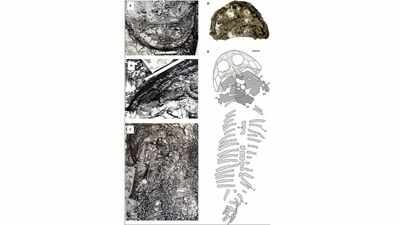
Nearly 80 years ago, a British expedition discovered the battered remains of a giant fossil on the peak of an Arctic island. Unable to take it with them, they snapped some pictures, took some bones and left the fossil to be ravaged by the icy winds and rain. Little did they know it would be found again decades later and turn out to be the first of its kind and a giant among its peers. According to a report by Phys.org, the fossil found on Bjørnøya (Bear Island) has now been identified as a new species of ancient amphibian-like creature, a plagiosaurid, named Arctobatrachus urdensis. The creature was roughly 2.7 m (about 8.9 feet) long, making it by far the largest plagiosaurid ever discovered.A fossil forgotten in the ArcticPlagiosaurids were a group of extinct bottom-dwelling, flat-bodied creatures that lived during the Triassic period (~251 to 201 million years ago). What set them apart was their extremely bizarre body shape. “The skull was much wider than long, and its outline resembles a boomerang,” said Rainer Schoch, a paleontologist at the State Museum of Natural History Stuttgart, as per the report.According to the study titled ‘A giant plagiosaurid temnospondyl from Bjørnøya (Svalbard, Norway) and the origin of the plagiosaurid body plan’, these creatures lived at the bottom of rivers, lakes and seas, where they would lie in wait for anything that came too close, sucking in their prey through wide, gaping mouths lined with tiny teeth.Their fossils have been discovered across the ancient world, from Brazil to China, but one fossil, discovered in 1948, would not be recovered until decades later. Assuming the harsh Arctic winters wouldn’t allow the fossil to survive, researchers had long given up on it until a Norwegian field party made a chance rediscovery in 1984.In the 37 years since it was last seen by human eyes, the fossil had been thoroughly beaten, and various cracks and missing bones told a tale of decades exposed to Mother Nature’s harsh climate.After a weeklong excavation, it was finally retrieved, yet it would sit mostly unexamined for a few more decades until it was fully prepared at the Stuttgart museum for the current study.A giant predator of the Triassic seasUsing photographs taken in 1948, the researchers reconstructed the missing portions of the skull. The skull alone was a whopping 70 cm (~27.6 inches) wide, but only around 21 cm (~8.3 inches) long, giving it an unusual shape. The skull was much wider than long, and its outline created a near-perfect semicircle.Its massive size, large teeth and unusually wide mouth all suggested it had been an active hunter and possibly a top predator. In addition, its features were unlike any other, suggesting it was an entirely new species. They named it Arctobatrachus urdensis, as per the report.Analysis of its position in the family tree revealed it was one of the earliest members of the plagiosaurids, giving researchers a rare window into what the ancestors of this bizarre lineage may have looked like. Initially, these creatures were more active swimmers with less flat bodies before evolving into more sedentary, flatter-bodied animals.The discovery adds to the growing understanding of these elusive marine creatures.“Many people are fascinated by our past,” Schoch said, as per the report. “What did the planet, its climate and life look like, say 240 million years ago?” Fossils like this giant flat-headed plagiosaurid offer a glimpse into that ancient world.