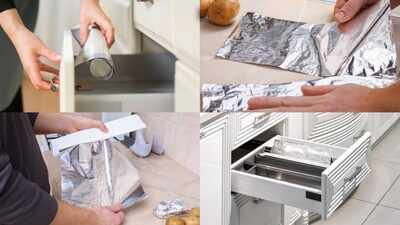
If you’ve scrolled past a video of someone lining their kitchen drawer with a neat sheet of aluminium foil and wondered whether it’s actually doing anything useful, you’re not alone. This quiet little hack has been spreading steadily across social media and home-organisation circles recently. Unlike many viral kitchen tricks that fizzle out once someone tries them, this one keeps sticking around because the reasoning is genuinely sound, not just aesthetically pleasing. Here’s what the foil is actually doing in there, what it can’t do despite some of the wilder claims floating around online, and how to set it up properly.
It creates a moisture barrier your wood drawer doesn’t have
Wooden kitchen drawers sit right in the middle of a genuinely humid environment, absorbing steam from cooking, condensation from wet utensils, and general kitchen dampness day after day, which over time leads to swelling, warping, and even mould in poorly ventilated spaces. A sheet of foil laid flat across the base acts as a straightforward waterproof partition between the drawer’s contents and the wood itself, intercepting moisture before it ever has the chance to soak in. It’s a small layer doing a genuinely practical job that most drawers were never really built to handle on their own.
It saves your drawer from scratches, stains, and constant scrubbing
Cutlery drawers take a real daily beating; forks and knives scrape across the same patch of wood meal after meal, gradually carving out gouges and splinters that cleaning can’t fix once they’ve set in. A thin layer of foil absorbs that friction instead. When it inevitably gets stained with grease, food residue, or general grime, you lift it out and lay down a fresh sheet rather than scrubbing the drawer itself. It turns what used to be a proper cleaning chore into something that takes about ten seconds.
The reflective surface has a small but genuine bonus
Kitchen drawers, especially deeper ones or those without direct light overhead, tend to swallow small items into their darker corners, such as measuring spoons, loose twist ties, or that one missing teaspoon you swear you own. Foil’s naturally reflective surface bounces ambient light back up into the drawer regardless of which side faces up, making it marginally easier to spot smaller items at a glance. It’s not going to replace a proper drawer light, but it’s a genuinely useful side effect of a hack that was never really designed with visibility in mind.
Here’s the part the internet tends to oversell
Not every claim attached to this hack holds up, and it’s worth knowing where the line actually sits. Aluminium foil has zero antibacterial or antimicrobial properties, despite what some viral posts suggest, so simply lining a drawer with it does nothing to sanitise your cutlery or kill bacteria sitting in there. The same goes for silver tarnish specifically; resting dry silverware on a sheet of foil alone doesn’t prevent or reverse tarnishing. That only happens through a genuine electrochemical reaction, which requires foil, baking soda, and hot water working together, not just foil sitting there passively on its own.
How to actually set it up properly
Start by fully emptying the drawer and cleaning it thoroughly, making sure it’s completely dry before laying anything down, since trapping moisture underneath the foil defeats the entire purpose. Measure and cut the foil to fit the drawer’s internal dimensions, pressing it flat rather than leaving loose folds where debris can collect. There’s no fixed replacement schedule; a drawer holding rarely used serving pieces might stay clean for months, while a cutlery drawer getting scraped daily may need a fresh sheet every few weeks, so the simplest rule is to replace it whenever it looks torn, damp, or visibly stained.Disclaimer: This article is intended for general informational purposes only. Aluminium foil acts as a physical barrier against moisture and stains, but it does not sanitise, disinfect, or kill bacteria, and should not be relied upon as a substitute for regular cleaning of drawers and utensils. Avoid prolonged direct contact between foil and acidic or salty foods, as aluminium can react with certain substances over time