
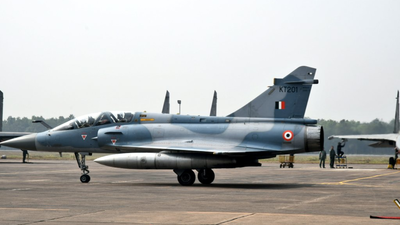
The aerial component of the Kargil Sector in 1999 was a unique campaign. Never before or after has an air force engaged in an air-to-ground campaign at those altitudes. With fighter pilots more attuned to air-to-air combat at these altitudes of 14-18,000 feet.So, when the Indian Air Force (IAF) began Operation Safed Sagar on May 26, the arm was writing how to fight air-to-ground campaigns at those altitudes. Although direct combat operations began on May 26, the air force had been participating in combat support operations such as logistics, casualty evacuation and aerial reconnaissance for a few more days.
Fighting a war at 18,000 feet
Fighting at these altitudes was not new for the Indian armed forces; the army had evicted Pakistani irregulars from Dras and Kargil Saltoro Ridge in 1948, then again in the 1962 war, followed by the 1965 war in which fighting took place with the army capturing key positions such as Black Rock and then again in 1971 when solid gains were made in the Shingo and Shyok river valleys. The army and the air force had also been deployed since 1984, as the country fought on the higher Saltoro Ridge that guards the Siachen Glacier from the Pakistanis to the west. The air force has been involved in many of these operations, mostly in the logistics and casualty evacuation roles, although offensive air action did take part in the Kargil sector in 1948. The air force had also been operating fighters from Ladakh and performing Combat Air Patrols (CAP) over the Siachen sector since the mid-1980s, while the first fighter to land at Leh was the tiny Gnat that landed there in 1964.As the Pakistani army transgressed the Line of Control (LoC) and sat atop the mountains dotting the high ground above the sliver of highway that connected Ladakh to the rest of India, with the intention of cutting off this road link. The gravity of the situation began to dawn after two patrols of the army were ambushed in the Kaksar region, the first in mid-May and the second one on May 17th. As additional forces were thrust into the area, mainly the 8th Mountain Division, under the command of Major General Mohinder Puri, which was involved in counter-insurgency operations in the Kashmir Valley.The air force initially pitched in with logistics support, casualty evacuation and reconnaissance. A Canberra, of the 106 ‘Lynx’ Squadron, on a reconnaissance mission was struck by a Man Portable Air Defence System (MANPAD). The twin-engine spy plane returned to the Srinagar Air Force Base powered by a single engine. The army was tasked with fighting a literal uphill battle.As the size and scope of the Pakistani intrusion became apparent, the Cabinet Committee on Security (CCS), headed by late Prime Minister Atal Bihari Vajpayee, cleared the use of offensive air power on May 25th.
Operation Safed Sagar: lightning strike from the sky
A day later, offensive air operations began with a gusto. For the first time after the 1971 war, in which Pakistan was split in two, IAF’s fighter pilots took off armed and with an intent to kill. The targets spread across in the form of the blade of a sickle from the Batalik sector in the east to the Mushkoh Valley in the west. The Pakistanis perched upon the mountain tops and ridge lines were tough to detect by the pilots. This was due to the fact that the Pakistanis had cleverly constructed sangars and bunkers using locally available material, thus helping them blend in with their surroundings. Spotting these fortifications becomes even more difficult when the aircraft is flying at hundreds of kilometers per hour.For the MiG-21, the most numerous aircraft in the IAF service and also over the battlefield, the bombing speed was around 500 to 800 kmph. Of the thirteen combat squadrons (including the Canberra and MiG-25 units) braving Pakistani fire, three squadrons, the 17th, 51st and 108th, were flying different variants of the MiG-21. With other squadrons flying the Mirage-2000, Jaguar, MiG-23 BN, MiG-25, MiG-27 and the MiG-29. Apart from the then-recently inducted Sukhoi-30, all fixed-wing combat aircraft types took part in the operations. These aircraft performed different types of roles, ranging from air strikes to reconnaissance to escorting strike packages to CAP.
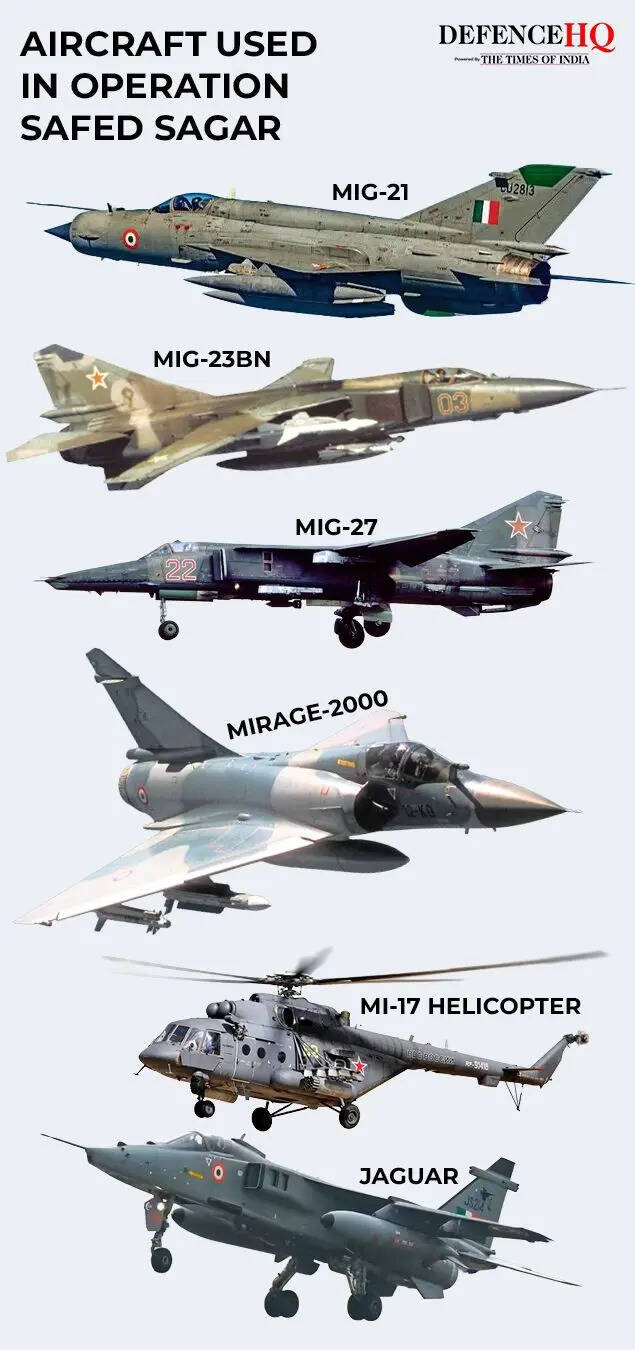
Aircraft used in Operation Safed Sagar
The IAF went to war at an altitude that was higher than its high-altitude air-to-ground range at Tosa Maidan, which was at an altitude of around 10,000 feet. Waging war at 18,000 feet comes with its own challenges, especially for the air force that had practiced waging war at much lower altitudes, striking armoured columns, airbases and logistics nodes in the plains of Punjab and across the deserts opposite Rajasthan. Ballistics and bomb drift affect the weapon differently as the wind resistance provided by the thinner air is lower and also because at those altitudes wind speeds at times reach hurricane levels. This means that even a carefully aimed bomb could still land much farther away and have the potential to hit own troops, although due to expert planning by the aircrew, no such incident took place. The decision of the government of the day was to not cross the LoC, this limited the attack geometry or the approaches the pilots could take, thus limiting options. Unlike now, when the air force has smart munitions and long-range weapons, during the Kargil conflict, options were limited. With the initial strikes limited to dumb bombs, rockets and internal cannons.
Early losses force a rethink
A day after the conflict began, the IAF faced reversals. While engaging ground targets in Muntho Dhalo in the Batalik sector, then Flight Lieutenant Nachiketa’s MiG-27’s engine ingested exhaust gas from the aircraft’s 30mm cannon, resulting in an engine flameout. As his engine was not able to restart, the pilot was forced to eject. Squadron Leader Ajay Ahuja, who was looking for Nachiketa, was shot down by a Pakistani MANPAD. Ahuja, like Nachiketa, ejected safely, but unlike the latter, who was taken prisoner, was shot dead in cold blood. The very next day, a Mi-17 helicopter of the IAF was shot down while on a rocket attack on Tololing.The IAF needed to redraw its tactics in light of the specter of shoulder-fired air defence missiles.
The IAF changes tack
After the downing of the helicopter that led to the loss of lives of Squadron Leader Rajiv Pundir, Flight Lieutenant S Muhilan, Sergeant Raj Kishore Sahu and Sergeant PVNR Prasad, the IAF stopped flying helicopters in an offensive role. Although the IAF continued to use helicopters for casualty evacuation, observation and logistics roles. For the fighters, things changed more significantly. The first of these changes was that the aircraft now had to fly outside the range of the Pakistani MANPADs. The increased distance for bomb release reduced accuracy of the bombs that were dropped on target.
Mirage-2000 brings precision to Kargil
The air force which was already working at that point of time to integrate Laser Guided Bombs (LGBs) on its Mirage-2000 fleet, sped up the process. The IAF’s elite Aircraft and Systems Testing Establishment (ASTE) had carried out a test bombing of a laser guided bomb aided by the Israeli origin Litening pod, all the bomb was guided to its target, the new electric fuse did not function, thus delaying the deployment of the bomb just months before the conflict. The software work also was not complete.A decision was made to ready this precision bombing capability as the conflict began. Efforts began the very next day. Air force engineers as well as those from Israeli form Rafael the makers of the pods ironed out the problems. The pod was tested in both day and night. The entire process was completed by June 4. The very next morning a small team of 7tth Squadron, which flew the Mirage-2000, was briefed on the pod. The pod was soon deployed for reconnaissance missions during both day and night. The Litening pod was also used for assessing the damage caused by air strikes. The pod was first used to target to guide a laser guided weapon on Tiger Hill on June 24, thus dawned the era of precision targeting for the IAF.
The Kargil War was a stepping stone for the Indian Air Force in the precision weapons age. Bombs, like other weapons, behave differently at high altitudes. Charts and tables made for bombs are for much lower altitudes. Precision guidance gave the air force immense capability. The bomb was first used on Tiger Hill with great effect. The Pakistanis were not expecting that strike, or the one at Muntho Dhalo. This was a tremendous thing and a turning point. Now we have advanced tremendously in indigenous guided bomb tech, with the DRDO developing many bombs, but remember, it all started in Kargil.
Air Vice Marshal Prashant Mohan (Retd) commanded a MiG-21 squadron and two frontline air bases
Lessons that outlived the war
One of the more understated lessons from Kargil was just how badly India needed its own navigation technology. During the conflict an officer suggested rigging handheld GPS units onto fighters and helicopters for high-altitude bombing, flying at 9 km, safely above missile range, and releasing bombs at a GPS point calculated for trajectory and wind. Trials began on May 29, 1999, with the first live mission flown the very next day. But the war also exposed a deeper problem that India had no GPS of its own, and had to scramble for foreign data mid-conflict. That gap, long flagged but never urgently addressed, finally pushed ISRO to build an indigenous satellite constellation, meant for disaster management, fleet tracking, mapping and precise timing. It placed India among a small club, alongside the US, Russia, Europe and China, with its own positioning system.As the conflict ended, many of these lessons were institutionalised. The armed forces began to make changes ny from direct learnings of the conflict, while others came via the Kargil Review Committee. Some of these changes included the creation of the post of Chief of Defence Staff, greater integration between the three services, establishment of the Defence Intelligence Agency among others. The conflict in Kargil was a watershed event in Indian military history, the lessons and learnings from it are still guiding the forces and are insuring that the armed forces remain at the forefront of innovation.