
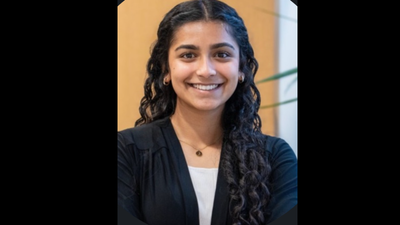
Zainab Nathani, a high school junior from Niles, Illinois, has designed a material that can pull drinkable water straight out of humid air, powered entirely by sunlight. Studying at Niles Township West High School, she built her project around emulsion-templated composite biogels, porous, bio-based structures engineered to trap moisture from the atmosphere and release it as liquid water once warmed by natural sunlight, with no electricity or added energy required. The work grew out of her broader research into water purification and harvesting technologies, alongside a long-standing commitment to clean water access in her community. Her project went on to earn a Fourth Award in the Materials Science category at the 76th Annual Regeneron International Science and Engineering Fair, held in Phoenix in May 2026, after qualifying through the Illinois Junior Academy of Science State Exposition. Beyond the laboratory, Nathani has founded a local initiative funding clean water wells overseas, pairing technical innovation with sustained civic advocacy for global water equity.
Zainab Nathani’s clean water advocacy goes beyond her scientific research
Nathani’s motivation traces back to community-level concerns rather than a purely academic starting point. According to EarthEcho, she has led local initiatives to raise awareness and support for clean water access, alongside her own research into water purification and harvesting technologies. She has expressed a wish to become a Water Challenge Ambassador, a role focused on empowering communities with knowledge and encouraging youth action on global water issues.Her interests extend beyond the lab into hands-on civic work. Through the Niles Area Thirst Project, an initiative she founded that is affiliated with the international Thirst Project, she raises funds to help build wells in areas without reliable access to clean water. She also serves as President of her school’s Futures In STEM Club and competes as a three-season varsity athlete, balancing scientific research with school leadership and outreach.
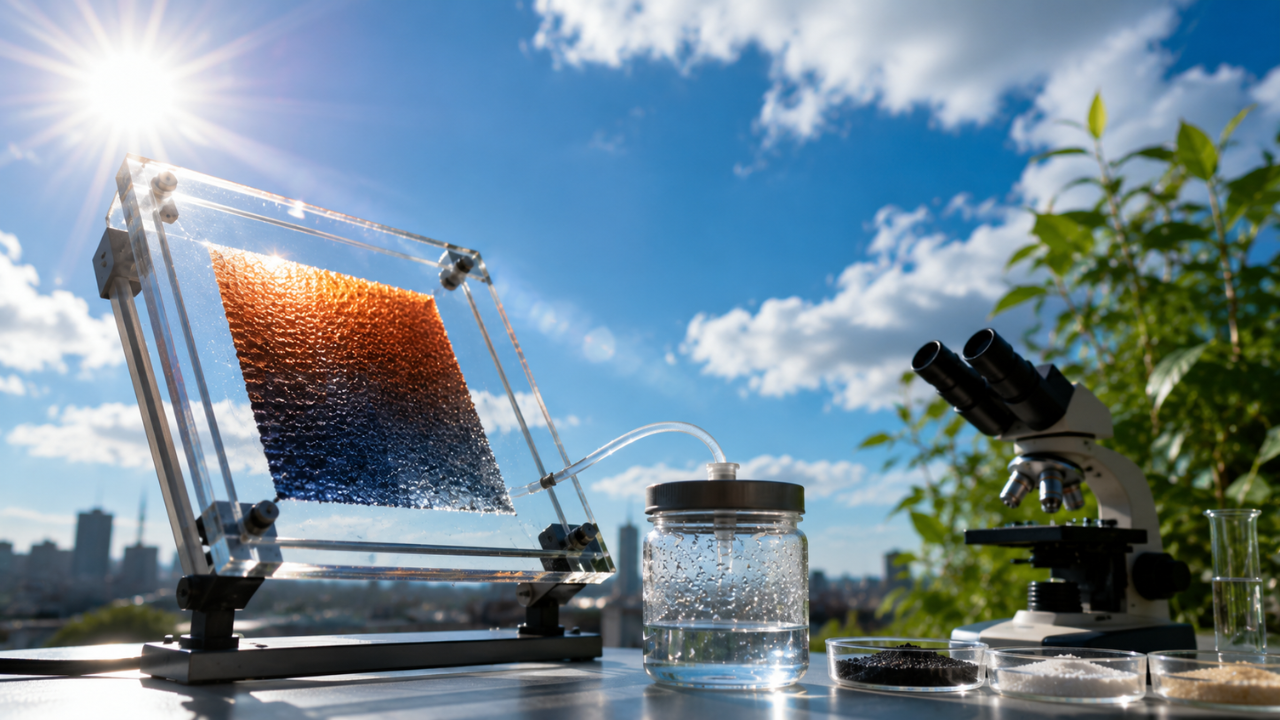
Image AI generated
How Zainab Nathani’s material captures moisture from the air using solar heat
According to her LinkedIn profile, Nathani’s water-harvesting material was developed while working with senior researchers at the Midwest Desalination Research Institute, where she has focused on creating low-cost nanomaterials for atmospheric water harvesting. This overlaps with an established but still-developing scientific field: rather than relying on desalination or traditional filtration, such materials use their internal pore structure to capture ambient moisture even in relatively dry conditions, then release that trapped water using solar heat, without requiring electricity or additional energy input.Her ISEF project specifically applied a technique known as emulsion templating, in which a controlled mixture of two normally unmixable liquids is used to shape a porous gel structure from bio-based components. This method allows the resulting material’s pore architecture to be finely tuned, which is central to maximising how much water vapour it can absorb before being warmed by sunlight to release the collected water.
Zainab Nathani earns Fourth Award at ISEF 2026 for water-harvesting project
Nathani’s project, titled “Emulsion-Templated Composite Biogels for Scalable Solar-Driven Atmospheric Water Generation,” earned a Fourth Award in the Materials Science category at the 76th Annual Regeneron International Science and Engineering Fair, held in Phoenix in May 2026. According to the official press release from the Society for Science, the organisation that runs the competition, she qualified for the international stage through the Illinois Junior Academy of Science State Exposition.The word “scalable” in her project’s title signals an intent beyond laboratory demonstration; the design was developed with future manufacturing and real-world deployment in mind, rather than being a one-off proof of concept. This positions her research within a broader push by scientists internationally to move atmospheric water generation out of specialised laboratories and into affordable, everyday devices, particularly for use in arid or water-stressed regions.
How Zainab Nathani combines scientific innovation with clean water outreach
What stands out in Nathani’s profile is the consistency between her laboratory work and her outreach efforts. Her fundraising for clean water wells through the Thirst Project chapter she founded runs alongside her technical research into water-harvesting nanomaterials, suggesting these are not separate pursuits but two expressions of the same underlying concern for global water equity.As she continues her studies at Niles Township West High School, Nathani also tutors younger students in mathematics, science, history, and language arts. Her combination of technical innovation, recognised at the international level, and sustained community engagement points to a research trajectory that may continue to bridge scientific discovery with tangible impact on water access challenges worldwide.