
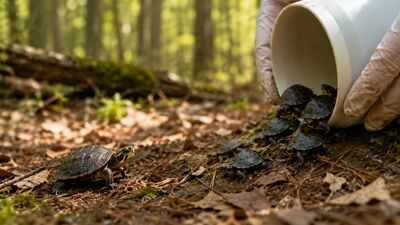
In 2011, Ivy was released into a Massachusetts marsh as a tiny seven-gram Blanding’s turtle after spending her first months in human care. Then she disappeared. For more than a decade, there was no confirmed sign of the turtle, leaving conservationists with no way of knowing whether she had survived. According to the Commonwealth of Massachusetts (Mass), in 2023, she turned up again during a routine survey, no longer a hatchling, but a full-grown adult. Two years later, Ivy was found nesting at Great Meadows National Wildlife Refuge, where she laid eight eggs, seven hatched and the young turtles were given their own head start through a conservation programme before being returned to the wild. In June 2026, two of Ivy’s daughters were released into the same Massachusetts landscape, marking a rare second-generation milestone for the effort to restore Blanding’s turtles.
A seven-gram hatchling disappeared into the wild after leaving Stone Zoo
Ivy’s beginning was tied to a nesting journey that took her mother well beyond the wetlands of Great Meadows National Wildlife Refuge. In 2010, the adult female travelled more than 1.2 miles to reach a nesting site at a nearby office park. Eleven young turtles emerged from that nest. Among them was a female weighing only seven grams.That hatchling became Ivy. Rather than immediately being left to face the hazards of her first year in the wild, she spent about 10 months under the care of animal staff at Stone Zoo. She was released in 2011, joining the long-running effort to strengthen one of Massachusetts’ threatened turtle populations. What happened next was less certain. Ivy was not seen again for years.For a species such as the Blanding’s turtle, that gap matters. Young turtles are especially vulnerable to predators, and reaching adulthood is a difficult part of the life cycle. A turtle can disappear from regular surveys without necessarily disappearing from the landscape, but there is no way of knowing that from an empty monitoring record. Ivy eventually supplied the answer herself.
Ivy returned as an adult and laid eight eggs in 2025
In 2023, during a routine survey, conservation workers found Ivy again. She had survived in the Great Meadows landscape and had grown into a full-sized adult.Adult Blanding’s turtles can live for decades, and females do not begin reproducing immediately. So a successful release is not really the end point of the work. The longer-term test is whether those animals survive, mature and eventually contribute offspring of their own.As reported by Mass, Ivy provided that missing link. On the night of June 25, 2025, Zoo New England senior field conservationist Jimmy Welch watched over a protected wildflower meadow as Ivy began digging a nest. She started laying at about 2.30 am.By the end of the nesting attempt, there were eight eggs. Seven hatched later that year.
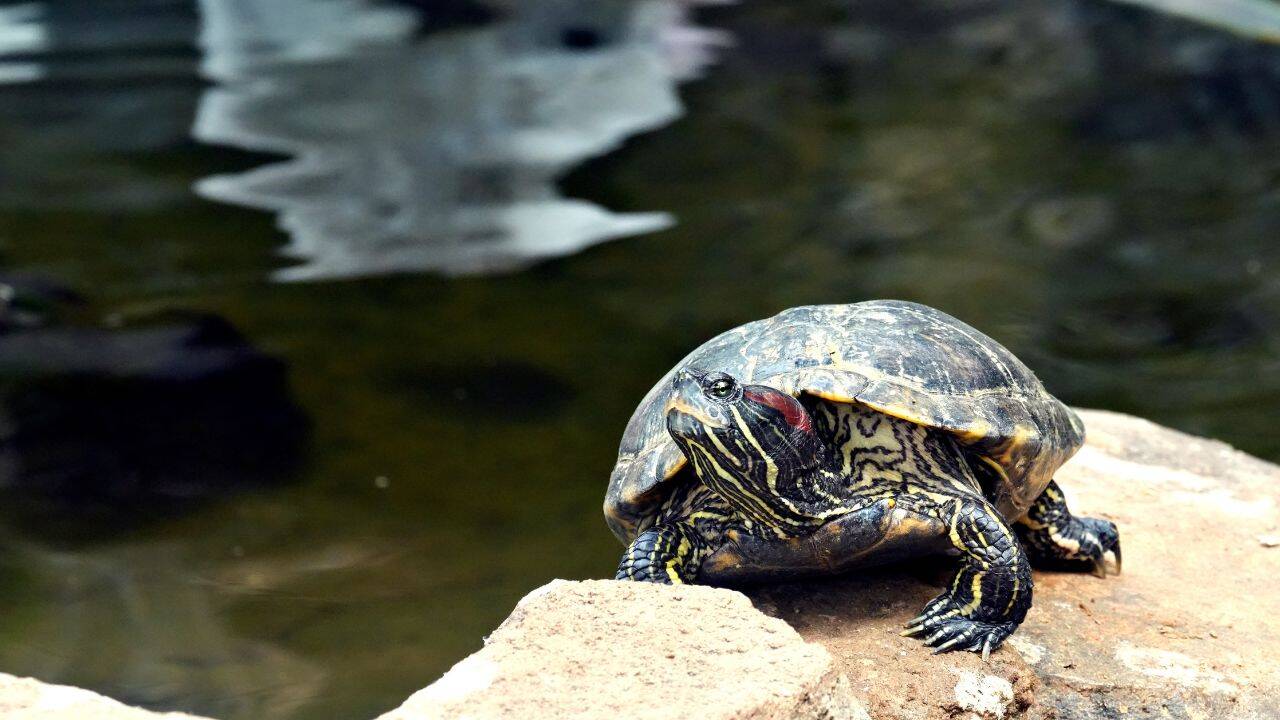
Her offspring received a head start of their own
The young turtles did not spend their first winter exposed to the same risks their mother had faced. Instead, they entered Zoo New England’s HATCH programme, which stands for Hatchling and Turtle Conservation through Headstarting.The approach is fairly straightforward. Hatchlings are collected from the wild in early autumn and placed with participating schools, where students care for them in warm aquariums through the colder months. They have food readily available and are protected from many of the predators that take a heavy toll on very young turtles.When spring arrives, the turtles are returned to the wild. The programme has involved more than 22,000 Massachusetts school students since 2009. More than 1,400 Blanding’s turtles have been given this early period of protected growth through Zoo New England’s conservation work.According to the organisations involved, headstarted Blanding’s turtles have been estimated to be 40 times more likely to survive to adulthood than turtles left to grow entirely in the wild. Ivy’s seven hatchlings followed that same route. Local schoolchildren cared for them before they were returned to Great Meadows in spring 2026.Two of them were held back for the June release that carried a little more meaning than the usual return of young turtles. They were Ivy’s offspring.
Ivy’s offspring offer the first proof of a self-sustaining future
On June 25, 2026, Zoo New England, MassWildlife and the U.S. Fish and Wildlife Service gathered at Great Meadows National Wildlife Refuge with conservation partners, supporters and donors. Two of the young turtles were released into the wild.They were the first confirmed second-generation offspring produced through the Great Meadows Blanding’s turtle conservation programme, which began in 2003.Their release was therefore different from simply adding more young turtles to a struggling population. It showed that at least one turtle produced through the programme had survived long enough to reproduce, and that her young could now enter the wild as part of the next generation.For conservationists, that is the point at which a headstarting programme begins to demonstrate something harder to achieve than a series of successful releases: reproduction within the recovering population itself.“Every year, we protect nests and release headstarted turtles to help restore these threatened turtle populations,” Welch said. “But the goal is to have the population become self-sustaining.”
Two decades of conservation work helped bring a new generation back to Great Meadows
The June release was also a marker for the wider programme at Great Meadows. Dr Bryan Windmiller, who founded Zoo New England’s Blanding’s turtle conservation programme there, has spent more than two decades working on the species.That work has involved far more than raising hatchlings. Blanding’s turtles occupy a landscape where wetlands, roads, developed areas and other changes can make movement and nesting difficult. Protecting nests, monitoring turtles and finding suitable places for young animals to be released all form part of the effort.The species is listed as threatened in Massachusetts, and its recovery has required several organisations to keep working together over a long period.Mike Jones, MassWildlife’s state herpetologist, said the new generation reflected the contribution of Zoo New England, the U.S. Fish and Wildlife Service, schools and the local community.Great Meadows itself has also become an important part of that partnership. The national wildlife refuge provides protected habitat where Blanding’s turtles can feed, move between wetlands and lay their eggs.