

Scientists have demonstrated direct brain-to-brain communication using a system that transmitted information between people without speech, typing or physical gestures. The research led to ‘BrainNet,’ a system that connected three people and allowed them to collaborate on a task using brain signals. Electrical activity was recorded from the brain and transmitted over the internet, while magnetic stimulation delivered the information to another participant’s brain. The experiment did not enable participants to read complete thoughts or communicate freely, but it showed that information linked to a person’s decision could be extracted from brain activity and transmitted to another brain. The findings provide an early demonstration of a multi-person brain-to-brain communication network.
How did scientists begin connecting human brains
The story behind BrainNet began before the three-person experiment. According to the MIT Technology Review researchers had already demonstrated in 2015 that two people could be connected through a brain-to-brain interface. That earlier experiment involved a game similar to 20 Questions. One person could use brain activity to communicate information to another person, showing that brain signals could carry enough information for a simple question-and-answer interaction.The next challenge was that if two brains could exchange information, could several brains be connected into the same system? The BrainNet researchers set out to answer that question. Their findings, described in the paper ‘BrainNet: A Multi-Person Brain-to-Brain Interface for Direct Collaboration Between Brains,’ presented what they described as the first multi-person, non-invasive direct brain-to-brain interface designed for collaborative problem-solving.
BrainNet allowing people to communicate without speaking
BrainNet combined two technologies named electroencephalography (EEG) and transcranial magnetic stimulation (TMS). The MIT review explained that EEG equipment uses electrodes placed on the head to detect electrical activity produced by the brain. The system can recognise particular patterns associated with a person’s decision. TMS, meanwhile, was used to send information into another person’s brain. Rather than requiring an implant, the technique uses magnetic stimulation applied from outside the head.The research paper explains that two participants acted as ‘senders,’ while a third participant became the ‘receiver.’ The senders watched a Tetris-like game and decided whether a falling block should be rotated before it was dropped. Their decisions were detected through EEG and transmitted through the internet. The receiver could not see the game screen. Instead, information from the two senders was delivered to the receiver’s brain through magnetic stimulation of the visual area at the back of the brain. The receiver then used brain activity to make the final decision.
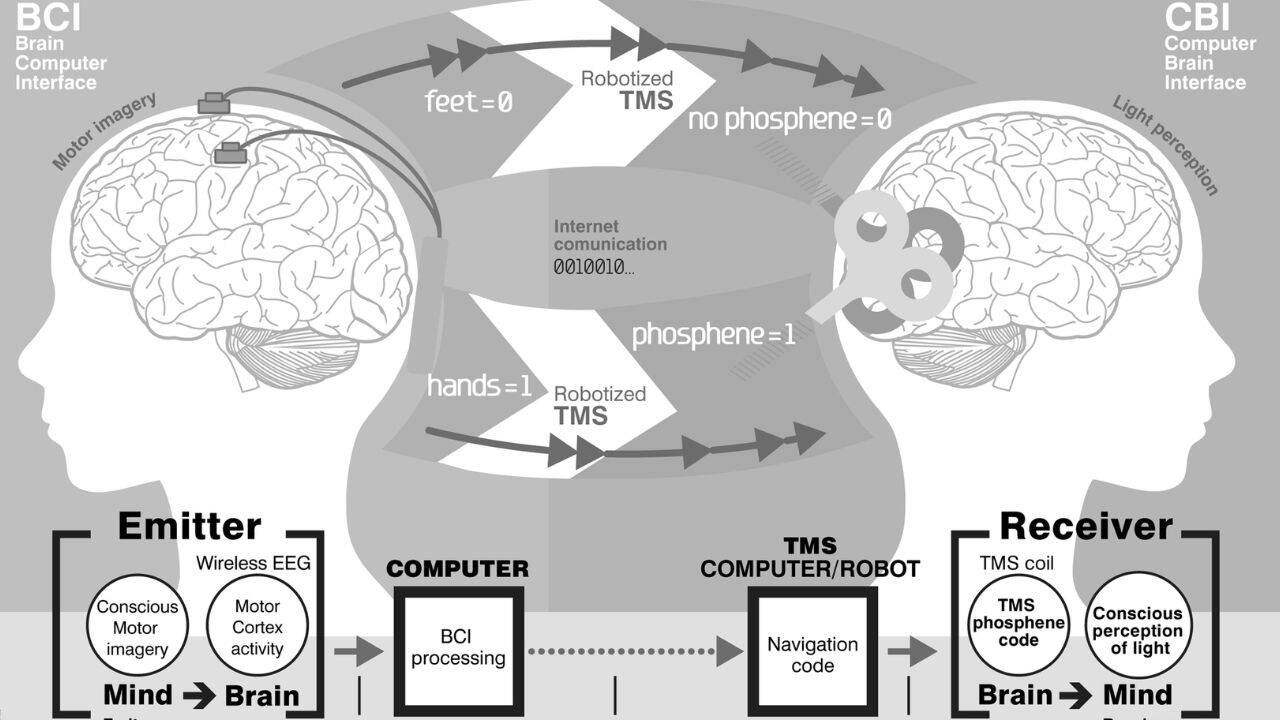
Brain-to-brain (B2B) communication system. Image Credit: Wikipedia
Was this experiment really a hive mind
Not quite. The phrase ‘hive mind’ makes the achievement sound more advanced than it was. BrainNet did not allow participants to read complete thoughts, hear sentences inside each other’s heads or freely communicate whatever they wanted. The system was designed to transmit very limited pieces of information connected to a specific task. That limitation is important. The researchers were not creating a shared consciousness. They were demonstrating that a carefully designed system could take a small amount of information from one brain, send it electronically and use stimulation to deliver that information to another brain.Still, the experiment introduced something genuinely new. The receiver was not simply getting one person’s decision. Two senders could provide information, allowing the receiver to combine their signals before deciding what to do. The system also included another round in which the senders could provide feedback on the receiver’s decision. The research paper noted that five groups of three participants successfully used BrainNet, achieving an average accuracy of about 81.3% on the task.
Could the receiver tell which brain was more reliable
One of the most interesting parts of the experiment was not simply whether the system worked, but ‘how the receiver handled information from different people.’ The researchers deliberately made one sender’s information less reliable by adding ‘noise’ to that person’s signal. The receiver was then able to learn which sender was providing more dependable information. According to the study, receivers could distinguish between the reliability of the senders using the information delivered through BrainNet and favour the more reliable source when making decisions. That feature is what made the researchers compare the system with a social network. In ordinary human groups, people naturally learn whose information can be trusted. BrainNet showed a basic version of that process taking place through direct brain-to-brain communication.
What could a network of connected brains eventually become
The researchers were careful about what the experiment actually demonstrated, but its possible implications were much broader. The MIT Technology Review described BrainNet as a ‘world-first brain-to-brain network’ and highlighted its potential as a new form of communication. The researchers themselves suggested that future systems could involve larger numbers of people. The research paper noted that the current system used two senders and one receiver, but that the concept could potentially be expanded to include more participants. With suitable equipment, each person could also potentially send and receive information through the brain interface.That possibility raises the prospect of people collaborating on tasks while bypassing some conventional forms of communication. For now, BrainNet remains a carefully controlled research demonstration rather than a real-world telepathic network. It showed that human brains could become nodes in a network where information moves from one brain, through technology, and into another. The idea of a ‘social network of brains’ may still sound like science fiction. BrainNet showed that its first basic building blocks are already possible.