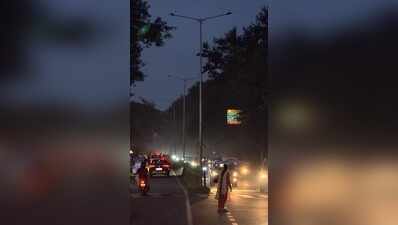
Ranchi: Ranchi’s poorly lit outskirts are adding to commuters’ difficulties during the monsoon, with stretches around Khelgaon, Booty More, Ratu Road and Ormanjhi remaining dark after sunset.The lack of adequate lighting makes potholes, waterlogged patches and other road hazards difficult to spot. Residents said the darkness was also affecting movement and commercial activity in several areas.The concerns come even as Jharkhand is promoting solar street lighting through the Jharkhand Renewable Energy Development Agency (JREDA). The agency’s records show that installations under its Solar Photovoltaic Programme are under way. A JREDA hoarding displayed during a recent Adivasi Diwas event in Ranchi claimed that 59,262 solar streetlights had been installed across the state, with a combined capacity of 5,169 kW.In Khelgaon, residents said the problem extended beyond traffic safety. Parts of the area are close to forested stretches, and the lack of lighting leaves commuters wary of encountering wild animals or venomous snakes, particularly during the monsoon. They also said poor lighting had discouraged businesses from expanding along some stretches, leaving parts of the road deserted after evening hours.“After 7 or 8 pm, many stretches become so dark that people avoid stopping here. The jungle is right next to the road, so there is always a fear of suddenly seeing an animal or snake. Even shops are hesitant to operate late,” said Neelam Tudu, a tea seller near the Khelgaon housing complex.Commuters using the Ormanjhi side of the city face similar concerns, particularly on roads connecting residential areas, institutions and highway stretches. The route is also important as it leads towards Mesra and the main campus of Birla Institute of Technology (BIT) on the Ranchi-Hazaribag road.Ormanjhi block development officer (BDO) Kameshwar Bedia, said the stretch under their block’s jurisdiction had not received complaints about darkness. “The stretch till Irba falls under our jurisdiction, while the other stretches are looked after by several organisations, including the NHAI. I have not received any formal complaint yet,” he said.Residents said vehicles often approached at high speed, while pedestrians and cyclists became difficult to spot against the poorly lit background. During rain, waterlogging and mud further reduce visibility.“During the rain, you cannot tell whether there is a pothole, a broken road edge or standing water until you are almost on top of it. Two-wheelers are especially vulnerable,” said Devansh, a commuter.Residents around Booty More and Ratu Road said stretches with inadequate lighting became particularly hazardous after rain, when reflective road markings and potholes were difficult to distinguish.