
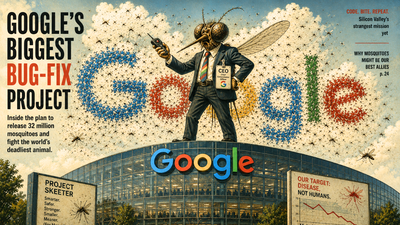
“If you think you are too small to make a difference, try sleeping with a mosquito.”Whether those words belong to the Dalai Lama, an ancient African proverb or simply to every exhausted human who has ever lain wide awake at 2 AM listening to that infamous high-pitched whine, the debate over its authorship continues. What is not up for debate, however, is the savage truth it carries.No creature has ever done so much damage with so little size. Roughly the size of a grain of rice, the mosquito is responsible for more human deaths than any other animal on Earth. Malaria, dengue, yellow fever, Zika and West Nile virus have helped make the tiny insect one of humanity’s oldest and deadliest enemies. Every year, mosquito-borne diseases infect hundreds of millions of people and kill more than a million. Sharks, lions and bears combined don’t even come close. Nature’s apex predator is, embarrassingly, something you can kill with a single clap, if you can ever land it.Which is why a proposal of releasing 32 million mosquitoes would normally sound like terrible news. It feels like the opening of a horror film where a scientist says “trust me” and nobody does.Instead, it may become part of the solution.Google‘s life sciences division, Verily, is seeking approval to release up to 32 million specially treated male mosquitoes across parts of Florida and California. The insects carry a naturally occurring bacterium called Wolbachia. When they mate with wild female mosquitoes, the eggs fail to hatch. Over time, local mosquito populations shrink. The goal is to reduce disease-carrying mosquitoes without pesticides or genetic modification. In other words: Google is using mosquitoes to destroy mosquitoes. It’s the most passive-aggressive pest control strategy ever conceived, and honestly, we should respect it.It sounds strange at first. Yet after years of successful trials elsewhere, scientists believe the approach could become a powerful new weapon against one of humanity’s deadliest enemies.
Inside Google’s unique plan to fight the world’s deadliest animal
To understand why researchers are pursuing such an unusual strategy, it helps to understand the scale of the problem.Mosquitoes are responsible for transmitting some of the world’s most dangerous diseases. Malaria alone kills more than 600,000 people each year, most of them children under five. Dengue threatens billions of people across tropical and subtropical regions and continues to expand its reach as temperatures rise.Humanity has spent centuries trying to fight back. Wetlands have been drained. Entire regions have been sprayed with insecticides. Billions of dollars have been spent on repellents, pesticides and bed nets. We’ve tried everything. Citronella candles that smell like a spa and do absolutely nothing. Wristbands that allegedly work by the power of suggestion. That one guy in every barbecue who insists he doesn’t get bitten, he’s lying.These efforts have saved countless lives. Yet mosquitoes remain remarkably resilient. Many species have evolved resistance to common insecticides while others have adapted their behaviour to avoid control measures. Evolution is a slow process, except apparently when the selection pressure is a human trying to swat you then it takes roughly a Tuesday afternoon.That has pushed scientists to look for new solutions.
The bacterium that could outsmart mosquitoes
The key to Google’s strategy is not the mosquito itself but Wolbachia.Scientists first identified the bacterium more than a century ago. Today it is known to exist naturally in roughly 60 percent of insect species. What makes it useful is its unusual effect on mosquito reproduction. Essentially: it’s a bacterium that makes male mosquitoes romantically useless. Scientists found a way to weaponise incompatibility, which is either brilliant science or the most relatable concept in human history.When male mosquitoes carrying Wolbachia mate with wild females that do not carry the bacterium, the eggs simply do not hatch. The result is straightforward. Fewer offspring means fewer mosquitoes in the next generation.Because only female mosquitoes bite humans, releasing Wolbachia-carrying males does not increase the number of biting insects. Instead, it gradually suppresses local populations. For the record, the females bite because they need blood to produce eggs. The males just drink nectar and mind their business. Nature’s gender dynamics are complicated, and we will not be taking questions.The approach has attracted attention because it avoids many of the concerns associated with chemical pesticides and genetically engineered insects. Researchers are simply using a naturally occurring bacterium to interrupt the mosquito life cycle.The challenge is scale. Producing millions of male mosquitoes, separating them accurately from females and releasing them across large areas requires a level of automation that few organisations can manage. Sexing 32 million mosquitoes by hand sounds like the worst unpaid internship in Silicon Valley history.This is where Google enters the picture. Using artificial intelligence, robotics and automated sorting systems, Verily has developed a process capable of producing and releasing mosquitoes on an industrial scale. Google has, at various points in its history, tried to organise the world’s information, build self-driving cars and cure ageing. Farming 32 million mosquitoes is, genuinely, not even in the top five wildest things on that list.
What happened in Singapore
The strongest evidence for the approach comes from Singapore.Since 2018, Verily has partnered with Singapore’s National Environment Agency on Project Wolbachia. The programme now releases more than 10 million male mosquitoes every week. Ten million. Every week. For context, that is more mosquitoes than people at most music festivals, except these ones cannot be stopped by a VIP wristband.The results have attracted global attention. In areas where releases took place, researchers reported reductions of 80 to 90 percent in local Aedes aegypti mosquito populations. Dengue cases fell by more than 70 percent after sustained releases.Those are the kinds of numbers that public health experts rarely ignore. A 70 percent reduction in dengue cases. Politicians have entire careers on smaller wins than that.The proposed releases in Florida and California are intended to test whether similar results can be achieved in much larger and more complex environments.
Why the plan is still controversial
Not everyone is convinced.Some critics worry about the ecological consequences of suppressing mosquito populations. Mosquitoes serve as food for birds, bats and fish. Some species also play a role in pollination. Yes, the mosquito does have defenders. They are mostly bats, and nobody asked them.Others remain sceptical of large-scale biological interventions, particularly after years of debate surrounding genetically engineered mosquitoes. Scientists acknowledge those concerns. That is why the proposal is undergoing review by the US Environmental Protection Agency. Which is reassuring, unless you’ve been following the news, in which case: godspeed, everyone.For now, researchers argue that the potential benefits deserve serious consideration. Mosquito-borne diseases continue to affect millions of people every year and existing control methods are struggling to keep pace.
The bigger picture
For now, the mosquito remains undefeated. It has survived ice ages, adapted to pesticides and spread disease for more than 200 million years.Google has been doing software for about thirty. The mosquito is not worried. And yet here we are, armed with a bacterium, a sorting robot and a suspiciously large amount of optimism.Whether Verily’s approach succeeds or fails, the proposal reflects a growing shift in how scientists think about disease control. Rather than trying to kill every mosquito, they are looking for ways to make mosquito populations collapse naturally. It is, in the most literal sense, letting them self-destruct. Scientists have essentially discovered that the best weapon against a mosquito is another, slightly worse mosquito.It is an unusual strategy. It sounds counterintuitive. And it involves releasing millions of mosquitoes into the wild. Yet if the science holds, those 32 million male mosquitoes could help reduce the numbers of one of humanity’s deadliest enemies.For once, more mosquitoes might ultimately mean fewer mosquitoes. Which is either the most elegant solution in the history of public health, or the opening line of an apology from a future documentary. We choose to believe the former.