
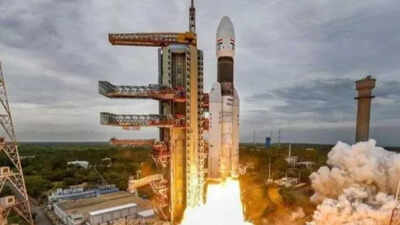
For decades, launching a rocket into space followed a remarkably simple pattern: build it, launch it, use it once and throw most of it away.That model worked, but it was expensive.Now, the world’s space industry is trying to change the equation. Instead of watching a rocket disappear after delivering its payload, companies and space agencies want the most expensive parts of it to come back to Earth, land safely and fly again.China has just taken another important step in that race.On August 19, Chinese private space company LandSpace successfully recovered the first stage of its Zhuque-3 rocket after an orbital launch, landing the booster on a designated site in Gansu.It was China’s first successful land-based recovery of an orbital-class rocket by a private company, following an earlier Chinese success in July in which a rocket stage was recovered using a net on a sea platform.The achievement puts China alongside the US in a club that, until recently, was dominated by SpaceX.But why is everyone suddenly so interested in rockets that come back?And does a reusable rocket really make spaceflight cheaper?
Basic idea is surprisingly simple
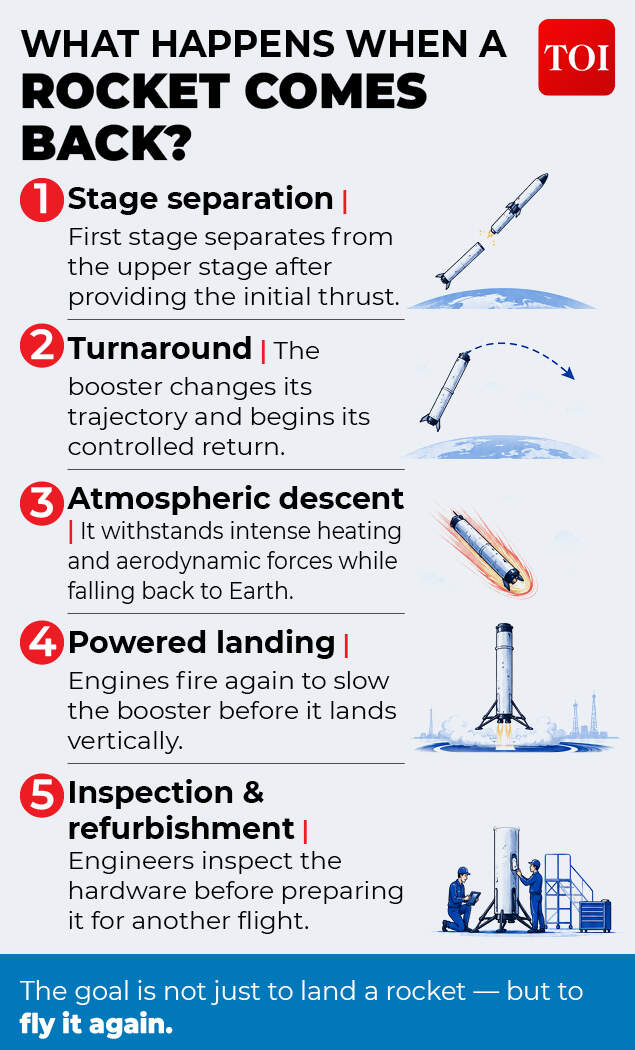
Think of a rocket as a delivery vehicle.When you order something online, you don’t expect the delivery van to be thrown away after dropping your package at the door. You use it again because the vehicle itself is valuable.Traditional rockets have largely done the opposite.A launch vehicle consists of multiple stages packed with engines, fuel tanks, electronics and other expensive hardware. Once the rocket has done its job, most of those components have traditionally fallen into the ocean or burned up in the atmosphere.A reusable rocket tries to change that.The most important part to reuse is usually the first stage, the section containing the powerful engines that provides the initial thrust needed to escape Earth’s thick lower atmosphere.After separating from the upper stage, the booster turns around, controls its descent and returns to Earth.It can then be inspected, refurbished and launched again.That sounds straightforward. It is anything but.A rocket returning from space is travelling at enormous speed and must survive extreme heating, precisely control its trajectory and then slow down enough to land within a relatively small area.It is essentially asking a machine designed to go up to suddenly become an aircraft coming back down.
What happens when a rocket comes back?
When a reusable rocket’s first stage separates from the upper stage, it does not simply fall back to Earth. It has to actively control its return.First, the booster uses its onboard computers, engines and control systems to change its trajectory and head towards a predetermined landing area. As it descends through the atmosphere, it must withstand intense aerodynamic forces and heating.
How does a reusable rocket work?
Near the end of the flight, the rocket fires its engines again to slow down dramatically. In systems such as SpaceX’s Falcon 9, the booster then uses landing legs and grid fins to control its final descent before touching down vertically.After landing, the booster is taken back for inspection and refurbishment.Engineers check its engines, tanks, electronics and other components for damage or wear before deciding whether it is ready to fly again.The remarkable part is that the rocket is essentially doing two very different jobs during the same mission: first acting as a high-performance launch vehicle travelling thousands of kilometres per hour, and then transforming into a precisely controlled landing machine.
Why does bringing a rocket back matter so much?
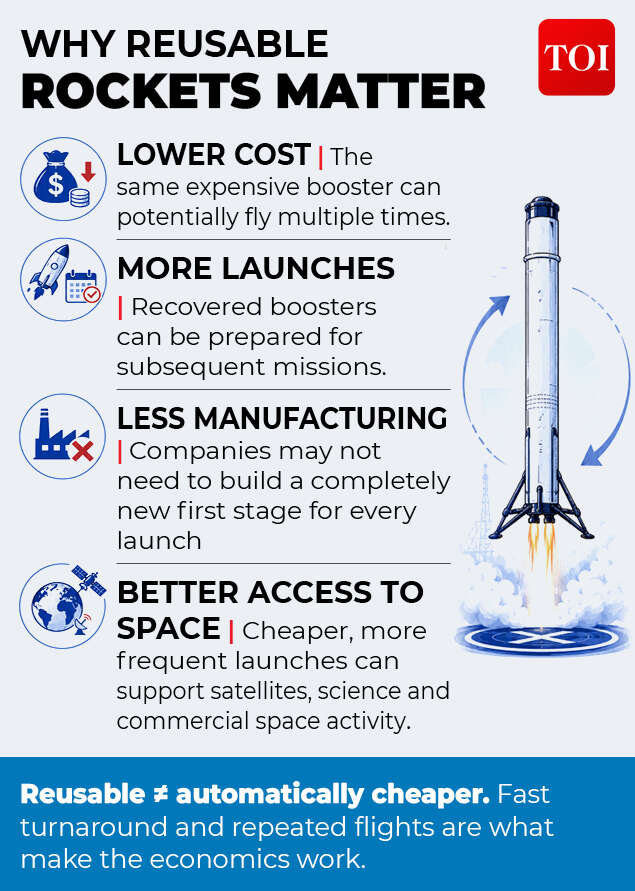
The biggest reason is cost.Launching something into space requires enormous amounts of energy. But the rocket hardware itself is also extremely expensive.If the vehicle can be flown multiple times, the cost of building a new first stage does not have to be paid for every launch.That can fundamentally change the economics of spaceflight.
Importance of rockets that can be reused
A Nasa analysis of Falcon 9 found that the average cost of a flight using a new booster was around $65 million, compared with about $50 million when a previously flown booster was used.The analysis also found that the savings from reusing the booster were only one part of the overall launch economics, highlighting why rapid turnaround and repeated flights are crucial to making reusability worthwhile.The study estimated that the cost of putting a kilogram into low Earth orbit could fall substantially when previously flown hardware was reused.The numbers vary depending on the mission and recovery profile, but they illustrate the basic economic logic behind the global push for reusable rockets.Reusable rockets can also make launches more frequent.Instead of waiting for a completely new rocket to be manufactured, tested and assembled for every mission, a recovered booster can potentially be prepared for another flight.That becomes especially important as the number of satellites in orbit grows.Communications constellations, Earth-observation networks, navigation systems and scientific missions all require regular launches. A world in which hundreds or thousands of satellites need to be deployed is very different from the early space age, when a launch was a relatively rare event.In that world, a rocket that can fly again starts looking less like disposable hardware and more like an aircraft.There is another advantage: manufacturing capacity.If a launch company can reuse a booster several times, it does not necessarily need to build as many first stages to maintain a high launch frequency.That could reduce pressure on factories, supply chains and specialised components.But there is an important catch.Reusable does not automatically mean cheap.A booster has to be recovered, inspected, maintained and refurbished. If refurbishment becomes too complicated or expensive, some of the economic advantage disappears.The real prize, therefore, is not simply landing a rocket once.It is being able to land it, refurbish it quickly and fly it again and again.
SpaceX changed the game
The modern reusable-rocket race is impossible to discuss without SpaceX.SpaceX demonstrated that a large orbital rocket booster could repeatedly return to Earth and land vertically as part of a commercially operational launch system.Its Falcon 9 became the clearest proof that rocket reusability could move from an engineering experiment to an operational business model.SpaceX’s Falcon 9 has become the world’s most frequently flown orbital rocket, with 165 launches in 2025 alone and nearly 100 Falcon 9 flights already completed in 2026 by late August. The company says partial reusability has reduced the cost per tonne to orbit by about 85% compared with the historical average for orbital launches.That high launch rate matters because it demonstrates the other half of the reusable-rocket equation: reuse becomes most valuable when there are enough launches to use the recovered hardware frequently.The goal is therefore not just to save a rocket but to create a launch system that behaves more like a fleet.
China wants to catch up
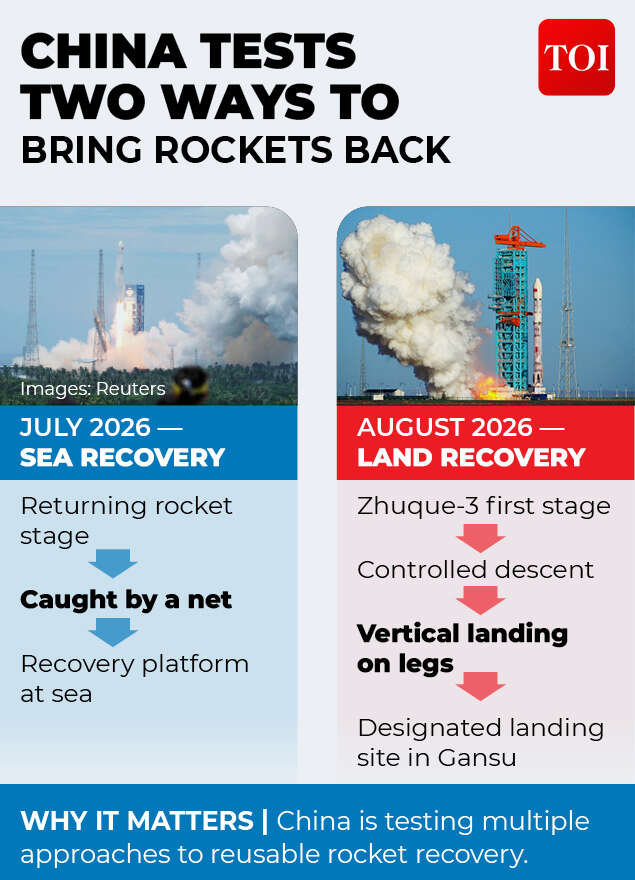
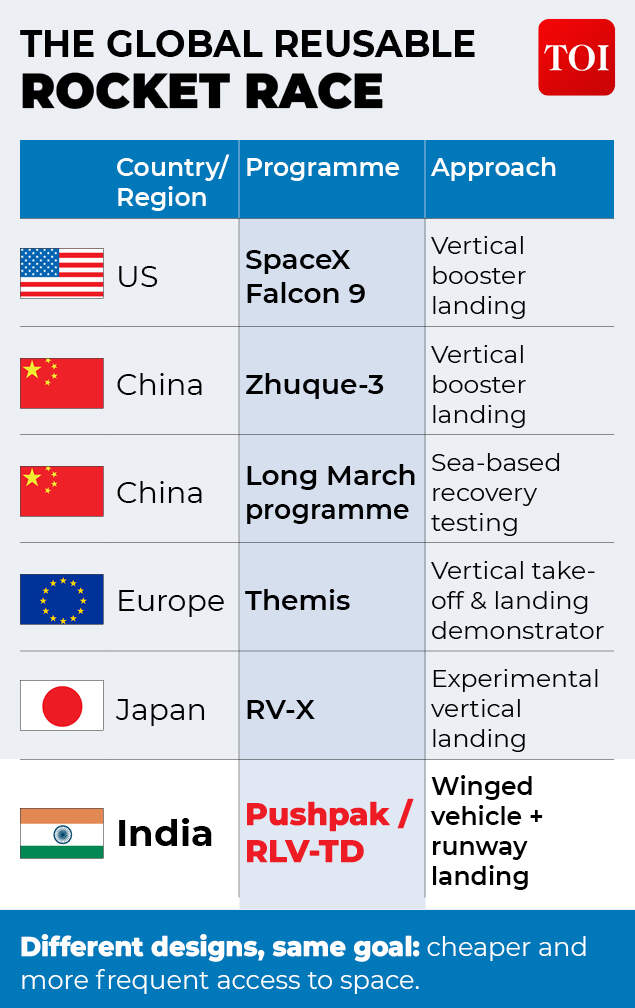
LandSpace’s methane-fuelled Zhuque-3 is designed as a reusable launcher and is broadly aimed at the same emerging market as rockets such as Falcon 9.Its successful August landing involved the first stage separating after the orbital portion of the mission, turning back towards Earth and touching down on landing legs at a designated site in Gansu.China’s progress is notable because both state-owned and private-sector programmes are pursuing reusable technology.In July, China demonstrated a different recovery approach by using a net mounted on a sea platform to catch a returning rocket stage. Zhuque-3’s landing on solid ground shows the country is testing multiple recovery methods.
China’s two recovery methods
And the reason is strategic as much as commercial.China is building a rapidly expanding space sector, including satellite constellations and commercial launch capabilities. A reusable rocket could allow Chinese companies to launch more frequently while lowering the cost of putting payloads into orbit.That makes reusability increasingly important not just for individual companies but for China’s broader ambition to become a major global space power.
What about Europe?
Europe has been slower to enter the reusable-rocket race, but it is now developing its own technology.The European Space Agency’s Themis programme is designed specifically to demonstrate low-cost rocket recovery and reuse technologies.
The new ‘space race’ for resusable rockets
The prototype uses the reusable methane-fuelled Prometheus engine and is intended to demonstrate vertical launch and landing.The programme reflects Europe’s effort to respond to a launch market increasingly shaped by reusable US rockets, while building technologies for its next generation of launch vehicles.
Japan is experimenting too
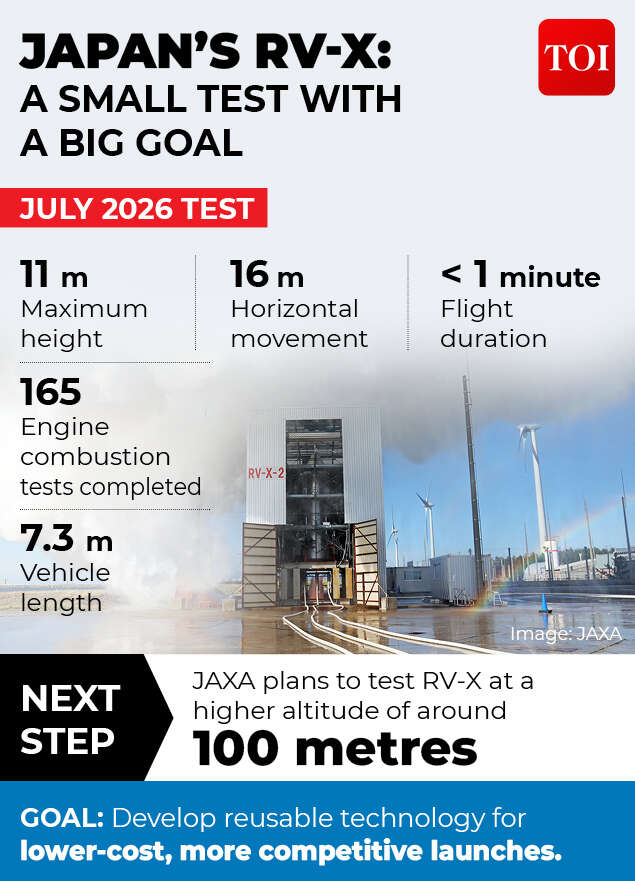
Japan is also pursuing reusable rocket technology.Its efforts include experimental reusable launch vehicles and vertical take-off and landing concepts aimed at eventually reducing launch costs and increasing launch frequency.In July, the Japan Aerospace Exploration Agency (JAXA) and Mitsubishi Heavy Industries successfully tested the experimental RV-X rocket, which lifted off, hovered, moved horizontally and then landed upright at the Noshiro Testing Center in northeastern Japan.The test lasted less than a minute, with the vehicle rising 11 metres and moving 16 metres horizontally while maintaining its position before landing safely.
Japan’s RV-X test
The test was small in scale but significant in purpose: JJapan is trying to develop the reusable technologies that could eventually underpin a lower-cost successor to its expendable H3 rockets and compete in a launch market increasingly shaped by SpaceX’s reusable technology.The 7.3-metre-long RV-X is equipped with a more durable engine and shock-absorbing landing gear. Its engine has already completed 165 combustion tests, while JAXA plans to push the vehicle to an altitude of around 100 metres in future tests.The programme is also being developed alongside France and Germany, showing how reusable launch technology is becoming a strategic priority well beyond the US and China.
So, where does India stand
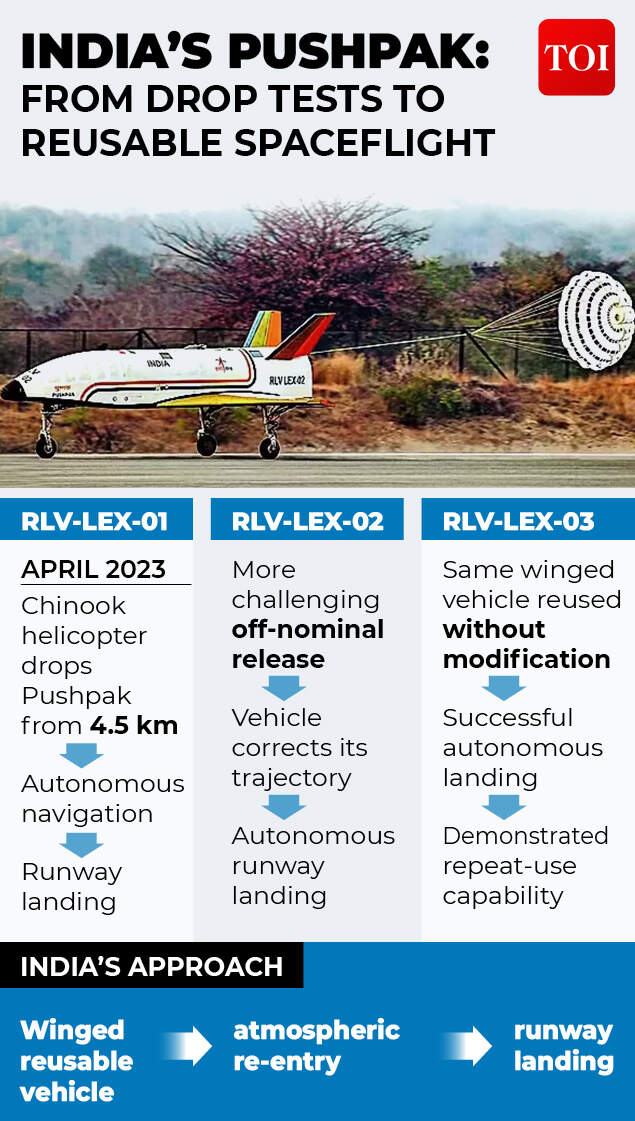
India has actually been working on reusable launch technology for years.Isro’s programme is centred around the Reusable Launch Vehicle Technology Demonstrator (RLV-TD), popularly associated with the winged vehicle called Pushpak.But India’s approach is somewhat different from China’s Zhuque-3 or SpaceX’s Falcon 9.Instead of developing only a vertically landing rocket booster, Isro has been testing a winged spaceplane-like vehicle designed to return from space and land on a runway.This is a different technological route to reusability, rather than a direct Indian equivalent of Falcon 9’s reusable first-stage architecture.In April 2023, Isro successfully conducted the first Reusable Launch Vehicle Autonomous Landing Experiment, dropping Pushpak from an Indian Air Force Chinook helicopter at an altitude of 4.5 km. The vehicle then autonomously navigated to and landed on a runway.
India’s Pushpak journey
A second test made the challenge harder by releasing Pushpak from off-nominal conditions. It autonomously corrected its trajectory and landed on the runway, validating navigation, control, landing and deceleration systems needed for a future space-returning vehicle.Then came the third landing experiment.In RLV-LEX-03, Isro went a step further by reusing the same winged vehicle and flight systems from the previous landing experiment without modification.That demonstrated not just that Pushpak could land autonomously, but that its hardware could withstand one test and be flown again.
India’s bigger plan: Pushpak is only the beginning
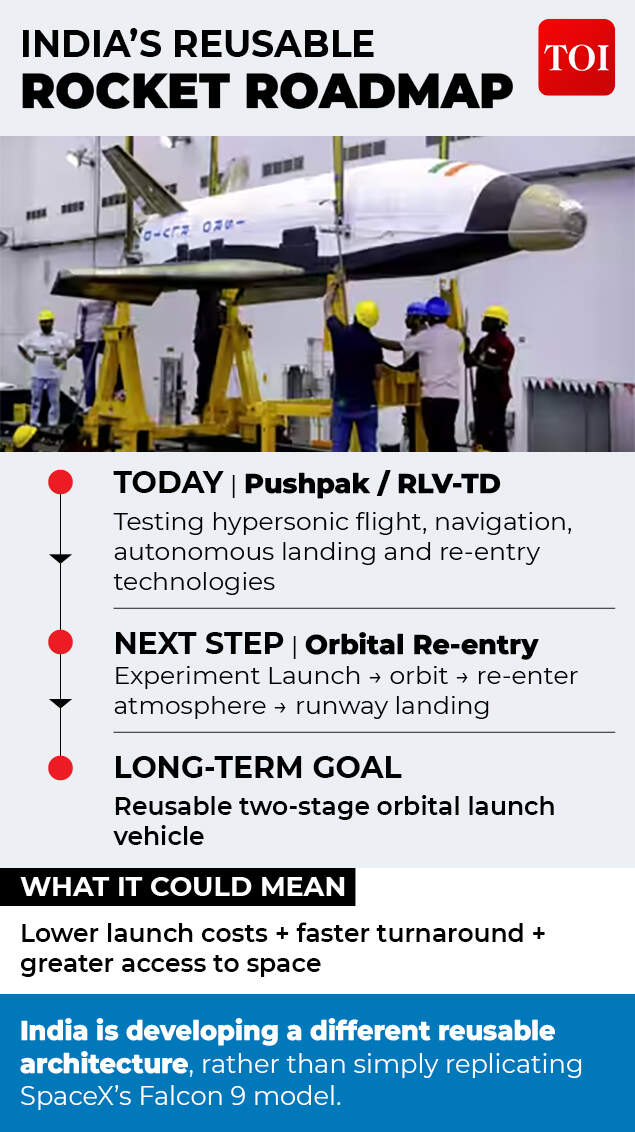
Isro describes the RLV-TD as a flying test bed for technologies including hypersonic flight, autonomous navigation and landing, and powered cruise flight.The eventual objective is much bigger: the technology is intended to contribute to the development of the first stage of a reusable two-stage orbital launch vehicle.Isro is also developing landing gear technology for the next stage of its programme. Its plan for the Reusable Launch Vehicle-Orbital Re-entry Experiment envisages launching Pushpak to orbit, allowing it to complete several orbits, re-enter the atmosphere and land on a runway using deployable landing gear.
What India ultimately wants
A dedicated landing-gear drop-test facility was commissioned at the Vikram Sarabhai Space Centre in 2025 to support this work.So India’s answer to reusable rockets is not simply “build our own Falcon 9.”It is developing a different architecture and gradually testing the technologies needed to make an orbital vehicle reusable.The Indian Space Policy 2023 also explicitly allows non-government entities to develop and commercialise launch vehicles and reusable, recoverable and reconfigurable space-transportation technologies.That opens another important door: India’s reusable-rocket future may not belong to Isro alone.
Why this race matters beyond cheaper launches
At first glance, reusable rockets sound like an engineering trick designed to save money.They are much more than that.Lower launch costs can make it easier to deploy satellites, expand communication networks, monitor climate and agriculture, conduct scientific missions and build large satellite constellations.For governments, cheaper and more frequent access to space can also strengthen national capabilities.For private companies, it can create entirely new business models.And for scientists, it could mean that missions once considered too expensive become realistic.But there is an even bigger change taking place.For most of the space age, getting into space was the difficult part.The next challenge is making access to space routine.That requires rockets that can fly frequently, turnaround times that are measured in days or weeks rather than months or years, reliable recovery systems and a large enough market to keep the vehicles busy.
Real dream is not a rocket that lands
China’s latest success is impressive. But the landing itself is only one piece of the puzzle.The real test comes afterwards.Can the Zhuque-3 booster be inspected quickly? Can it be refurbished without replacing most of its expensive hardware? How many times can it fly? And can each additional flight actually lower the cost of launching satellites?The same questions apply to every reusable rocket programme, including India’s.Because the ultimate goal is not simply to watch a rocket come back dramatically through the atmosphere and land upright.It is to make that landing boring.A successful reusable launch system would eventually make rocket recovery so routine that nobody would think twice about it — much like nobody celebrates when an aircraft lands safely after every flight.That is why countries are racing to build rockets that come back.The future of spaceflight may depend not on how spectacularly a rocket can leave Earth, but on how cheaply, reliably and repeatedly it can return.