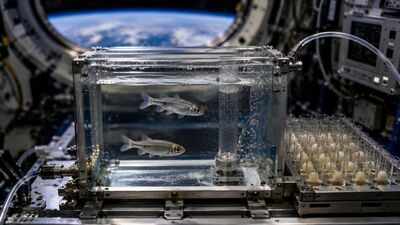
When humans leave Earth, even something as basic as knowing which way is up can become confusing. That made fish surprisingly useful subjects for space research. In 1973, Nasa sent two mummichogs and 50 eggs aboard Skylab 3, giving scientists a chance to watch both adult fish and young that developed entirely in orbit. Soon after reaching microgravity, the adults began swimming in tight loops before gradually adapting and using the aquarium’s lights as a visual reference. The experiment offered a glimpse into how a nervous system responds when gravity, normally a constant source of information, suddenly disappears.Fish later returned to space in experiments involving goldfish and Japanese medaka, helping researchers investigate the tiny inner-ear structures responsible for sensing movement, as well as changes in bone density during weightlessness. What began with a small aquarium in Skylab became part of a much broader effort to understand how living bodies adapt beyond Earth.
How Nasa’s 1973 Skylab mission took fish into orbit
On July 28, 1973, two mummichogs left Earth aboard Skylab 3, the second crewed mission to America’s first space station. The species, Fundulus heteroclitus, is a small minnow native to the Atlantic coast of North America.They were accompanied by 50 eggs, giving the experiment a second purpose. Scientists would not only be able to watch fish that had developed under normal gravity, but also observe young fish that began life in orbit.Mummichogs were well suited to the job. They are remarkably tolerant animals, capable of living through changes in temperature and salinity and surviving in habitats that would be difficult for many other fish. The species was also readily available around Cape Canaveral, where Nasa’s launches were taking place.
Why Nasa wanted fish in orbit
The experiment was really about the human balance system.When astronauts first enter microgravity, their brains receive conflicting information from systems that normally work together to tell them which way is up. The inner ear plays an important part in this process. On Earth, gravity provides a constant reference. In orbit, that reference is largely absent.The resulting confusion can cause space motion sickness. A significant proportion of astronauts experience it when first entering microgravity, making the condition more than an uncomfortable side effect of spaceflight. It can interfere with work during the first few days of a mission.Fish offered scientists a way of looking at the same problem without having to reproduce human symptoms directly. Their vestibular systems also respond to changes in orientation, while their normal life in water already gives them experience of buoyancy.The question was fairly simple: what happens when an animal accustomed to floating suddenly loses gravity altogether?
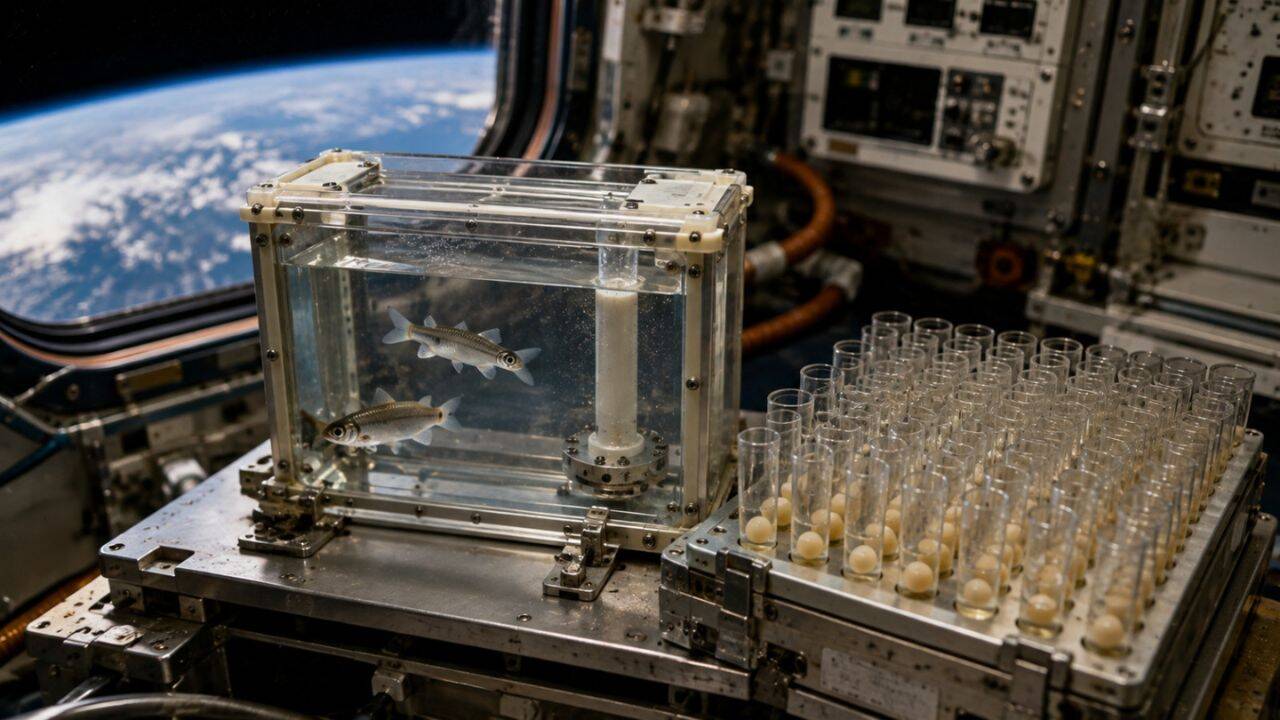
The 1973 fish experiment revealed how animals adapt to microgravity
The answer became apparent soon after the Skylab crew began watching their unusual passengers. At first, the mummichogs swam in tight loops, repeatedly pitching forward. Their behaviour suggested that their sense of orientation had been disrupted. They could move, but their internal signals no longer provided a reliable indication of where they were in relation to gravity.There was no way for the astronauts to ask the fish whether they felt sick, of course. Instead, researchers had to infer what was happening from their movements.The looping gradually subsided. By around the third day, the fish had begun to adapt, following a pattern that was broadly similar to the adjustment experienced by the astronauts themselves.The aquarium’s lights then became useful in a way that was never intended as a replacement for gravity. The fish began using them as a visual reference, keeping their backs oriented towards the lights. With no obvious gravitational direction to follow, light provided a substitute cue for “up”.It was an important detail because it showed that the fish were not simply becoming motionless or losing the ability to control themselves. Their nervous systems were finding another way to establish orientation.
Nasa’s space-born fish responded differently to weightlessness
The eggs provided perhaps the most interesting part of the experiment.They hatched during the third week of the mission, producing young fish that had never experienced ordinary gravity. From the beginning, the fry swam in a normal-looking manner for their environment, orienting themselves using the available visual cues.They also responded differently when the aquarium was disturbed. Shaking the tank temporarily confused them, and they could begin looping in much the same way as the older fish had done after launch. But the young fish recovered quickly.The distinction mattered. The adult mummichogs had to adjust an existing sensory system to an unfamiliar environment. The fry were developing in that environment from the start.Their behaviour suggested that an animal’s sense of orientation is not entirely fixed around the gravitational conditions in which it first evolved. When those conditions change early enough, the nervous system can develop around a different set of signals.
How goldfish helped scientists study movement and gravity in space
Fish continued to make occasional trips into space after Skylab, although some experiments were far less gentle.Goldfish became subjects in research designed to investigate the role of the otoliths, tiny structures in the inner ear involved in sensing movement and gravity. Six fish were flown to the International Space Station for one such experiment.Their vestibular systems had been altered before launch. One fish had its otoliths removed, while four had the structures removed from one side only. The sixth was left untreated as a comparison.The fish initially showed the familiar looping behaviour. Those that had undergone surgery also tended to roll towards the affected side. With time, however, their movements became more controlled. By about the eighth day, the operated fish had recovered from the initial imbalance, although some looping behaviour could still be seen later in the experiment.The fish eventually returned to Earth and adapted to normal gravity again.
How Japanese medaka helped reveal the effects of weightlessness on living tissue
Japanese rice fish, or medaka, provided scientists with a different experimental opportunity.Some mutant medaka carry a genetic change that delays the formation of otoliths and can sometimes prevent it altogether. That meant scientists could investigate the effects of altered vestibular development without surgically removing the structures.Medaka were exposed to short periods of weightlessness during parabolic flights, the aircraft manoeuvres commonly known as “vomit comet” flights. During these brief periods of freefall, scientists could watch how fish behaved without Earth’s usual gravitational pull.Later space experiments went beyond orientation. Medaka sent into orbit showed changes in bone mineral density, providing another parallel with human spaceflight. Long periods in microgravity are known to weaken human bones, so the fish became useful subjects for studying how living tissue responds when mechanical loading is greatly reduced.Their small bodies made them particularly convenient for experiments that would be difficult to conduct with larger animals.
Fish are now part of a much bigger space experiment
The role of fish in space research has since moved beyond the question of motion sickness.Zebrafish have been sent to China’s Tiangong space station as part of experiments looking at whether a small aquatic ecosystem can function in microgravity. The idea involves fish and algae interacting within a contained environment, allowing researchers to study the exchange of oxygen, nutrients and waste.That is a different problem from the one Nasa was investigating in 1973. The early mummichog experiment focused on the nervous system and the strange sensory consequences of losing gravity.