
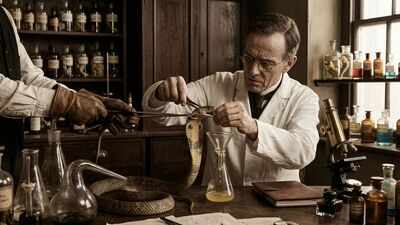
A snake bite in the late 19th century offered little certainty about what would happen next. There were attempts to counter venom with chemicals and other remedies, but no established treatment could directly neutralise the poison. Then, in France in 1894, two research teams arrived at a very different idea. Albert Calmette, working within the Pasteur Institute tradition, and Césaire Auguste Phisalix with Gabriel Bertrand at the National Museum of Natural History, independently showed that blood serum from immunised animals could protect against snake venom. Their experiments were presented to the French Society of Biology on February 10 that year. The discovery marked the beginning of antivenom serotherapy, although the credit for it would later become unevenly distributed.
A deadly cobra in Saigon pushed Calmette towards a new treatment
Albert Calmette’s route towards antivenom began in French Indochina. After meeting Louis Pasteur in Paris in 1890, Calmette was invited to organise vaccination work at the Pasteur Institute’s newly established branch in Saigon. There he encountered the effects of the Indian cobra, Naja naja, and began investigating ways of countering its venom.The study published in Journal of Venomous Animals and Toxins including Tropical Diseases, titled, ‘Paths to the discovery of antivenom serotherapy in France’ reveals his first published work on snake envenoming appeared in 1891. Calmette tested several chemical substances as possible treatments, including gold chloride. The results were not convincing enough to establish an effective therapy, but the experiments kept his attention on venom and its effects. By 1894, his approach had shifted towards immunity and the use of serum from animals that had been exposed to venom.The idea was part of a much wider change taking place in experimental medicine. Scientists were beginning to understand that exposure to weakened forms of harmful substances could leave animals better able to withstand later attacks. According to the study, Work by Henry Sewall, for example, had shown that repeated exposure of pigeons to small doses of rattlesnake venom could increase their resistance. The emerging science of serum therapy provided another piece of the puzzle.
Phisalix’s search began with a puzzle about natural immunity
Phisalix did not begin with the same therapeutic objective. His research was rooted more strongly in natural history and the question of why some animals could withstand poisons that were deadly to others.Working with Gabriel Bertrand, he examined the relationship between snake venom, blood and natural resistance. Their experiments gradually moved towards the possibility that an animal exposed to venom could acquire a form of protection that might somehow be transferred through its blood.By early 1894, their experiments had taken a significant step. Phisalix and Bertrand found that heating viper venom could weaken its toxic effects sufficiently for it to be used to immunise guinea pigs. They then showed that serum taken from immunised animals could counter the effects of venom in other animals. Their work was presented alongside Calmette’s at the same scientific meeting in Paris.
The experiment that changed snakebite treatment
The principle behind the new treatment was relatively simple, even if the science surrounding it was still developing. An animal was exposed to controlled amounts of venom in a way that stimulated its immune system without killing it. Its blood then contained protective substances capable of neutralising venom. Serum obtained from that animal could be transferred to another animal suffering from envenoming.Calmette achieved complete immunisation using chemically treated cobra venom and demonstrated that serum from immunised animals could have both preventive and therapeutic effects. Phisalix and Bertrand reached a similar result using heat-attenuated viper venom. Their experiments provided some of the earliest evidence that immune serum could directly counteract the lethal effects of a snake toxin.
Calmette turned the discovery into a treatment
The two groups did not have the same influence after 1894. Calmette moved quickly towards practical production. According to Fogarty International Center, at the Pasteur Institute in Lille, he began producing antivenom serum using horses immunised with cobra venom. By using larger animals, researchers could obtain much greater quantities of serum than were possible from laboratory animals such as rabbits or guinea pigs.This helped carry the discovery beyond the laboratory. Calmette promoted the treatment internationally, publishing and presenting his findings in several countries. The work eventually led to the wider production of antivenom sera in different parts of the world, including Brazil, India, Australia, South Africa, the United States and Britain during the following years.Phisalix’s career took a different direction. He returned to questions surrounding natural immunity and poisonous animals rather than building a comparable production programme. He died in 1906, aged 54, and received considerably less recognition than Calmette for the discovery.
Calmette became the name attached to a two-team discovery
The historical record makes the story less straightforward than the familiar account in which Calmette alone created the first antivenom. The 1894 discovery was made independently by Calmette and by Phisalix and Bertrand, with both teams demonstrating the protective properties of serum from venom-immunised animals.The French Academy of Sciences awarded the Montyon Prize to Phisalix and Bertrand for their discovery in 1894, while Phisalix later received the Bréant Prize for his wider work on venom and poisonous animals. Yet Calmette became the name most commonly associated with antivenom serotherapy. His role in developing the treatment for practical use, his international promotion of the method and his continued work in the field all contributed to that reputation.There was also an important technical difference between their methods. Calmette favoured chemical attenuation of venom, while Phisalix and Bertrand used heat. Later research showed that these approaches could stimulate different types of antibody responses, helping explain some of the differences observed between their sera.
The century-old science behind today’s antivenom
The basic principle established in the 1890s remains recognisable in antivenom production today. Venom is administered to an animal, usually a horse and sometimes another suitable species, in controlled quantities. The animal develops antibodies against components of the venom. Plasma is then collected and processed to obtain the antibody preparation used as antivenom.The method has not remained completely unchanged. Purification, concentration and processing techniques have developed substantially, helping reduce unwanted reactions associated with early, relatively crude serum preparations. Modern products can contain whole immunoglobulins or antibody fragments rather than the unrefined serum preparations used during the early years of serotherapy.
The discovery spread far beyond France
The French experiments quickly influenced researchers elsewhere. In Brazil, the work had particular importance for Vital Brazil Mineiro da Campanha, whose later research demonstrated the specificity of antivenom sera. Production of antivenom began at the Butantan Institute in Brazil in 1901, followed by programmes in several other countries.More than a century after the experiments of 1894, antivenom remains the principal scientifically validated treatment for serious snake envenoming. The technology surrounding its manufacture has changed, but the central idea developed by those early researchers using the immune response of one animal to protect another; still sits at the heart of the treatment.