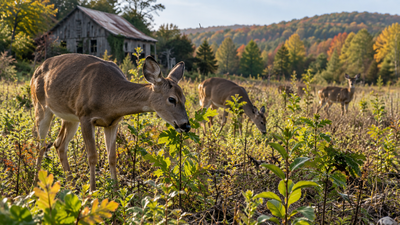
A long-term experiment near Ithaca, New York, has found that white-tailed deer increased the diversity of seeds germinated from the soil and reduced the abundance of woody plants aboveground. According to a study published in PubMed, titled ‘Deer impact seedbanks and plant communities over 18 years of post-agricultural succession’, the deer exclusion experiment began in 2005 in abandoned agricultural fields. Seedbank data were collected annually from 2005 to 2021, and 280,674 emerged seedlings were identified. Across all years, deer increased Shannon-Wiener diversity of germinated seeds by 8% and reduced woody plant abundance by 50%. Only the exclosure treatment had trees exceeding 1 cm diameter at breast height after 16 years.
How did scientists track deer for 18 years near Ithaca
A deer exclusion experiment began in 2005 near Ithaca, New York. Six blocks were established in abandoned agricultural fields. Each contained two 15 by 15 metre plots: one left accessible to deer and one surrounded by 2.5 metre woven wire fencing. The study states that the fencing prevents deer from entering while allowing smaller animals and birds to move freely.The authors report that soil samples were collected each October from 2005 to 2021 and tested in a greenhouse germination assay. In total, 280,674 emerged seedlings were identified. Aboveground vegetation data were collected from 2019 to 2022, and a woody plant survey was carried out in 2021. According to the paper, the study extends earlier findings from the same experiment, which had reported six years of seedbank data.
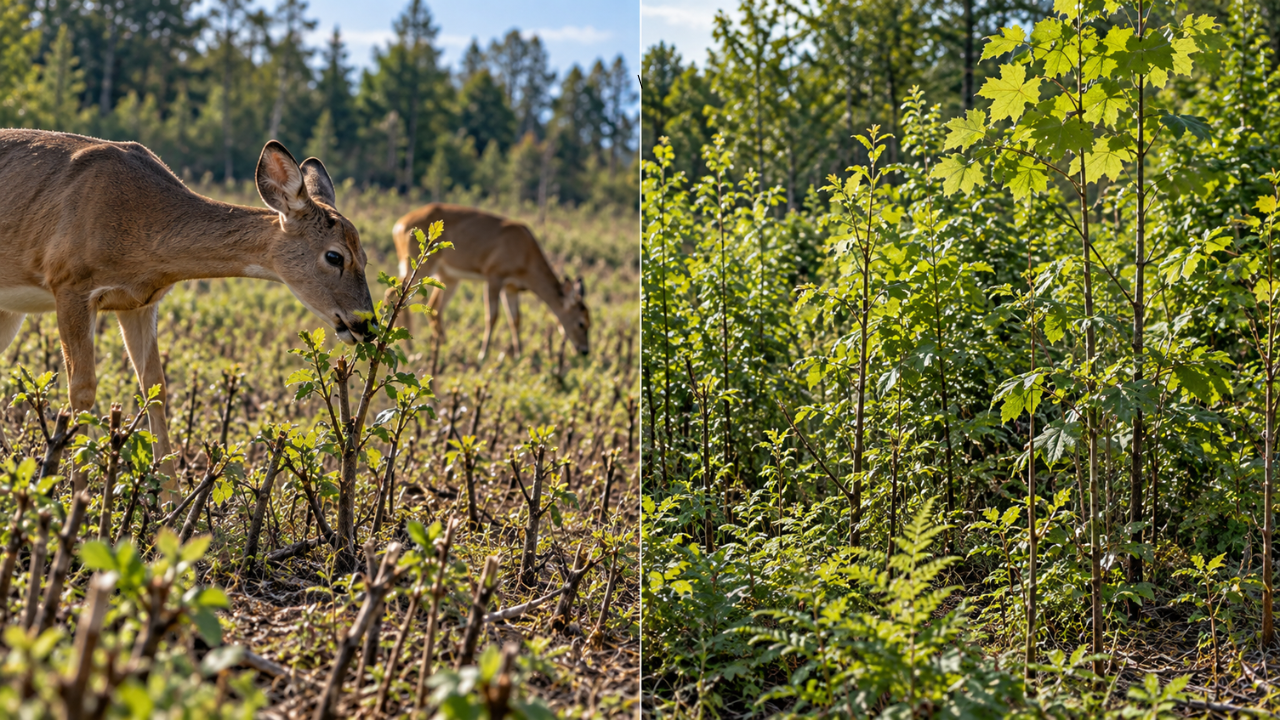
Image AI generated
How did deer change seedbank diversity and species composition
The study reports that, across all years, deer increased Shannon-Wiener diversity of germinated seeds by 8% relative to exclusion plots. Deer did not affect seedbank abundance or species richness. According to the authors, deer reduced abundance by 14%, but this effect was only marginally significant (P = 0.075). The seedbank analysis identified 144 species, of which seven each produced more than 10,000 emerged seedlings.The paper states that deer altered seedbank composition, although not the percentage of biennial or perennial species, or of native species. Among individual species, only 22% of emerged Rumex crispus seedlings came from browsed control plots, compared with 35% for Oxalis species and 69% for Panicum capillare. The authors note that the difference for P. capillare was not statistically significant.
How did deer browsing affect woody plants
According to the study, deer had little effect on aboveground plant communities in 2019 or 2022. Total cover, species richness, diversity, and the percentage of biennial or perennial and native species were not significantly affected by the exclosure treatment. Goldenrod (Solidago spp.) biomass in 2019 and height in 2021 were also unaffected.Woody plants showed a clear difference. The authors report that deer reduced woody plant abundance by 50%, with a mean of 22 ± 3 plants per 18 square metres in the exclusion treatment and 11 ± 4 in the browsed control (P = 0.044). Only the exclusion treatment had trees exceeding 1 cm diameter at breast height. The paper records seven Populus deltoides trees averaging 14.7 ± 2.6 cm and one Robinia pseudoacacia tree measuring 23.0 cm. Woody species made up only 47 of the 280,674 seedlings in the seedbank assay, and the authors conclude that the aboveground effect was a direct effect of deer browsing rather than a consequence of seedbank changes.
Why could deer browsing affect secondary succession forests
The authors conclude that deer increased seedbank diversity, altered its composition, and suppressed woody plants aboveground, and that these changes are likely to affect secondary succession. According to the paper, increased seedbank diversity might increase the feasibility of passive restoration, whereas suppression of woody plants would delay forest recovery. They also state that it is unlikely the seed bank would contribute much to shrub and tree recruitment, as woody species were barely represented in it.