A reef may be built from concrete and carefully engineered structures, but for young marine life, it appears that the right soundtrack could matter too. In Hawaiʻi, scientists have been experimenting with an unusual approach to reef restoration, playing the sounds of a healthy coral reef underwater and combining them with artificial structures designed to provide the biological cues young corals need to settle. The results offer an intriguing new direction for rebuilding damaged reefs, although researchers stress that attracting larvae is only an early step toward creating a functioning ecosystem.
Turning up the reef sounds
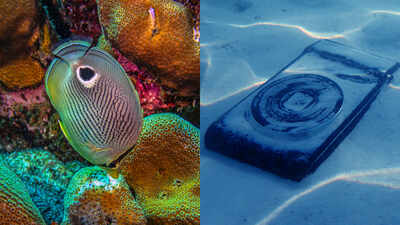
According to Nature, the experiment took place in Kāneʻohe Bay, off Oʻahu, where researchers placed 37 artificial structures on a sandy seafloor at depths of about 4.5 metres. An underwater speaker played recordings captured from a healthy reef from sunset through sunrise for two weeks.The recordings contained the familiar crackles and pops produced by reef organisms, including fish and snapping shrimp. Healthy reefs tend to be noisier than degraded ones, where declining animal populations can leave the underwater environment comparatively quiet.Because coral and fish larvae drift through the ocean before choosing where to settle, these sounds can act as environmental clues. The researchers wanted to see whether restoring that acoustic signal could make artificial habitats more attractive.
Adding bacteria to the equation
Sound was only one part of the experiment. Some of the artificial structures were coated with BRINK, a bioactive reef coating containing living bacteria.The idea comes from observations of natural reefs, where bacterial films on surfaces provide chemical cues that can help coral larvae identify suitable places to settle. By adding the living coating to artificial structures, researchers hoped to reproduce some of the signals normally found on healthy reef surfaces.The team conducted three experiments during coral spawning events in 2023 and 2024. Divers returned to the structures after the new moon and used specialised blue light and yellow filters to locate newly settled coral larvae.
Sound and surface worked together
The strongest coral settlement occurred on structures positioned closest to the underwater speaker. The bacteria-coated structures performed particularly well, suggesting that combining acoustic and biological cues may be more effective than relying on an artificial surface alone.Some structures featuring crevices also performed well alongside the sound. Separately, 3D-printed structures developed by the Hawaiʻi Institute of Marine Biology showed promising results when exposed to reef sounds.A companion fish study found a similarly striking response. Autonomous underwater cameras recorded fish larvae for up to three weeks at sites with either an active or silent speaker. The sound-enhanced site attracted between four and 14 times more fish larvae overall, with the pattern remaining after researchers switched the locations of the speakers.
A promising beginning, not a finished reef
The findings are encouraging, but they do not yet demonstrate that the approach can create a mature reef. The experiments measured settlement and larval abundance rather than whether the young organisms survived, grew into adults or ultimately established a functioning ecosystem.The fish results also represent a range rather than a single increase, and the experiments have so far been conducted at one location. Longer studies and trials at other reefs and during different seasons will be needed to determine whether the effect holds.The research forms part of a larger effort to develop hybrid reefs combining engineered structures with living coral. A planned project off Oʻahu could eventually put the concept into a much larger coastal-protection setting.Images Courtesy: istockFor now, the experiments suggest that reef restoration may involve more than providing a physical place to grow. Giving young marine life the right biological and acoustic signals could help guide them home.