
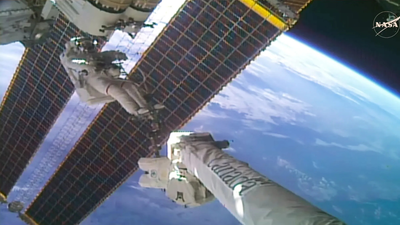
Nasa astronaut Anil Menon and Canadian Space Agency astronaut Joshua Kutryk completed a seven-hour, 11-minute spacewalk on October 29, installing and deploying the seventh roll-out solar array on the International Space Station (ISS). The operation marked Nasa’s 100th US spacewalk from the station and advanced a multi-year effort to increase its electricity-generating capacity. Working outside the orbiting laboratory, the astronauts fitted the new array to the station’s 2A electrical power channel and completed additional tasks ahead of another planned spacewalk on November 5. The final installation is expected to complete the solar-array upgrade, increasing the station’s available power by up to 30%. The milestone marked Menon’s fourth spacewalk and Kutryk’s first.
How Anil Menon and Joshua Kutryk installed the solar array
The spacewalk began at 7:57 am EDT, when the astronauts switched their spacesuits to battery power and exited the station through its Quest airlock. Menon was responsible for carrying out the installation alongside Kutryk, who moved along the station’s truss structure to reach the worksite.Menon used the Canadarm2 robotic arm to help transport the rolled-up solar array to its installation point on the station’s port-side truss, approximately 260 miles above Earth. The astronauts secured the array to its mounting structure and connected it to the station’s electrical system before deploying it.The spacewalk concluded at 3:08 pm EDT, after seven hours and 11 minutes. Nasa said the astronauts also completed preparatory tasks for the next spacewalk, scheduled for November 5.
What is the new roll-out solar array?
The International Space Station Roll-Out Solar Array, or IROSA, is a compact solar-power system designed to supplement the station’s original solar arrays. Unlike conventional rigid panels, these arrays are rolled up for transport and unfurl once installed in orbit.The technology allows additional solar-generating capacity to be delivered without requiring the large structures to be launched in their fully extended form. Once deployed, the arrays collect sunlight and convert it into electricity for the station’s systems and operations.The latest installation is part of a wider programme that began in 2021. Six additional roll-out arrays had already been installed before the October 29 spacewalk, with the seventh now in place and the eighth scheduled for installation during the next excursion.
How much power will the solar-array upgrade add?
The completed upgrade is expected to increase the ISS’s available power by up to 30%. Once all eight IROSAs are installed, the station’s electricity-generation capacity is expected to rise from approximately 160 kilowatts to around 215 kilowatts.The additional electricity will help support the station’s scientific research, operational systems and other critical activities. It is also intended to help meet the power requirements associated with the station’s eventual safe and controlled deorbit.The new arrays supplement the station’s original solar panels, which have experienced declining performance after years of exposure to the harsh conditions of space. The additional capacity is therefore important to maintaining the ISS’s operations as it approaches the later stages of its planned service life.
Nasa has another spacewalk planned for November 5
The October 29 operation was the penultimate installation in the solar-array upgrade programme. Menon and Kutryk are scheduled to conduct another spacewalk on November 5 to install and deploy the eighth and final IROSA on the station’s 3B electrical power channel.Nasa expects this installation to complete the power-system augmentation programme. The two astronauts carried out preparatory work during their latest excursion to help prepare for the next operation.The final spacewalk will mark the completion of a project that has progressively expanded the station’s electricity-generating capability since the first roll-out solar arrays were installed in 2021.
A milestone for Nasa’s spacewalk programme
The October 29 excursion was designated US spacewalk 100, marking the 100th spacewalk conducted from the ISS’s Quest airlock without a space shuttle docked to the station. It was also the 285th spacewalk supporting the assembly, maintenance and upgrading of the orbiting laboratory.For Menon, the mission marked his fourth spacewalk. Kutryk, representing the Canadian Space Agency, completed his first. The astronauts’ work combined a major station-power upgrade with a milestone in the history of human activity outside the ISS.With the seventh array now installed, Nasa is preparing for the final scheduled installation on November 5, which is expected to complete the station’s roll-out solar-array upgrade.