For years, a lone stone standing in Farley Wood near the town of Matlock in Derbyshire was thought to be an isolated monument with nothing much around it. That changed after George Bird, a 24-year-old amateur archaeologist and student, kept wondering what else the surrounding forest might be hiding and pushed for a closer look. According to a statement from Forestry England, the government agency that manages the site, excavations carried out with the archaeology series Time Team have now confirmed that the stone was never alone at all. It turned out to be one part of a much larger Bronze Age ceremonial complex, complete with a stone circle and a ceremonial platform, and carbon dating has placed the site at around 1,700 BCE, making it roughly 3,700 years old and a significant addition to the record of ancient monuments hidden across England’s forests. The discovery also suggests that much more prehistoric archaeology could remain hidden beneath Britain’s managed woodland.
How archaeologists uncovered a hidden Bronze Age ceremonial platform in Farley Wood
The Farley Moor standing stone itself is no small marker, rising 2 metres tall and half a metre wide, making it the third largest stone among the Gritstone Moors that stretch across the Peak District and Yorkshire Dales. What the team found beside it changed the picture entirely. Excavations revealed a ceremonial platform positioned right next to the stone, and crucially, the platform predates the standing stone itself. According to Forestry England’s Lead Historic Environment Advisor Dr Lawrence Shaw, that sequence suggests continuous ritual use of the site over hundreds of years, closely tied to water and the importance it held for Bronze Age communities. The main stone had also been deliberately placed directly above a natural spring, a detail that points to the site being chosen with real intent rather than convenience.
Why the 5 other stones nearby reshaped what researchers thought they knew about the site
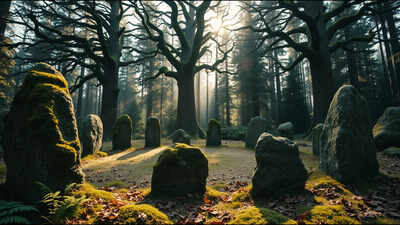
The investigation did not stop at the platform. Archaeologists identified 5 additional stones near the main one and determined that these had also once stood upright, together forming a stone circle or oval measuring roughly 25 metres by 23 metres. That single discovery is what turned what looked like a modest lone marker into a genuine prehistoric monument, and it now joins a documented group of 25 other stone circles already known across the Peak District. Dr Derek Pitman, an archaeologist and anthropologist at Bournemouth University who worked on the excavation, said the scale of activity likely present in that landscape highlights the reach of Bronze Age ritual life well beyond famous sites like Stonehenge. A wider landscape survey conducted alongside the dig also suggested there is potential for more undiscovered prehistoric monuments in the surrounding area, including additional stone circles yet to be identified.
What the Farley Moor stone circle reveals about England’s forests as archaeological archives
The scale of what the forest was hiding puts the discovery in a much larger context. Forestry England manages 1,500 woods and forests across the country, and according to the agency, these forests collectively protect nearly 100,000 known archaeological sites and monuments, including 750 scheduled monuments and 30 registered parks and gardens. Even though the Farley Moor site is not formally a scheduled monument, Forestry England has said it will manage and protect the entire circle as though it were one, in order to preserve it. Archaeologists now plan to return to the site next summer for a longer and more detailed investigation, aiming to answer questions the discovery has already raised, including exactly when the site was first built and how large the larger ceremonial complex actually is. For a forest that many visitors know mainly for its trees and trails, the find is a reminder of how much history can sit quietly underfoot until someone is curious enough to ask what else might be there.