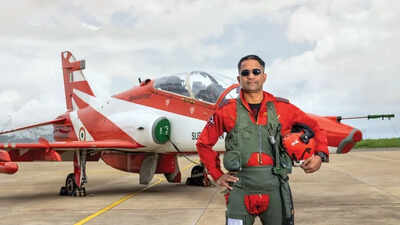
PUNE: For three decades, the scarlet-and-white trails of the Suryakiran Aerobatic Team have painted the Indian skies with precision, discipline and spectacle.But beyond the breathtaking loops, barrel rolls and synchronized formations lies a deeper story, one of national pride, technological evolution and the relentless pursuit of excellence within the Indian Air Force (IAF).As the team completes 30 years, Commanding Officer Group Captain Ajay Dasarathi says the journey of Suryakiran is inseparable from the journey of the IAF itself.“Thirty years of Suryakiran have been defined by precision and excellence. The team has mirrored the growth of the Indian Air Force,” Group Captain Dashrathi told TOI. “Today, both the team and the service it represents have a global footprint and earn admiration not just in our neighbourhood but on the world stage.”From airshows in India to international events like the Dubai Air Show, the nine-aircraft aerobatic team has emerged as one of the most visible symbols of India’s aviation prowess.According to Dasarathi, the biggest achievement of the team is not merely operational or technical — it is emotional.“We have inspired billions of people, especially children. We have also carried the tricolour overseas, strengthening diplomatic bonds and instilling pride among the Indian diaspora,” he said.“That ultimately contributes to the nation by inspiring future generations to serve the country.”
Among the world’s elite
Suryakiran today stands among a rare class of aerobatic teams globally. It is one of only three nine-aircraft aerobatic teams in the world — a distinction that reflects the complexity and precision demanded by such displays.Yet, Dasarathi avoids direct comparisons with other global teams.“Every aerobatic team is unique in how they perform and the challenges they overcome,” he said.“But considering the invitations we receive from abroad and our performances at major international events, we can confidently say we are second to none.”The recognition, he noted, is a reflection not only of the pilots but also of the technicians and support crew who ensure that every sortie is executed flawlessly.“Our aircrew and technicians are capable of putting on a show at par with any aerobatic team in the world. That has led to recognition within the international aviation community,” he added.
A legacy that predates Suryakiran
Though the Suryakiran team formally came into existence in 1996 flying the Kiran Mk-II jet trainers, Dasarathi pointed out that the roots of military aerobatics in India go much deeper.“The journey did not begin with the Kiran aircraft,” he explained. “Its lineage can be traced back to the ad hoc aerobatic teams of the 1960s and formally to the Thunderbolts flying the Hunter aircraft.”The evolution from Hunters to Kirans and eventually to the Hawk Mk-132 advanced jet trainer reflects the transformation of the Indian Air Force itself — from legacy combat platforms to modern, agile systems.“Each aircraft brought its own capabilities and limitations,” Dasarathi said. “The team has relentlessly worked to understand every platform and devise displays that showcase not only the aircraft but also the skill of IAF aircrew.”Modern display flying, he explained, demands far more than aerial flair.“Today’s aircraft are agile, capable of sustaining high G-forces and operating at low subsonic speeds. The display profile and training have evolved to exploit those capabilities while safely demonstrating what a modern fighter aircraft can do.”
The milestone years
Among the many milestones in the team’s history, Dasarathi singled out two defining moments from the past decade.The first was the re-induction of the team in 2015 after a temporary disbandment.“Rebuilding the formation and revalidating display profiles from six to nine aircraft by 2017 was one of the most challenging phases,” he said. “It demanded exhaustive training, stringent safety procedures and unmatched team cohesion.”The second was the massive airshow in Chennai in October 2024 , a landmark event that tested the team’s technical and operational capabilities at an unprecedented scale.“The Chennai Air Show remains one of our most memorable and demanding displays,” he recalled. “The debut of the indigenously designed tricolour smoke system before a world-record crowd of 1.7 million spectators was a major milestone.”The event demonstrated not only aerial precision but also India’s growing indigenous aerospace capability.
Eyes on the future
Even as the team celebrates its rich legacy, its focus remains firmly on the future and on inspiring the next generation to wear the uniform.“The future of Suryakiran is to motivate the youth to join the Indian Air Force and serve the nation,” Dasarathi said.He added that the team is currently well-settled on the Hawk aircraft platform and will continue flying the same aircraft in upcoming display seasons.“The team is settled in the current aircraft and will continue flying it in the coming years,” he said, while hinting at future developments. “As for new formations and international shows, you will be the first to know when it happens.”The emphasis on indigenous capability is also expected to grow further.“The Indian Air Force is steadily strengthening indigenous capability across all operations and platforms,” Dasarathi said.“As ambassadors of the IAF, we look forward to greater integration of Indian systems and technologies that showcase the nation’s growing aerospace self-reliance.”
The making of a Suryakiran pilot
While the public often associates aerobatic flying with daredevilry, Dasarathi insists that Suryakiran flying is fundamentally about discipline and refinement of basic fighter flying skills.“A pilot does not start training for Suryakiran only after joining the team,” he said.“The display manoeuvres are iterations of skills that a fighter pilot has learned throughout his career.”What distinguishes a Suryakiran pilot, however, is the ability to execute those manoeuvres with microscopic margins for error.“Focus, maturity, teamwork and the ability to handle high-performance machines safely in a high-risk environment are essential,” he said.Display flying close to the ground and before massive crowds places enormous psychological and physical demands on the pilot.“The pilot has to constantly evaluate options every second and become almost one with the machine,” Dasarathi explained.“It is the ultimate marriage of technology, passion and skill.”Preparation for every airshow begins long before take-off. Pilots spend hours studying terrain, obstructions and crowd layouts unique to each venue. This is followed by detailed briefings and “chair flying” sessions — a mental rehearsal where pilots visualize every manoeuvre, radio call and control input.“The brain effectively rehearses the entire display from take-off to landing,” he said. “And perhaps the most important preparation is still getting a good night’s rest before the display.”
Inspiring the next generation
Beyond spectacle and military diplomacy, Dashrathi believes the team’s primary mission remains inspiration.“The core duty of Suryakiran is to inspire the next generation by instilling national pride and planting the seeds of aspiration,” he said.Every Suryakiran pilot, he said, was once a child watching aircraft streak across the sky.“SKAT showcases that anyone can achieve this through hard work, discipline and an unrelenting pursuit of perfection.”Social media has significantly expanded the team’s reach, allowing it to connect with millions of young Indians beyond physical airshow venues.“The armed forces need capable and motivated youngsters to carry the baton forward,” Dasarathi said. “Suryakiran has always played a major role in that effort and will continue to do so.”As the team celebrates its 30th anniversary, its message to the nation remains simple but powerful.“Dream big, remain disciplined and never stop pushing your limits,” Dasarathi said. “The sky rewards dedication, courage and professionalism.”