Sleep is supposed to be the one time a body fully lets its guard down. Eyes closed, muscles relaxed, awareness fades, and for most of us, that’s exactly the point.But out in the wild, going fully unconscious for hours at a stretch isn’t always an option. Predators don’t wait for a convenient time, water doesn’t stop moving, and worldly mechanisms of the animal world don’t pause just because an animal needs rest.So some of the rare species evolved a strange workaround. Instead of shutting down completely, they let one half of the brain sleep while the other stays switched on.And this becomes obvious in a strange looking bizzare appearance on the outside as an animal resting peacefully with one eye wide open, quietly watching the world while the rest of it drifts off, scientifically known as unihemispheric slow-wave sleep.This survival trick can be spotted on all spheres of the Earth in the creatures that dot the oceans, skies, and riverbanks.Here are five animals that have mastered this unusual survival tactic:
Representative Image
Dolphins
Dolphins are the classic example of this phenomenon. Since they’re air-breathing mammals living entirely in water, going fully unconscious would mean drowning. So one half of the dolphin’s brain rests at a time while the other stays alert, keeping the animal swimming, surfacing for air, and watching for danger, and also while genuinely resting.
Mallard ducks
Mallard ducks use the same half-brain trick, but for a different reason. When resting in a group, ducks positioned on the outer edge tend to keep their outward-facing eye open, watching for predators, while birds in the centre sleep more fully. However, ducks reposition and switch which eye stays open depending on where they end up in the group.
Crocodiles
A study on juvenile saltwater crocodiles found they frequently rest with just one eye closed, and that this behaviour becomes more common when a person or another crocodile is nearby. The open eye consistently faces the perceived source of interest. Researchers believe this suggests half-brain vigilance during sleep may be an evolutionarily ancient trait, shared far back in the family tree connecting reptiles, birds and mammals.
Fur seals
Fur seals are a particularly interesting case because they live both on land and in water. Their sleep pattern changes depending on the setting. In water, they depend more heavily on the one-eye-open, half-brain approach, similar to dolphins. On land, where the threat of drowning disappears, they tend to sleep more like typical land mammals, with both hemispheres of the brain resting together.
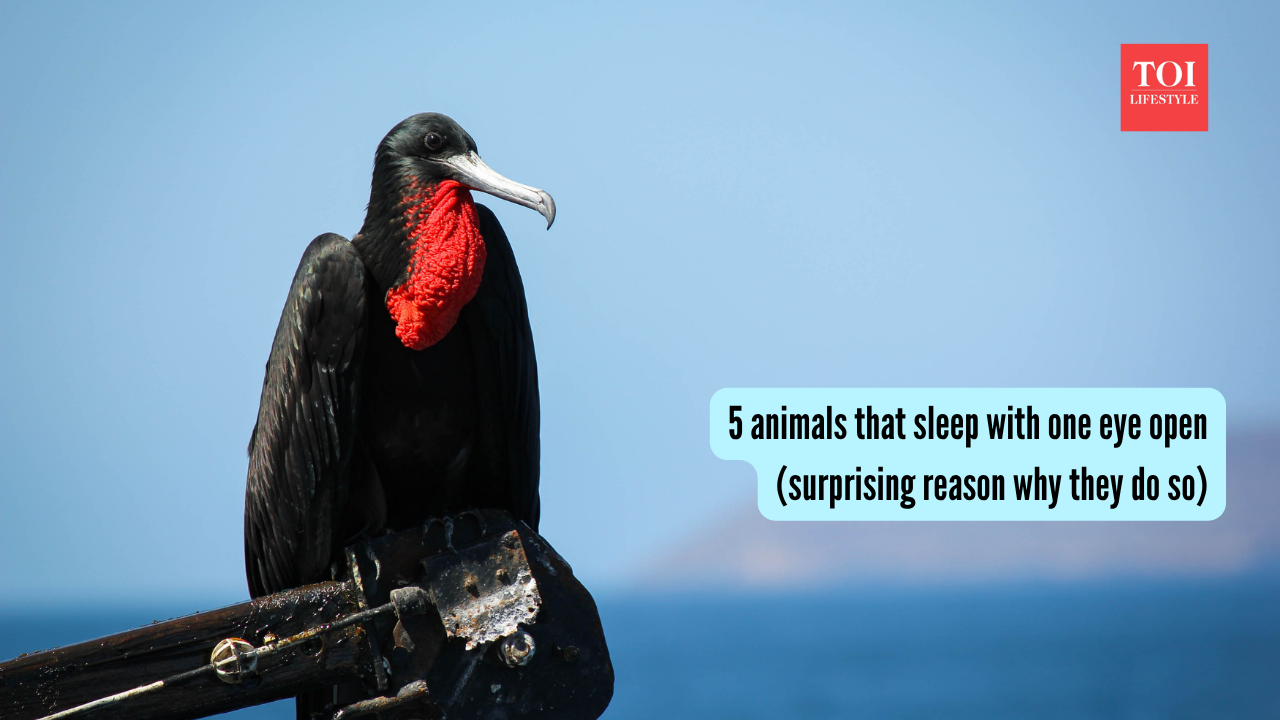
Frigate birds
Frigate birds take this adaptation to an extreme few animals can match. During long ocean crossings that can last for days without landing, these birds enter brief bouts of unihemispheric sleep while still airborne, resting one half of the brain at a time so they can keep flying safely. Even with sharply reduced total sleep, their flight performance and attentiveness stay largely intact.