
For generations, the Canaanites have occupied a curious space between archaeology and biblical tradition. Mentioned repeatedly in the Hebrew Bible as the inhabitants of the land before the rise of ancient Israel, they have often been viewed through the lens of scripture rather than material evidence. Now, a remarkable discovery in southern Israel is offering a rare glimpse into their world. Archaeologists have uncovered a 5,500-year-old flint blade production centre near Kiryat Gat, dating to the Early Bronze Age. Far from being a modest workshop, the site appears to have functioned as a highly organised manufacturing hub, producing precision-crafted tools on a scale rarely seen from this period. The find not only sheds light on the technological abilities of ancient communities but also reveals a society already displaying signs of economic specialisation, skilled labour and regional trade.
Ancient Israel discovery reveals advanced Canaanite technology from the dawn of the Bronze Age
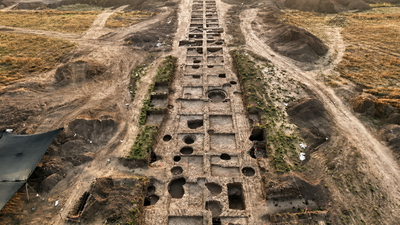
The excavation, carried out by the Israel Antiquities Authority (IAA) at Nahal Qomem near Kiryat Gat, uncovered what researchers describe as the first-known large-scale Canaanite blade workshop identified in southern Israel. The site contained enormous flint cores, carefully shaped stone blocks from which long, razor-sharp blades were produced. Archaeologists also uncovered hundreds of underground pits that served various purposes, including storage, craft production and ritual activity.In a statement reported by The Times of Israel, the Israel Antiquities Authority (IAA), researchers highlighted the sophistication of the technology:“The most impressive findings discovered at the site are large flint cores, from which extremely sharp, uniformly shaped blades were produced.”The authority added:“The blades themselves were used as knives for cutting and butchering, and as harvesting tools, like sickle blades.”These were not rough stone tools fashioned for immediate use. The blades exhibit remarkable consistency in size and form, indicating a standardised production process that required extensive expertise. Archaeologists noted that specialised techniques were employed to exert controlled pressure on the flint, allowing craftsmen to detach long, uniform blades with extraordinary precision.
Archaeologists uncover first-known Canaanite blade production centre with evidence of mass manufacturing
One of the most striking aspects of the discovery is its scale. Rather than representing a household industry, the workshop appears to have functioned as a dedicated manufacturing centre supplying tools across a much wider region.Dr Jacob Vardi, a prehistorian with the Israel Antiquities Authority, explained:“This is a sophisticated industry, not only because of the tools themselves, but also because of what is not found.”He continued:“The waste fragments, the debitage, were not scattered outside the site, perhaps to better protect and preserve the professional knowledge within the group of experts.”That observation offers a fascinating insight into how knowledge may have been managed nearly six millennia ago. The careful control of manufacturing waste suggests that blade production was not an open craft but a specialised profession, potentially restricted to a small group of trained artisans.According to the IAA, the workshop likely acted as a distribution centre for tools used across the Levant. Such an operation points to established trade networks and organised economic systems much earlier than many people might expect.
What the 5,500-year-old workshop reveals about biblical-era societies, trade and urbanisation
The significance of the discovery extends well beyond the blades themselves. Archaeologists believe the site provides valuable evidence for understanding the social transformation taking place during the Early Bronze Age, when small agricultural communities were gradually developing into larger, more complex settlements.The Israel Antiquities Authority stated:“This is clear evidence that already at the onset of the Bronze Age, the local society here was organised and complex, and had professional specialisation.”The authority further noted:“The discovery of a sophisticated workshop indicates a society with a complex social and economic structure already at the beginning of the Early Bronze Age.”For historians, that conclusion may be the most important aspect of the find. The workshop demonstrates that technological expertise, economic organisation and specialised labour were already emerging in the southern Levant around 3500 BCE. These developments formed the foundations upon which later urban centres would be built.While it would be misleading to claim that the discovery “proves” every biblical account, it does provide tangible archaeological evidence of sophisticated societies living in the region traditionally associated with the Canaanites. It paints a picture of communities that were innovative, organised and connected through trade long before written records became widespread.Thousands of years later, the sharp edges of those flint blades still tell a surprisingly modern story: knowledge had value, expertise created influence, and technology helped shape the rise of civilisation itself.