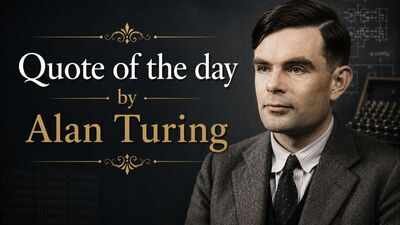
Long before anyone had built a machine capable of holding a real conversation, Alan Turing was already asking what would happen the day one finally could. “If a machine can think, it might think more intelligently than we do, and then where should we be?” he said, posing a question that sounded almost like science fiction in his own time and now sounds closer to a live policy debate. Turing was not raising this as an abstract curiosity. He was one of the people actually building the earliest machines capable of anything resembling thought, which meant he was also one of the first people forced to ask what it would mean if his own creation eventually thought better than he did.
Quote of the day by Alan Turing
“If a machine can think, it might think more intelligently than we do, and then where should we be?”
Where this line comes from: A 1951 BBC broadcast
Turing said this during a BBC radio broadcast titled “Can Digital Computers Think?”, aired on the fifteenth of May, 1951, as part of a series on early computing machines. He went on, in the same broadcast, to note that even keeping such machines in a subservient position, switching off the power at strategic moments, would still leave humanity feeling greatly humbled as a species.The broadcast came only a year after his landmark paper Computing Machinery and Intelligence, which had introduced what later became known as the Turing test, a practical way of asking whether a machine could convincingly imitate human conversation. The BBC talk pushed the implications of that question further, moving from whether a machine could think at all to what would follow if it could think better than the humans who built it.The series itself, Automatic Calculating Machines, featured several other British computing pioneers alongside Turing, reflecting how seriously the topic was already being taken by the scientific establishment barely a decade after the first working electronic computers had been built. Turing’s contribution stood out even within that company for how directly he was willing to follow the logic of machine intelligence to its most uncomfortable conclusions, rather than reassuring listeners that human superiority was safely permanent.
What is the meaning of the quote
The quote is built around a conditional that Turing takes seriously rather than dismisses. Most people, when imagining a thinking machine, picture something roughly equivalent to human intelligence, a clever assistant rather than a superior mind. Turing’s question refuses that comfortable assumption. If thought is something a machine can genuinely achieve, he is arguing, there is no obvious reason it would stop at matching human intelligence rather than exceeding it.The second half of the sentence, “then where should we be,” is doing the real work. It is not a request for a technical forecast. It is a question about status and control, asked by someone who had spent his career treating machines as tools that extended human capability, suddenly confronting the possibility that the relationship could reverse.There is also something notably restrained about how Turing phrases the concern. He does not predict catastrophe or make dramatic claims about machines turning hostile. He simply asks where humanity would stand, a question that leaves the answer genuinely open rather than assuming the worst. That restraint is part of what makes the line still feel credible rather than alarmist more than seventy years later.
Turing’s own answer to the question he raised
Turing did not leave the question entirely open. In the same broadcast, he suggested that even if humanity retained a formal ability to control such machines, for instance by having the power to switch them off, the mere existence of something that could out-think its creators would be enough to humble the species regardless of who technically remained in charge.That distinction matters. Turing was not necessarily predicting that machines would seize control in any dramatic sense. He was pointing at something quieter and, in some ways, more unsettling: a shift in humanity’s sense of its own place at the top of the intellectual hierarchy, whether or not machines ever exercised power to match that shift in status.
Why the question feels sharper in the age of AI
Turing’s question has moved from theoretical to genuinely practical territory far faster than most of his contemporaries expected. Modern AI systems now write, translate, summarise and generate code at a scale and speed no individual human could match, even though the deeper question of whether any of this constitutes thinking in Turing’s original sense remains as contested as it was in 1951.The computer scientist Stuart Russell, in his 2019 book Human Compatible, revived a version of Turing’s concern under the label of the control problem, the challenge of ensuring that increasingly capable AI systems remain aligned with human intentions even as their capabilities exceed human oversight in specific domains. Russell’s argument, decades after Turing’s broadcast, is essentially a more technical restatement of the same worry: capability racing ahead of certainty about who, or what, actually remains in control of the outcome.What has changed since 1951 is mainly the scale of the systems being discussed, not the underlying shape of the question. Turing was reasoning from first principles about machines that barely existed yet. Russell and his contemporaries are reasoning about systems already deployed at global scale, trained on more text and data than any individual human could review in several lifetimes. The gap between building a capable system and fully understanding what it will do has, if anything, widened rather than closed in the decades since Turing first raised the concern.
How to apply this quote in daily life
You do not need to be building artificial intelligence to feel a smaller version of Turing’s question in daily life. Any time a person hands a decision over to a system they do not fully understand, an algorithm recommending what to buy, a navigation app choosing a route, a scheduling tool allocating their time, a miniature version of the same trade-off appears. The tool may be more efficient than manual judgement, but efficiency and understanding are not the same thing, and losing track of that difference has a cost even at a much smaller scale than Turing was imagining.A useful habit is to periodically ask, of any tool or system you have come to rely on, whether you could still explain the reasoning behind its output if asked to. If the honest answer is no, that is not necessarily a reason to abandon the tool, but it is worth noticing, since the gap between using something and understanding it is exactly the gap Turing was pointing at, just at a scale most people will never personally encounter.
Other famous quotes by Alan Turing
- “We can see only a short distance ahead, but we can see plenty there that needs to be done.”
- “The original question, ‘Can machines think?’ I believe to be too meaningless to deserve discussion.”
- “I believe that at the end of the century the use of words and general educated opinion will have altered so much that one will be able to speak of machines thinking without expecting to be contradicted.”
- “It is customary, in a talk or article on this subject, to offer a grain of comfort… I cannot offer any such comfort, for I believe that no such bounds can be set.”