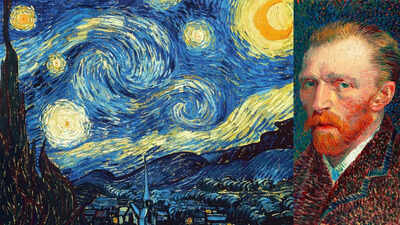
Most people look at The Starry Night and see a moonlit village beneath a sky alive with swirling stars. Scientists looked at the same painting and saw something else entirely. Hidden within those famous blue spirals is a pattern that resembles one of nature’s most complex phenomena called turbulence.The Starry Night was painted by Vincent van Gogh in June 1889 while he was staying at the Saint-Paul-de-Mausole asylum in southern France. The work has often been linked to his mental state at the time. He had admitted himself there after a severe breakdown, and many art historians have read the painting as an expression of inner chaos and intense emotion.It has since become one of the world’s most recognisable works of art, reproduced on everything from mugs and T-shirts to phone covers. Yet its biggest surprise was uncovered not by art historians, but by physicists.
The water flowing
Turbulence is a common phenomenon in nature. It appears in flowing rivers, ocean currents, rising smoke, storm clouds and even blood moving through the body. Instead of flowing in straight lines, fluids form swirling structures that break apart and reform again. These structures are chaotic, yet not completely random.In 1941, Russian mathematician Andrey Kolmogorov developed a statistical theory explaining how energy moves through turbulent flows. More than six decades later, researchers wondered if Van Gogh’s painted sky followed similar rules.When they analysed the brightness of different parts of The Starry Night, they found that the changes in light closely matched the statistical patterns expected in turbulent motion. The results, published in Physics of Fluids, suggested that the painting captured the visual rhythm of turbulence with striking accuracy.Turbulence appears everywhere in the painting. It appears in smoke rising from a fire, clouds moving across the sky, rivers rushing around rocks and even cream swirling into a cup of coffee.
Art first, science later
The finding does not mean Van Gogh secretly understood advanced mathematics. Researchers believe the artist achieved it through extraordinary observation rather than scientific calculation.Van Gogh may have been extremely sensitive to how movement appears in nature. He spent long hours observing skies, landscapes and light conditions.He painted what he saw and felt, capturing the movement of the night sky so convincingly that modern physics recognised familiar patterns within it.
The science isn’t settled yet
Turbulence remains one of the hardest problems in physics. Even today, scientists cannot fully predict it with complete accuracy, despite its importance in weather systems, aviation, ocean currents and astrophysics.The Starry Night sits at the intersection of art and a problem physics still struggles to solve. That uncertainty is part of why continues to attract scientific interest.For the same reason, researchers have also compared turbulence-like patterns in paintings such as Chain Pier, Brighton by John Constable, and even in images of Jupiter’s Great Red Spot captured by NASA’s Voyager 1 spacecraft in 1979.Today, The Starry Night is displayed at the Museum of Modern Art in New York.