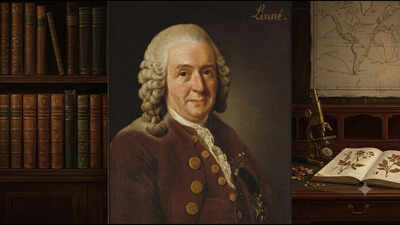
Throughout time, man has always searched for his rightful place within nature. Man is one and the same biological entity as every other living thing, but he possesses unique capabilities of reasoning and questioning which distinguish him from all other species and give him a special vantage point within nature. This idea was examined by Carl Linnaeus in the following quotation: “Man is the only animal endowed with reason, and should therefore know where nature does not. In man nature attains its highest degree, but in man’s consciousness there is nothing essential either of himself or nature.”Carl Linnaeus (1707-1778) was a Swedish botanist, zoologist and physician best known for developing the system of biological classification and the two-part scientific naming system still widely used today. His work gave scientists a common framework for identifying and organising living organisms and earned him a lasting place in the history of natural science.
Quote of the day by Carl Linnaeus
“Human beings, having, above all creatures, received the power of reason, need to be aware where nature is unaware. Nature reaches its culmination in humans, but human consciousness has not its essence in itself or nature”
What does this quote mean?
Linnaeus suggests that human beings occupy a distinctive position in nature because we possess the ability to reason about the world around us. Other organisms respond to their environments, but humans can consciously study those processes, question them and consider their consequences. The quote therefore presents consciousness not merely as a privilege, but as something that carries responsibility.
Humans can observe the world that made them
There is something remarkable about being part of nature while also being able to study it. Humans can examine their own bodies, trace the evolution of species and investigate the laws governing distant stars. We can stand inside a forest and simultaneously think about how that forest functions as an ecosystem. This ability to step back and reflect gives us a unique relationship with the natural world.
Reason brings responsibility with it
Knowing more also means being capable of making choices. Humans can alter landscapes, redirect rivers, breed plants and animals, extract resources and transform entire ecosystems. Because we understand at least some of the consequences of these actions, Linnaeus’ argument can be read as a reminder that awareness should lead to responsibility. The ability to understand nature should not become a licence to exploit it without limits.
Nature does not need to explain itself to exist
A tree does not need to understand photosynthesis to carry it out. A bird does not need to study migration before flying thousands of kilometres. Nature operates through processes that existed long before humans developed scientific explanations for them. Linnaeus’ reflection highlights the unusual position of humanity: we are capable of asking why these processes occur, even though the natural world itself simply continues to function.
The more we understand nature, the more connected we become to it
Scientific knowledge has repeatedly challenged the idea that humans exist completely apart from the rest of life. Biology shows our connections with other species, genetics reveals shared ancestry and ecology demonstrates how dependent human societies are on healthy natural systems. Understanding nature therefore does not necessarily place us above it. In many ways, it reveals how deeply we are embedded within it.
Consciousness changes how we see our place in the world
Humans have the capability of being aware of themselves and hence can think about not only what is happening right now, but also what will happen in the future. They can envision the future and can ponder about what a climate change will mean for future generations; what the loss of a species will result into, and whether some actions should be undertaken just because they are possible.
Why this quote still matters today
Linnaeus existed many centuries ago when environmental sciences had not been invented yet, but his quote is relevant to the present-day issues of humanity. On one hand, people have a rare gift of comprehending nature and changing it according to their needs; on the other hand, there is always a price for the above-mentioned abilities. In order to emphasize the responsibility of humans toward the environment, Linnaeus urges people to recognize that reason is not only a sign of human supremacy but also an indication of the awareness of being a part of the environment.