
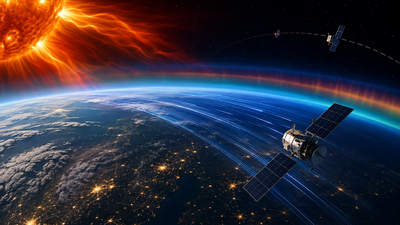
Earth’s atmosphere does not simply end where airplanes stop flying. Far above the planet, in a region known as the thermosphere, an extremely thin layer of gas continues to interact with satellites orbiting Earth. Changes in this region may seem insignificant, but they can alter atmospheric drag and gradually affect the paths of spacecraft. These changes become particularly important when activity from the Sun causes the upper atmosphere to heat up and expand. As the number of satellites operating in low Earth orbit continues to increase, predicting these changes has become an increasingly important challenge. NASA is now looking for new, affordable technologies that could help provide a clearer picture of this difficult-to-measure region. According to National Aeronautics and Space Administration (NASA), the agency is offering up to $500,000 through its Orbital Clarity Challenge to support new technologies that can measure these changing conditions and improve predictions of their impact on satellite orbits.
Why the upper atmosphere matters
The thermosphere is an extremely thin region of Earth’s atmosphere, but it still creates drag for satellites travelling through low Earth orbit. Even slight changes in atmospheric density can affect how much resistance a spacecraft experiences.Space weather is one of the main factors behind these changes. Activity from the Sun can send energy into Earth’s upper atmosphere, causing it to heat and expand. When this happens, atmospheric density can increase at altitudes where satellites operate, producing additional drag.Over time, that drag can slow a satellite and change its orbit. For satellite operators, predicting these changes is important for planning orbital adjustments and understanding how spacecraft may behave during periods of increased solar activity.
NASA is seeking new solutions
NASA’s Orbital Clarity Challenge is focused on finding low-cost technologies capable of measuring conditions in the thermosphere. The agency is specifically seeking approaches that can measure atmospheric density, pressure or drag in low Earth orbit. The emphasis is on affordability and scalability. Rather than depending only on expensive scientific instruments, NASA wants to explore technologies that could potentially be manufactured in larger numbers and deployed across commercial spacecraft.More widespread measurements could provide scientists with valuable information about how the upper atmosphere changes over time and how it responds to solar activity. This data could also help improve models used to predict atmospheric drag and its effect on satellite orbits.
Up to four winners could benefit
The competition will be conducted in three phases, with NASA planning to advance up to four winning concepts. The selected teams could receive up to $500,000 in prize money across the challenge. NASA also plans to provide the winning teams with a test flight at no cost after the competition. The aim is to help move promising concepts closer to becoming flight-ready technologies within a 12-month period.The challenge opened on August 19, 2026, and is part of NASA’s TechLeap Prize programme. According to NASA, the initiative involves the agency’s Heliophysics Division, Flight Opportunities programme and Center of Excellence for Collaborative Innovation.
Why better data could help
The challenge addresses a problem that is becoming more important as low Earth orbit grows increasingly crowded. Satellites depend on accurate predictions to maintain their orbits, but changing atmospheric conditions introduce uncertainties that are difficult to measure. Better and more widely available observations could help scientists understand how the thermosphere behaves during changing space-weather conditions. Improved data may eventually lead to more accurate predictions of atmospheric drag and the orbital changes experienced by satellites.NASA’s $500,000 Orbital Clarity Challenge is therefore about more than developing a new instrument. It is an effort to find practical and scalable ways to better understand one of Earth’s least accessible atmospheric regions, and to improve predictions that could help satellites navigate an increasingly busy environment in space.
Would you support funding for research into low-cost atmospheric measurement technologies?
3k+ users shared opinion today
5k+ users already voted today
3k+ users shared opinion today