
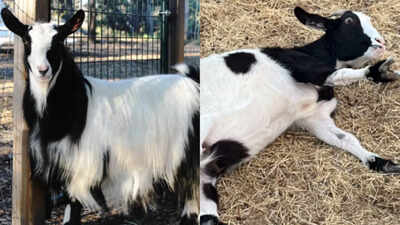
A viral video that has received more than 5.4 million likes shows a baby goat jumping down from a small staircase before suddenly freezing with all four legs stiff and toppling over. Within seconds, it gets back on its feet and starts moving again. While it may look as though the animal has fainted, that is not what actually happens. The behaviour is caused by a muscle condition known as myotonia congenita.These animals are called myotonic goats, also known as fainting goats. They do not lose consciousness. Instead, they have a rare inherited muscle condition called myotonia congenita, which causes their muscles to become temporarily stiff when they are startled or make a sudden movement.The unusual behaviour has made these goats famous around the world. Scientists and breeders have studied the breed for many years to understand how the condition affects the animals and why they are different from other goats.
The fainting goats
The history of myotonic goats goes back to the 1880s in the United States. Historical records say that a farm labourer named Tinsley arrived in central Tennessee with four unusual goats and a zebu cow. He worked there for a few years before moving away.His employer, Dr Mayberry, bought the goats along with their offspring. Those animals became the foundation of what is now recognised as the myotonic goat breed.The breed’s original source remains unknown. Researchers believe the goats must have originated somewhere else, but there is no clear evidence showing where they first came from.The muscle stiffness has led to many names for the breed over the years. People have called them fainting goats, stiff-leg goats, wooden-leg goats, nervous goats, scare goats and myotonic goats.
They do not actually faint
According to Dr Phillip Sponenberg, a leading expert on the breed, the condition affects only the muscles, The Guardian reported. When a goat is surprised, moves quickly or even steps over a small obstacle, its muscles suddenly become rigid. This stiffness may cause the animal to lose its balance and fall.However, the goat remains fully conscious throughout the episode. This muscle stiffness usually lasts only a few seconds before the muscles relax again and the goat gets back on its feet. Scientists say the condition is caused by changes in ion channels in the membranes of muscle cells. To understand this simply, muscles work because tiny charged particles move in and out of muscle cells through special pathways called ion channels.In myotonic goats, these channels do not work normally. As a result, the muscles cannot relax immediately after they contract. Instead, they stay stiff for a short time before returning to normal.Since the condition is limited to the muscles, it has nothing to do with the goat’s intelligence or nervous system.
Why farmers value them
In Tennessee, farmers mainly raised myotonic goats for meat. They were also easier to manage than many other goat breeds because they were poor jumpers and climbers. Unlike most goats, which can easily escape fences by climbing or jumping, myotonic goats usually stay within fenced areas.Because they are less agile climbers than many other goats, they are also less likely to damage vegetation by climbing trees or steep areas.During the 1950s, some ranchers in Texas bought these goats and began raising them there as well. Experts say the Tennessee and Texas populations both came from the same original animals and still share many similar characteristics.The breed is also known for good reproductive performance. Female goats often show strong maternal behaviour and successfully raise their young.Early studies have suggested that myotonic goats may have some resistance to parasites compared with certain other goat breeds.
Muscular stiffness
One important feature of the breed is its heavy muscling. Experts say myotonic goats generally have thicker muscles than many other goat breeds of similar size.Preliminary work at Virginia State University suggested that these goats may have a meat-to-bone ratio of about 4:1, compared with around 3:1 in many other goat breeds.Researchers say these findings are still preliminary. It may seem logical to think that permanently stiff muscles would produce tough meat. However, breeders say the opposite is true.According to those who have compared different goat breeds, myotonic goats are often praised for producing tender meat despite the temporary muscle stiffness seen while the animals are alive. Experts say the muscle condition does not make the meat tough.