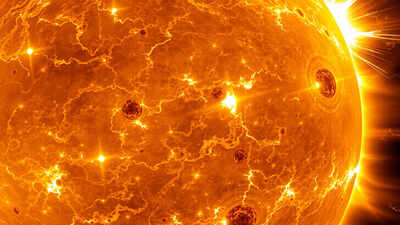
BENGALURU: More than a century of observations from India’s historic Kodaikanal Solar Observatory, operated by the Indian Institute of Astrophysics (IIA), Bengaluru, has helped scientists uncover new clues about how the Sun’s surface responds to its 11-year activity cycle.The findings, based on an analysis of 34,000 images collected since 1907, could improve understanding of the processes that drive solar activity and eventually aid efforts to predict changes that affect the space environment around Earth, as per the Department of Science and Technology (DST). IIA is an autonomous institute of DST.The Sun may appear calm from a distance, but its surface is constantly in motion. Hot material rises from the interior and sinks again, creating a pattern somewhat like boiling water in a pot. These movements produce enormous cellular structures on the solar surface, known as supergranules, which can stretch tens of thousands of kilometres across.Scientists have long known that these structures are linked to the Sun’s magnetic field. What has remained unclear is how they change as the Sun moves through its regular cycle of activity, which peaks roughly every 11 years and is marked by fluctuations in the number of sunspots.“IIA researchers set out to investigate the connection using the Kodaikanal archive, one of the world’s longest continuous records of solar observations. The team examined two features of the Sun’s surface network: the widths of the dark lanes that mark the boundaries of supergranules and the brightness of those regions. They then compared these measurements with sunspot activity over nine solar cycles,” as per DST.The results showed a strong connection between the Sun’s activity cycle and changes in these surface features. However, the relationship was not uniform across the solar surface.The strongest correlations appeared in bands about 11° to 22° North and South of the solar equator, regions that are also known to be important for sunspot activity. The study found that different properties of the solar network respond differently to changes in solar activity.One of the more intriguing findings was a delay in response. While changes in lane widths tended to peak around the same time as solar activity, changes in brightness lagged behind by as much as 1.5 years. The delay varied depending on latitude and was smallest near the regions where the correlations were strongest.The researchers, led by Prof KP Raju, say this suggests that different processes may be operating beneath the solar surface and that the effects of magnetic activity take time to work their way through different layers of the Sun’s atmosphere.The findings add a new piece to the long-standing puzzle of how supergranules form and evolve. They also offer fresh insight into how magnetic fields move across the solar surface, a process that influences the Sun’s radiation output, particularly in ultraviolet wavelengths.For solar physicists, the value of the study lies not only in the results but also in the archive that made them possible. Few observatories in the world possess such a long and uninterrupted record of solar observations.