They don’t move. They don’t make noise. They just sit there, stuck with their roots in place, doing what they do, flowering and soaking in sunlight. And when something comes along to eat them, they can’t run, can’t hide, and can’t fight back in any way we’d recognise as fighting.Or so most of us assume for nothing else but plants.Nature still has some mysterious traits that are still unknown to mankind, and so the plant kingdom has been quietly developing defence strategies for millions of years, and some of them are so silent and nearly unnoticeable that scientists are still looking to understand how they actually work.Thorns and spines are the obvious ones. Toxic berries and poisonous leaves are fairly well known. But underneath all of that, there’s a whole other layer of plant defence that operates with chemicals that are invisible and odourless to us.But recently, scientists have found a plant that silently wards off pests without us even noticing
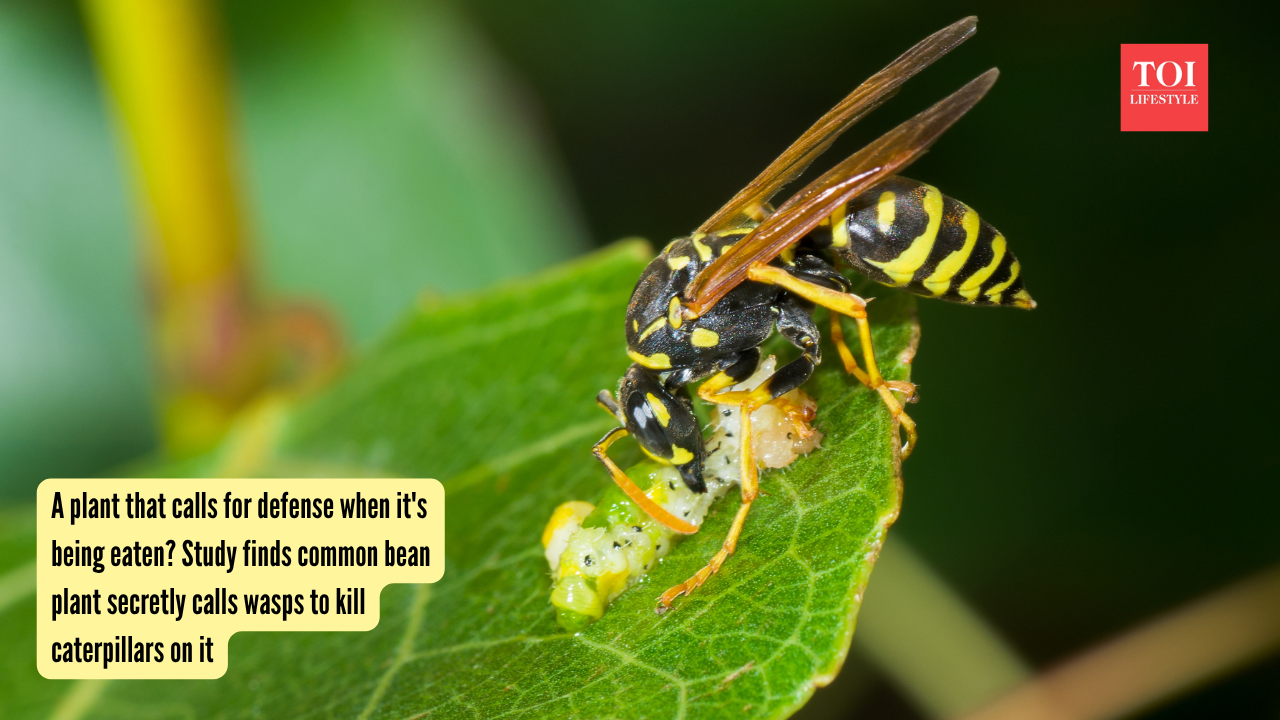
Representative Image
A plant that calls wasps and wards off pests!
When a caterpillar starts chewing on a common bean plant, the plant doesn’t just sit there and take it. It calls for backup.A recent study published in Science Advances found that the common bean Phaseolus vulgaris, one of the world’s most widely grown food crops, has developed an interesting response to caterpillar attack.When a caterpillar feeds on the plant, a compound present in the insect’s saliva causes the plant to release a specific chemical signal into the air. That signal, in turn, attracts parasitic wasps, which come near the plant, locate the caterpillars, and either consume them or lay their eggs inside their bodies, ending the threat for the plant.
Plant that calls for defense backups
The study tells how the plant distinguishes between different kinds of damage. Not just any wound from an insect triggers the response, it has to be the caterpillar’s saliva chomping the plant tissue. The chemical compound in that saliva acts as a kind of biological key that unlocks the plant’s alarm system, leading it to release volatile chemicals known as herbivore-induced plant volatiles, or HIPVs.
These plants communicate through airborne signals
These airborne signals are the plant’s way of communicating, not with other plants, but directly with the wasps that prey on its attackers. The wasps, drawn by the scent, are attracted towards the source and deal with the caterpillars accordingly.What makes this particularly striking is the specificity involved. The plant doesn’t release any general stress signal, it responds to a very particular molecular trigger in the caterpillar’s spit.This level of precision didn’t happen overnight. Plants, insects, and predators have been evolving side by side with each other for millions of years, and what we’re seeing here is the result of all that time. And yet the system works, quietly and reliably, every single time.Phaseolus vulgaris is not an exotic or rare species. It’s the plant behind kidney beans, black beans, navy beans, and pinto beans, which is grown across the world, eaten in almost every cuisine, and studied extensively for decades.