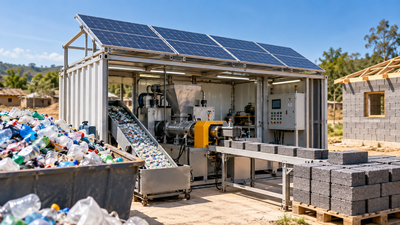
A team of Dutch engineering students has won first place at a major international hackathon with an idea that tackles two problems at once: plastic waste and a lack of safe, affordable housing. The project, ManufacturingBox, was developed by students from the University of Twente and took top honours at the World Federation of Engineering Organisations Hackathon, held to mark World Engineering Day for Sustainable Development in March 2025. At its heart is a self-sustaining micro-factory, powered entirely by solar energy, that shreds discarded plastic and presses it into durable building bricks. What began as a competition entry has since grown into something far more concrete, with the team working alongside Engineers Without Borders Netherlands and a Ghanaian waste management company to build and test a working prototype on the ground in Ghana. The project is still evolving, but its ambitions now stretch well beyond a single hackathon win.
How ManufacturingBox turns plastic waste into building bricks
The idea behind ManufacturingBox is straightforward but ambitious: take plastic that would otherwise end up as waste, shred it, and press it into bricks strong enough to build with, all powered by solar energy rather than the electricity grid. According to the University of Twente, the finished bricks “can be used to construct homes and sanitation facilities, improving living conditions while also creating jobs and fostering local waste management systems.”The project was developed with humanitarian engineering principles in mind, and its backers say it contributes to several UN Sustainable Development Goals at once, including poverty reduction, gender equality and building more sustainable communities. Rather than treating waste management and housing as separate issues, the micro-factory model tries to solve both through a single, community-based process.
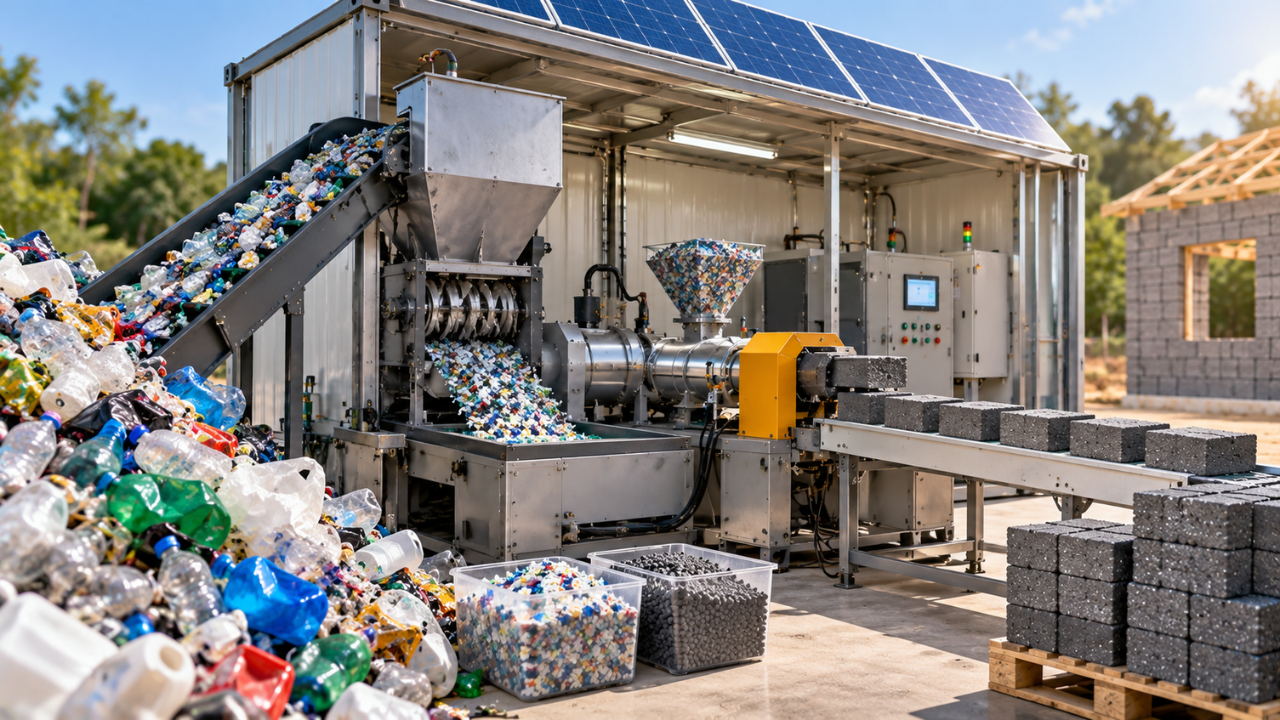
Image AI generated
How the team tested plastic brick production in Ghana
Winning the hackathon was only the starting point. According to EWB International, the team had already been working with the team before the competition, and the group partnered with Afua Opare-Baidu of TrashSmart, a Ghanaian waste management company, to test the concept outside a lab setting. This meant the project moved quickly from a student proposal into something being tried on the ground.Team member Tirsa van der Ouw travelled to Ghana as part of her master’s graduation project, where she built a prototype production process using low-cost, low-tech machinery, an oven and press combination that produced the first recycled plastic brick. At the same time, TrashSmart began building a plastic shredder and installed a shipping container to house the micro-factory, marking the shift from a design on paper to a physical production site.
How students are developing the recycled plastic bricks
Much of the project’s progress has depended on collaboration rather than the original student team working alone. Engineers Without Borders Netherlands has coordinated several linked student projects, covering everything from material science research into the plastic itself to the co-design of a washroom structure built from the recycled bricks, which is planned for a school in Kumasi as the first real-world pilot.A partnership with Kwame Nkrumah University of Science and Technology (KNUST) in Ghana has also taken shape, with two KNUST students due to travel to the Netherlands to work on the project directly. Engineers Without Borders International, reporting on the project, described this exchange as part of the team’s commitment to inclusive, cross-border engineering solutions.
Why the team is developing recycled plastic housing
Geert Talsma will refine both the production process and the brick design itself, and he is due to travel to Ghana in the second quarter of 2026 to help set up the production line and support construction of the pilot washroom. Beyond that single building, the team’s stated ambition is to expand the same approach into low-cost housing, using recycled plastic bricks to provide affordable homes rather than just sanitation facilities.Several challenges remain before that can happen. The team has said more research is needed into the composition of the plastics used, how the bricks perform over their life cycle, and what happens to them at the end of their use, alongside further testing to confirm they are safe for construction. Funding is the other major hurdle, and the team is actively seeking partners and institutions willing to support the project as it moves from a single pilot washroom toward a wider network of micro-factories across Ghana and beyond.