
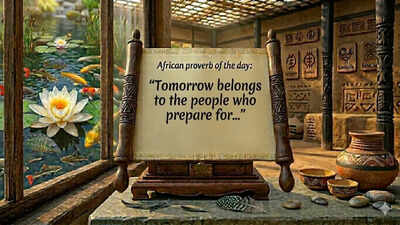
This African proverb sounds almost too simple at first. “Tomorrow belongs to the people who prepare for it today.” Nothing dramatic. Nothing mysterious. Just a straight line between action and outcome. But the more you sit with it, the more it starts to feel heavier than it looks on paper. It hints at responsibility, timing, and the quiet pressure of preparation that nobody really sees.People often repeat it in schools, workplaces, and even in motivational talks. It lands differently depending on context. Sometimes it feels encouraging. Sometimes it feels like a warning. It seems to sit in that middle space where truth usually lives, not loud, not soft, just consistent.And maybe that’s why it sticks.
African proverb of the day
“Tomorrow belongs to the people who prepare for it today.”
The core idea behind this African proverb
At its centre, this proverb is about ownership of time. Not in a literal sense, but in a behavioural one. It suggests that the future doesn’t randomly reward people. It responds, instead, to what is done in the present.Experts in traditional wisdom often say African proverbs tend to compress long life lessons into short, almost conversational lines. This one fits that pattern well. It links “tomorrow” with “today” in a way that feels obvious, yet easy to ignore in daily life.It appears to be saying something like this: if preparation is missing now, tomorrow arrives empty. Or at least less stable than expected.Simple idea. Not always a simple practice.
Why preparation matters more than motivation
Motivation is usually loud. It shows up in bursts. People feel inspired, make plans, write lists, and sometimes even start strong.But preparation is quieter. It doesn’t feel exciting. It looks like repetition, routine, and small corrections. It’s not very visible from the outside.And that’s where the proverb quietly leans in.It doesn’t talk about excitement. It talks about readiness.It might be suggesting that tomorrow doesn’t respond to how motivated someone feels, but to how prepared they actually are. There’s a gap between intention and readiness. A small one sometimes. A huge one at other times.That gap is where outcomes are decided.
The illusion of “I’ll do it later”
Most people understand preparation in theory. The issue is timing.There’s a common mental habit of pushing things forward. “I’ll start tomorrow.” “Next week will be better.” “After things settle down.”It sounds harmless. Even reasonable. But over time, those delays stack up.The proverb quietly challenges that habit. Not in a harsh way. More like a reminder sitting in the background. Tomorrow is not a separate space where preparation magically becomes easier. It is just today, extended.Some behavioural researchers suggest that humans naturally underestimate future effort. Tasks feel easier in imagination than in execution. That mismatch creates procrastination loops.This proverb seems to cut through that loop.Not with pressure. Just clarity.
Everyday examples people often overlook
Preparation doesn’t always look dramatic. It’s usually small.A student revising a little each day instead of cramming the night before.A worker checking details today so tomorrow doesn’t collapse under avoidable errors.A farmer preparing soil long before harvest season shows up.Nothing flashy. But consistent.Productivity experts often point out that systems matter more than sudden effort. Systems are built in advance. Not at the last minute.This proverb aligns closely with that idea, even though it comes from a much older oral tradition.It doesn’t glorify effort alone. It values the timing of effort.
The emotional side of preparation
There’s also a psychological layer here that people don’t always talk about.Preparation reduces anxiety.When someone prepares properly, tomorrow feels less threatening. Not because uncertainty disappears, but because readiness creates a sense of control. Without preparation, tomorrow can feel like something arriving too fast. Too heavy. Too unmanageable.So this proverb isn’t only about success or productivity. It also touches stability. Mental stability, even.It seems to suggest that preparation is a kind of emotional grounding.Not perfect. But helpful.
Why people still avoid preparing
Even when people know the benefits, avoidance still happens. That’s the strange part.Part of it might be cognitive load. Preparation requires thinking ahead, organising steps, and imagining outcomes. The brain sometimes prefers immediate tasks because they feel simpler.Another part might be optimism bias. The belief that “it will work out somehow.” That things will be easier tomorrow than they are today.But experience often disagrees.This is where the proverb quietly becomes relevant again. It doesn’t argue. It just states a pattern that repeats across time and cultures.Those who prepare tend to handle tomorrow better than those who don’t.Not always perfectly. But more reliably.
African wisdom and practical life lessons
African proverbs are often rooted in lived experience rather than abstract theory. They emerge from farming cycles, community living, oral teaching, and intergenerational observation.This one feels especially practical.It doesn’t rely on metaphor as much as some others. It uses direct language. Tomorrow. Today. Preparation. Ownership.Some scholars of oral tradition say this kind of proverb was likely used in teaching younger generations responsibility. Not through instruction manuals, but through short phrases repeated in daily life.A sentence like this can be remembered easily. Reused easily. Passed on easily.And that might be why it survives.
Modern life still runs on the same principle
Even though the world has changed massively, the underlying logic hasn’t.Deadlines still exist. Consequences still exist. Preparation still decides outcomes.The difference is speed. Everything feels faster now. Work cycles, communication, expectations. That speed makes preparation even more important, not less.Yet ironically, it also makes it harder to do.People often feel like they are constantly catching up. Always reacting. Rarely preparing.In that sense, the proverb feels almost more relevant now than before. It quietly pushes against a reactive lifestyle.It suggests something slightly uncomfortable: reacting is not the same as preparing.
Small disciplines that shape tomorrow
Preparation doesn’t have to be large-scale. It can be as small as:
- Planning the next day before it starts
- Keeping tasks organised instead of scattered
- Reviewing mistakes while they are still fresh
- Learning a skill bit by bit instead of all at once
None of this feels dramatic in the moment.But over time, it compounds.Experts in habit formation often describe this as “incremental advantage.” Tiny actions repeated consistently create large differences later.This proverb seems to point directly at that idea, long before modern productivity language existed.
The quiet pressure of responsibility
There is also a subtle responsibility embedded here.If tomorrow belongs to those who prepare today, then tomorrow is not random. It is partly shaped.That can feel empowering. But also slightly heavy. Because it implies accountability.Not everything is controllable, of course. Life interrupts plans. Unexpected things happen. That part is real.But within uncertainty, preparation still shifts probability. It tilts outcomes. And maybe that is the core message here – not control, but influence.
A small reflection on time itself
Time is strange. People always think they have more of it later. Rarely feels urgent until it becomes tight.This proverb quietly interrupts that illusion.It connects today and tomorrow like a continuous thread. Not separate compartments. One flowing into the other.It might be saying that tomorrow is not something waiting in the distance. It is something being built right now, whether consciously or not.That idea can be motivating. Or slightly uncomfortable. Sometimes both.
Closing thoughts
“Tomorrow belongs to the people who prepare for it today” doesn’t try to sound clever. It doesn’t rely on imagery or complexity. It simply links action with outcome in a way that feels hard to argue with.It’s not a promise of success. It’s more like a reminder of structure.Prepare today, and tomorrow becomes more manageable. Ignore today, and tomorrow tends to feel heavier than expected.Simple idea. But it doesn’t fade easily.It stays in the background, quietly influencing how people think about time, effort, and responsibility.