
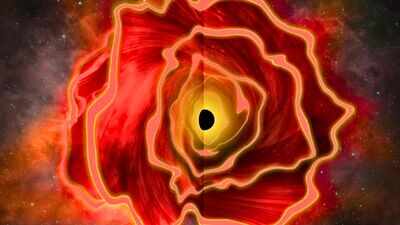
Astronomers have identified an unusual object from the early Universe that may represent a possible early stage of a supermassive black hole. It is called MoM-BH*-1, and was observed using Nasa’s James Webb Space Telescope about 660 million years after the Big Bang. It appears extremely red and compact, yet its light shows an unusual combination of features associated with both stars and active black holes. Researchers say the object is best explained as a supermassive black hole surrounded by an extremely dense, turbulent envelope of gas.The gas creates a powerful Balmer break and absorption features that make it look unlike an ordinary star or familiar active galaxy. MIT researchers have described the possible configuration as a ‘black hole star’, while the study published in the journal Nature, titled ‘A gas-enshrouded and gas-reddened black hole at cosmic dawn’, formally presents it as a gas-enshrouded, gas-reddened black hole. The finding could also offer clues to the mysterious little red dots seen by JWST. It may offer clues to how some black holes grew rapidly in the early Universe.
Possible ‘black hole star’ in early Universe may be a black hole hidden inside dense gas
The research suggests that a supermassive black hole is surrounded by a dense envelope of gas. Radiation falling towards the black hole provides energy, while gas absorbs, scatters, and re-emits that light. Researchers found that ordinary stars cannot reproduce the deep Balmer break. Their modelling required very dense hydrogen gas with little dust to reproduce the observed spectrum and infrared emission. The study describes this modelling as simplified, so it does not prove every detail of the proposed structure. Instead, it shows that a gas-enshrouded black hole can account for the spectral features. The source looks partly star-like while being powered by a black hole, creating the appearance described by MIT researchers as a possible ‘black hole star’.
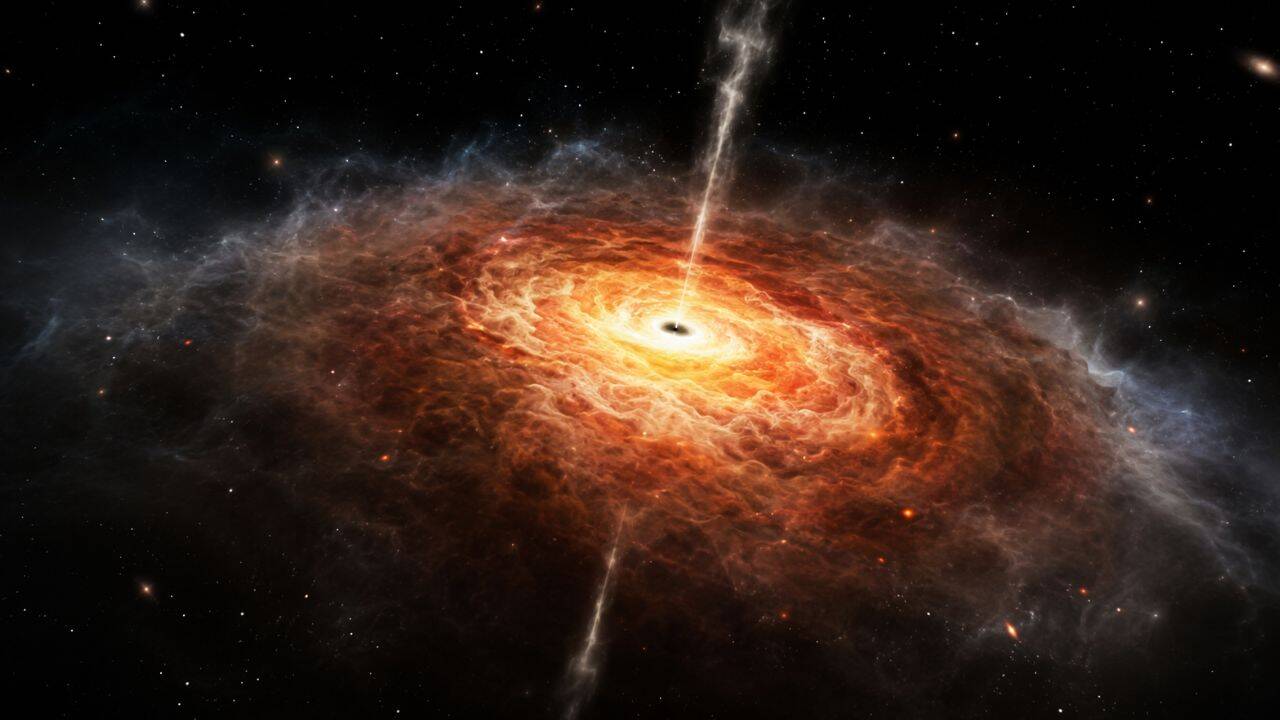
Possible ‘black hole star’ in early Universe may be a black hole hidden inside dense gas (PC: AI Generated)
James Webb Space Telescope spotted the unusual object 660 million years after the Big Bang
The object is interesting because it may connect to the little red dots that the James Webb Space Telescope has found in the early Universe. These red sources show combinations of broad emission lines and other spectral features that have been difficult to explain. The study proposes that MoM-BH*-1 could act as a template for the black-hole component of some little red dots. If a similar gas-enshrouded black hole sits inside a young, star-forming galaxy, the light could produce a red, compact appearance. Researchers stress that this is a proposed explanation, not a final identification for every little red dot. The finding gives astronomers a scenario they can test with additional observations and may help clarify why these objects appear in JWST images of space.
MoM-BH*-1 has an unusually strong Balmer break and deep absorption features
MoM-BH*-1 stood out because its spectrum contains an exceptionally strong Balmer break, where its light drops sharply across a specific wavelength range. The study reports a break strength of about 7.7, beyond the expected maximum for normal dust-free stellar populations. The object also shows broad Hβ emission and deep absorption in Hβ and Hγ. These absorption features indicate extremely dense gas around the central source. The researchers modelled the object using a black hole surrounded by dense, turbulent hydrogen gas and found that this arrangement could reproduce the main spectral features. The modelling also requires very little dust, supporting the idea that gas, rather than dust, is responsible for making the black hole appear unusually red.
How a gas-enshrouded black hole could offer clues to JWST’s mysterious little red dots
The discovery also matters for the question of how supermassive black holes grew in the young Universe. The paper notes that MoM-BH*-1 may represent an early growing black hole surrounded by dense gas, a configuration that could allow rapid, possibly super-Eddington accretion. The study’s modelling estimates that the central black hole has a mass of roughly 10^6 to 10^7 times that of the Sun. The source appears to have a host galaxy, but the black hole dominates almost all of the light detected from the object. Its formation remains an important question, but future observations of similar objects could help determine whether gas-enshrouded black holes were an important pathway for rapid black-hole growth in the early Universe.