
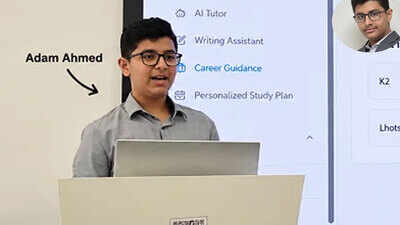
Why do some students avoid homework but spend hours playing video games?That question led 13-year-old Adam Ahmed, a Year 10 student from Sharjah in the UAE, to build an AI-powered education platform that would go on to receive international recognition. It also set him on a second path: creating a free, open-source tool designed to help multiple AI coding agents work together without duplicating or overwriting each other’s work.As reported by UAE Startup Story, Adam’s journey began with an experimental project called FutureEduAI, which later evolved into ScoolBot, an AI-powered and gamified learning platform designed around UAE Ministry of Education standards.
One question, an experiment and a Top 20 finish
Adam’s first attempt was relatively simple. He wanted to test whether a learning platform could capture a student’s attention in the way a video game does.He entered FutureEduAI into an AI Application Challenge organised by DDS, also known as Decoding Data Science, an AI and data science community in the MENA region. The project finished among the Top 20.Rather than treating the result as the final destination, Adam went back to work.“I thought I could do better, and that the overall idea of FutureEduAI was worth taking forward,” he said, as quoted by UAE Startup Story. “I’d also learned a lot by then, and had a lot more tools to help me work.”Using newer AI development tools, he rebuilt the platform and gave it a new name: ScoolBot.
From fourth place to international recognition
The first version of ScoolBot placed fourth in another DDS AI Application Challenge. Adam then began presenting the platform to teachers at his own school and later to school principals in Sharjah.The feedback helped him refine the product before it began receiving wider recognition.
| Award or challenge | Project/category | Result |
| DDS AI Application Challenge | FutureEduAI | Top 20 |
| DDS AI Application Challenge | ScoolBot v1 | 4th place |
| International AI Awards 2026 | Best AI Education | Gold |
| TeenTech Awards 2026 | Education | Gold Recognition |
ScoolBot was named a Gold winner in the Best AI Education category at the International AI Awards 2026. It also received Gold Recognition at the TeenTech Awards 2026, a UK-based competition for young innovators.“It was amazing, especially getting the email and the certificate announcing the International AI Awards and the TeenTech Awards,” Adam said, according to UAE Startup Story. “I was feeling very happy.”
Building for students, teachers and parents
ScoolBot brings together game-based quizzes, an AI tutor, classroom management tools and progress-tracking features.Students can use interactive quizzes and AI-assisted learning, while teachers have access to classroom tools and dashboards intended to reduce administrative work. Parents can also follow their children’s progress through the platform.But building ScoolBot led Adam to another problem—this time involving the AI tools he was using to create software.
When AI coding agents started getting in each other’s way
Adam experimented with using several AI coding agents simultaneously, assigning different parts of a software project to different tools.The problem was coordination.According to the account shared with UAE Startup Story, the agents could duplicate work, overwrite changes or interfere with tasks completed by another AI system. Adam also found himself manually passing information between them.His solution was Bothread, a free and open-source tool designed to enable multiple AI coding agents to communicate, coordinate tasks and avoid conflicts.“Honestly, I think it matters almost as much as ScoolBot because Bothread solves a real problem, and it’s completely open source, local, and free,” Adam said. “I think it can genuinely help a lot of people.”Since its launch in June 2026, Bothread has received early interest from developers, according to figures shared by the project.
The lesson from a 13-year-old founder
Adam’s story is not simply about winning awards at an unusually young age.His first project reached the Top 20. The next version finished fourth. Instead of abandoning the idea, he kept rebuilding it, seeking feedback and experimenting with new technology.For students interested in coding and AI, the journey offers a useful reminder: the first version does not have to be the final version—and sometimes, the most interesting ideas begin with a question that others have simply accepted as normal.Disclaimer: This article is based on information provided by ScoolBot and publicly available material, including statements attributed to Adam Ahmed and UAE Startup Story. TOI Education has not independently verified all claims, achievements or performance figures mentioned in the article.