
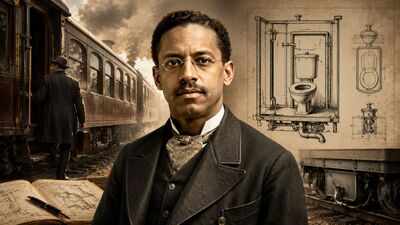
For many people, Lewis Howard Latimer is remembered for his later work on electric lighting and his association with Thomas Edison. Yet years before he became involved in the electrical industry, he helped solve a far more ordinary problem that affected railway passengers every day. Travelling by train in the nineteenth century was becoming increasingly common, but basic sanitation had not kept pace with the rapid expansion of rail transport. Toilets aboard many trains were little more than direct openings onto the tracks below, exposing passengers to dust, cinders and other debris. In 1874, Latimer, working alongside Charles W. Brown, secured a patent for an improved railway water closet that tackled this overlooked issue. It became the first patent in a career that would later include several influential engineering innovations.
Lewis Howard Latimer ‘s 1874 railway water closet patent solved a major train toilet problem
By the early 1870s, train toilets were far from comfortable. According to Mjengo Hub, many railway carriages used toilets that discharged waste directly onto the tracks beneath the train. The same opening also allowed dust, cinders and debris from the railway bed to be thrown back into the compartment during travel, creating an unpleasant experience for passengers.Rather than accepting the existing arrangement, Lewis Howard Latimer and Charles W. Brown redesigned the system. Their invention, granted as U.S. Patent 147,363 on 10 February 1874, introduced an improved water closet intended to create a more enclosed and safer toilet system inside railway cars. While the patent did not transform rail travel overnight, it addressed a practical problem that affected passenger comfort on a daily basis.
Who was Lewis Howard Latimer: His early life, family and journey into engineering
The railway toilet patent arrived before Latimer became associated with some of the biggest names in American technology. According to Frontiers, Lewis Latimer was born on 4 September 1848 in Chelsea, Massachusetts, to George Washington Latimer and Rebecca Latimer, who had escaped slavery in Virginia several years earlier. His childhood was shaped by hardship after his father disappeared following the 1857 Dred Scott v. Sandford decision, leaving his mother to raise the family.Despite receiving little formal education, Latimer developed a strong interest in learning and possessed exceptional artistic ability. During the American Civil War, he enlisted in the Union Navy and was honourably discharged in 1865. His military service helped him obtain employment at the Boston patent law firm Crosby, Halstead and Gould, initially working as what was then known as an office boy.
How Lewis Howard Latimer taught himself engineering and technical drafting
Latimer’s path into engineering did not begin through university study or technical training. Reportedly, he earned just three dollars a week when he joined the patent law firm. While working there, he taught himself drafting by learning to use instruments such as rulers and set squares. His skill in preparing detailed patent drawings gradually earned recognition from experienced draftsmen, eventually leading to promotion as head draftsman.Frontiers for Young Minds also notes that colleagues recognised his artistic talent and trained him in technical drafting. His growing reputation resulted in one of the firm’s most important assignments in 1876, when he prepared the patent drawings required for Alexander Graham Bell’s telephone patent.Working every day with inventions submitted by other people also exposed Latimer to a wide range of mechanical ideas. This steady contact with new concepts encouraged him to begin developing inventions of his own, with the improved railway water closet becoming his first successful patent.
Lewis Howard Latimer’s electric lighting innovations and work with Thomas Edison
The railway toilet patent marked only the beginning of Latimer’s inventive career. According to Frontiers, his work as a patent draftsman attracted the attention of Hiram Maxim, chief engineer of the U.S. Electric Lighting Company, who recruited him as both a draftsman and engineer. During 1881 and 1882, Latimer received several patents connected with incandescent lighting, including improvements to light bulbs, lamp stands and, most significantly, a better process for manufacturing carbon filaments.The publication explains that this work significantly improved the commercial production of electric lighting and eventually brought him to the attention of Thomas Edison. Edison later employed Latimer as a patent specialist, valuing his experience in identifying patent infringements and defending intellectual property relating to electric lighting.According to Mjengo Hub, Latimer later patented additional inventions, including improvements to electric lamp supports and cooling systems, building a career that extended well beyond his first railway innovation.
Lewis Howard Latimer’s legacy as an inventor and electric lighting pioneer
Although his contributions to railway sanitation are less widely known, Latimer’s later achievements earned considerable recognition.According to Frontiers, he published Incandescent Electric Lighting: A Practical Description of the Edison System in 1890, regarded as one of the earliest practical manuals on electric lighting. After establishing his own laboratory and patent consultancy in Queens, New York, he continued inventing while also participating in civic and artistic activities.Latimer became the only African American admitted to the Edison Pioneers in 1918, an organisation formed by employees who had worked with Edison during the early years of the electric lighting industry. He died in Queens on 11 December 1928, aged 80, and was later inducted into the U.S. National Inventors Hall of Fame in 2006.
Why Lewis Howard Latimer’s first 1874 railway water closet patent deserves greater recognition
The improved railway water closet rarely appears alongside Lewis Howard Latimer’s better-known achievements in electrical engineering, yet it represented an important beginning. Before contributing to the development of electric lighting, he focused on making railway travel cleaner and more practical through a straightforward engineering solution.According to Mjengo Hub, the 1874 patent addressed the problem of debris entering railway toilets while reducing the shortcomings of earlier systems that emptied directly onto the tracks. Combined with the account provided by Frontiers for Young Minds, the invention illustrates how Latimer’s career began with practical mechanical improvements before expanding into technologies that shaped the electrical age. His first patent may not have carried the same public recognition as his later work, but it established the inventive approach that would define the rest of his career.