
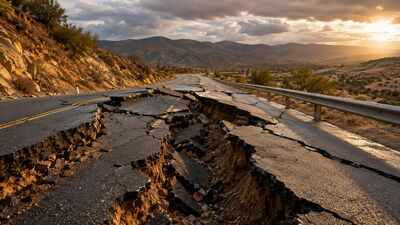
For decades, discussion about California’s next major earthquake has tended to revolve around a single fault. The southern stretch of the San Andreas has long been viewed as the state’s most closely watched geological boundary, largely because it has remained quiet since the mid-19th century despite continuing movement beneath the surface. That long silence has often been interpreted as a sign that energy is accumulating underground, although exactly how that stored stress might eventually be released has remained uncertain.New research offers a different perspective. Rather than focusing on one fault in isolation, scientists have examined how two neighbouring fault systems are behaving together. Their findings suggest that the underground conditions across part of Southern California have reached an unusual state, with strain levels matching or exceeding anything reconstructed over roughly the last thousand years. The work does not indicate that an earthquake is imminent, but it does point to a landscape where several large faults may now be more closely linked than previously understood.
Understanding how California’s major faults interact
The study led by Dr Liliane Burkhard of the University of Bern, published in the journal Advancing Earth and Space Sciences, titled ‘Cajon Pass and the Southern San Andreas Fault System: Earthquake Cycle Stress Accumulation and Present-Day Loading‘, investigated how stress has accumulated across the southern San Andreas Fault and the nearby San Jacinto Fault. Although each system has produced destructive earthquakes independently, they lie close enough in parts of Southern California that scientists have long wondered whether activity on one could trigger movement on the other.Instead of concentrating solely on historical earthquakes, the researchers reconstructed how tectonic stress has built up over many centuries. Their computer model combined geological evidence from prehistoric earthquakes with more recent records, allowing them to estimate how strain has shifted between faults through time.The picture that emerged differs from the traditional idea of one isolated fault steadily approaching failure. It suggests the interaction between neighbouring faults may be just as important.
The California mountain pass that could shape the next major earthquake
Attention centred on Cajon Pass, northeast of Los Angeles, where the San Andreas and San Jacinto faults approach one another before continuing on separate paths.Geologists sometimes describe places like this as gateways because they can influence how an earthquake develops. A rupture travelling along one fault may lose momentum as it reaches the junction, or it could continue across to the neighbouring fault if underground conditions allow.Historical evidence shows both outcomes have occurred at different times. The study reveals, during the powerful Fort Tejon earthquake of 1857, the rupture remained on the San Andreas before coming to an end near Cajon Pass. Earlier events appear to have behaved differently, extending beyond the junction and affecting both fault systems.
How scientists rebuilt California’s seismic past
Faults rarely move in a smooth, continuous way. As tectonic plates shift over time, sections of rock become locked together, preventing movement even though pressure continues to build beneath the surface. Eventually that stored energy is released during an earthquake.To understand where today’s conditions fit within the long geological record, the researchers reconstructed approximately a millennium of earthquake history. Carbon dating, tree-ring evidence and geological traces left behind by ancient ruptures helped fill the gaps where written records do not exist.Their simulations tracked how each major earthquake altered stress across surrounding faults before allowing that strain to rebuild gradually over succeeding centuries. Rather than revealing a simple increase on one fault alone, the model indicated that stress has accumulated across both the San Andreas and the San Jacinto in a remarkably similar pattern.
Why both fault systems are raising concern
One aspect of the findings attracted particular attention. The amount of stored strain appears to be unusually high on both faults at the same time.According to the reconstruction, one section of the San Jacinto Fault has exceeded any comparable stress level identified within the thousand-year model. Nearby sections of the southern San Andreas also sit close to those upper limits.The researchers suggest this balance may increase the likelihood that movement on one fault could continue onto the other if a large earthquake begins. Rather than acting independently, the two systems may currently be positioned in a way that allows a rupture to spread more easily across the junction between them.