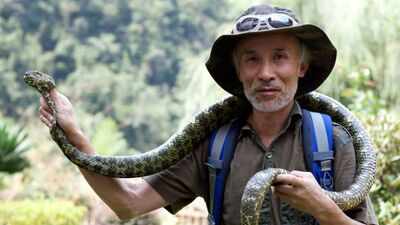
Chen Yuanhui has spent more than four decades studying one of China’s rarest venomous snakes, even though his work has cost him part of a finger and repeatedly put his life in danger. The 77-year-old, widely known as the ‘Snake Doctor,’ discovered the ‘Mangshan pit viper’ and has devoted his life to understanding and protecting it. His fascination began with a mysterious snakebite case in the mountains of Hunan, leading to the scientific recognition of a previously unknown species.Since then, Chen has faced dangerous bites, financial difficulties and offers from wildlife traders, yet he has continued his conservation work. According to the South China Morning Post, he has survived 9 bites from the Mangshan pit viper, losing part of a finger after the last one. For Chen, however, the risks have never outweighed his determination to protect the snake he brought to the world’s attention.
China’s ‘Snake Doctor’ devoted his life to studying and protecting one of the most rare viper snakes
Chen was originally from Guangdong province but moved to Hunan at a young age. SCMP reported that he graduated from a clinical college at 19 and later worked at a snakebite research centre. When the centre was discontinued in 1982, he chose to remain in the mountainous Mangshan region, where he worked as a doctor treating snakebite victims.His life changed in 1984 after he treated a forestry worker who had been bitten by an unfamiliar venomous snake. Locals called it the ‘little green dragon’ because of its distinctive yellow and green colouring, white tail and unusual markings. Chen suspected that the animal might be a species unknown to science. He began searching the forests around Mangshan Mountain, an investigation that would eventually shape the rest of his life.
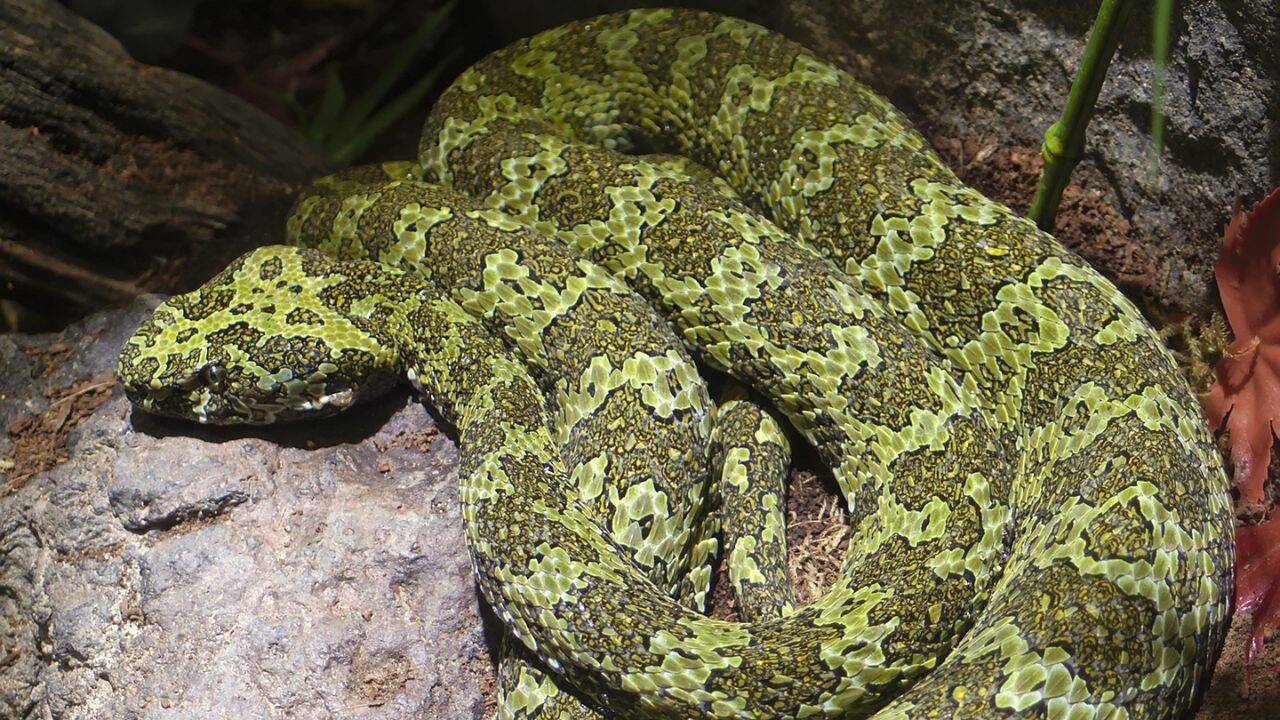
Mangshan pit viper. Image Credit: Wikipedia
A mysterious snake bite led to a major discovery
According to China Daily, Chen made a breakthrough in 1989 after learning that local people were selling snakes matching the descriptions. He used 400 yuan, which his family had saved for a refrigerator, to obtain them. He then travelled by train to Chengdu to meet the prominent zoologist ‘Zhao Ermi.’ In 1990, the two scientists announced the discovery of a new species, later named ‘Trimeresurus mangshanensis,’ or the ‘Mangshan pit viper.’ However, identifying the snake was only the beginning. Chen subsequently focused on the far more difficult task of protecting this rare species.
Chen continued his work even after being bitten 9 times and losing a finger
Working closely with the highly venomous snake came at a serious personal cost. SCMP reported that Chen has been bitten by Mangshan pit vipers nine times. After his eighth bite, he wrote what he believed could be his final words. The ninth bite was particularly severe because he spent the first critical moments photographing the bite marks for scientific records instead of immediately applying first aid. The venom ultimately caused him to lose part of his left middle finger.
Scientific research became central to the species’ survival
Chen recognised that the Mangshan pit viper needed more than protection from capture and killing. According to China Daily, he began an artificial breeding programme and spent years studying the animal’s population and distribution. His team also investigated how the snakes reproduce. In 2017, 10 snakes hatched in a simulated wild environment at the ‘Mangshan Museum of Natural History,’ where Chen’s team was carrying out breeding work.The programme became even more important after severe snowfall in 2008 killed more than 100 Mangshan pit vipers. According to China Daily, the disaster accelerated efforts to breed the species. By 2022, Chen had bred 160 Mangshan pit vipers, all of which were released into the mountain’s nature reserve. Fewer than 600 were believed to remain in existence.
The high price placed on a rare snake
The rarity of the Mangshan pit viper also attracted wildlife traders. According to SCMP, its black-market price reportedly rose to more than one million yuan, or over US$150,000, per snake after the species received an IUCN listing. Chen refused offers to sell the animals despite financial difficulties. He even moved snakes he had bred into his home after a dealer stole one from his breeding area. Chen feared that commercial trade could rapidly drive the species towards extinction. His work also created tensions at home. His wife quarrelled with him over his devotion to snakes and at one point threatened divorce, as per SCMP.
The snake doctor’s conservation legacy
Chen is now closely associated with the survival of the Mangshan pit viper. China Daily reported that a statue of him, with a snake around his shoulders, stands outside the Mangshan Museum of Natural History. His work has also contributed to the development of the Mangshan region, where the rare snake and surrounding natural scenery attract tourists and create opportunities for local residents.What began with a mysterious snakebite eventually led Chen to discover a previously unknown species and dedicate his life to its protection. More than 40 years later, his work continues to be defined by the same commitment. His career has helped ensure that one of China’s rarest snakes has a stronger chance of survival.

Statue of Chen Yuanhui outside a local natural history museum. Image Credit: South China Morning Post