
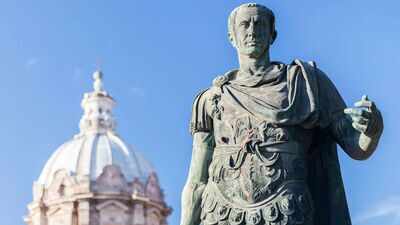
Did you know that the month of July is named after Julius Caesar? Long before he became one of history’s most celebrated military commanders, the Roman leader left a legacy so profound that even the calendar bears his name. While most people remember him for the iconic words “Veni, Vidi, Vici”, “I came, I saw, I conquered”.Caesar’s influence extended far beyond the battlefield. On his birth anniversary, here’s a look at the man whose victories, reforms and political vision changed the course of history.The phrase Veni, Vidi, Vici was written by Caesar in 47 BC after his victory over Pharnaces II, King of Pontus, at the Battle of Zela in present-day Türkiye. Instead of sending a lengthy report to the Roman Senate, Caesar chose just three words to describe his campaign. The message was simple but powerful.The battle had been won quickly, decisively and completely. Over the centuries, the phrase has come to symbolize swift and overwhelming success, and it remains one of the most famous military quotations ever recorded.But those three words tell only a small part of Caesar’s remarkable story.Born in 100 BC into the ancient Julian family, Gaius Julius Caesar grew up during a period of political instability in the Roman Republic. Although his family was noble, it was not among Rome’s most powerful. Through determination, political skill and extraordinary military talent, Caesar steadily rose through the ranks of Roman public life.His greatest military achievement came during the Gallic Wars, fought between 58 and 50 BC. Over nearly a decade, Caesar conquered vast territories covering much of modern-day France, Belgium and parts of Switzerland. These victories dramatically expanded Rome’s borders, brought immense wealth to the Republic and earned Caesar the unwavering loyalty of his soldiers. His detailed account of these campaigns, Commentaries on the Gallic War, is still studied today by historians and military professionals.However, Caesar’s ambition extended far beyond the battlefield. In 49 BC, the Roman Senate ordered him to give up command of his army before returning to Rome. Instead, Caesar crossed the Rubicon river with his troops, an act that violated Roman law and effectively declared civil war. It was a moment that changed history forever. Even today, the phrase “crossing the Rubicon” refers to making an irreversible decision.After defeating his rivals, Caesar became Rome’s most powerful leader. As dictator, he introduced a series of reforms that modernized the Roman state. He reorganized the administration, tackled corruption, reformed taxation, expanded citizenship, settled military veterans on land and introduced the Julian Calendar. That calendar later became the basis of the modern Gregorian calendar used across most of the world today.Yet with immense power came growing opposition. Many senators feared that Caesar intended to end the Republic and crown himself king. Their fears culminated on 15 March 44 BC, the famous Ides of March, when a group of conspirators assassinated him inside the Theatre of Pompey. Caesar was stabbed 23 times in one of history’s most famous political assassinations.Ironically, his death did not save the Roman Republic. Instead, it plunged Rome into another civil war, ultimately leading to the rise of his adopted heir, Augustus, who became the first emperor of Rome. In trying to stop one powerful ruler, the conspirators unintentionally helped create the Roman Empire.More than two thousand years after his death, Julius Caesar’s influence remains extraordinary. His military campaigns continue to be studied in military academies. His name inspired royal titles such as Kaiser in Germany and Tsar in Russia. His life has inspired countless books, films and William Shakespeare’s famous tragedy Julius Caesar.