
Smile at your dog; they love it!
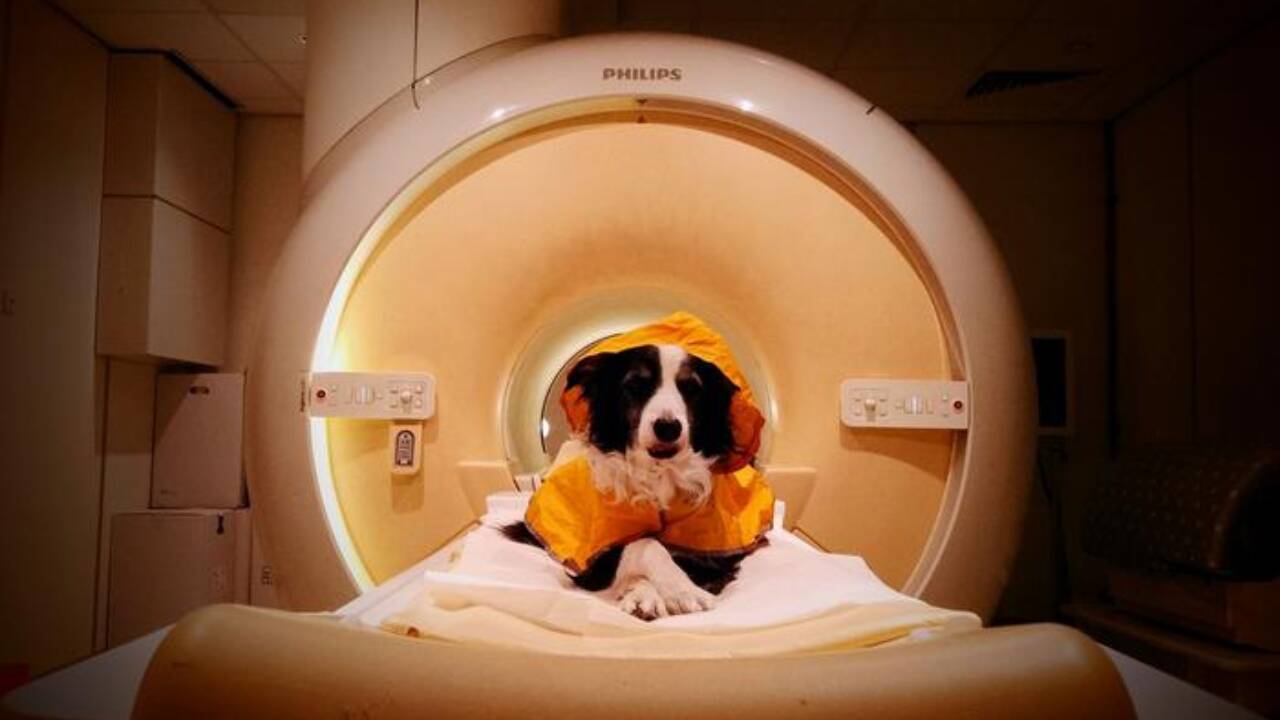
Trained pet dogs remained awake during fMRI scans as researchers measured their brain activity while (Pic credit: Laura V. Cuaya)
For the first time, scientists have evidence suggesting that dogs can distinguish between negative facial expressions, including anger, sadness and fear. “Humans are really good at picking up small details on the face, and so are dogs. This makes dogs very interesting. By studying their brains, we can understand what adaptations have developed to support their remarkable social and emotional understanding of humans,” first author Raúl Hernández-Pérez from the University of Vienna said.The researchers initially focused on happiness, the expression which had a particular significance for dogs, according to previous studies. To understand what’s going on in their brains, the researchers scanned eight dogs. During the scan, the dogs were shown images of strangers with either happy or neutral expressions. And guess what? Every time they were shown happy faces, the temporal cortex and the caudate nucleus, the regions in dogs’ brains linked to higher cognitive and reward processing, respectively, lit up!“The activity in the caudate nucleus is particularly interesting. It suggests that happy human faces may have emotional significance for dogs,” Laura Cuaya, also of the University of Vienna, who began the research at the National Autonomous University of Mexico and later expanded it through a collaboration at Eötvös Loránd University in Hungary, explained.
Your dog understands your emotions
The researchers also wanted to understand if the same regions of the brain respond to other emotions. So they showed images of people displaying happiness, anger, fear and sadness to 12 dogs. Using machine learning, the researchers analysed their brain activity. What the researchers found was striking. The dogs did not react the same way to these negative emotions. The temporal cortex-caudate nucleus network of dogs reacted uniquely to happiness. This means they are able to distinguish smiles from all three negative expressions. However, the dogs did not merely sort the world into good and bad, researchers said.Another brain analysis found that there were distinct patterns of activity in how they separated fear from anger and sadness. This is the first time scientists have found evidence suggesting dogs can distinguish between specific negative facial expressions. They can tell if you are sad or frightened.
Understanding an emotion doesn’t mean they experience it like us
Though dogs can distinguish between these emotions, it does not mean that they experience emotions exactly the same way humans do, researchers said. Also, a still photo of a human face doesn’t tell the whole story; in real life, dogs watch human body language, listen to nuances in our voices and detect information from our scent.“When we compare humans with primates, we are looking at abilities that may have come from a common ancestor. With dogs, the story is totally different. They followed a very different evolutionary path, yet through domestication, they developed the social abilities needed to understand and cooperate with us,” senior author Laura Cuaya of the University of Vienna said.The study only included pets who had loving families. The researchers noted that free-ranging dogs, like the ones who live on the street, navigate in a different social environment, which also means they may process human cues differently.The researchers are now hoping to understand how dogs integrate these brain signals to make sense of the humans around them. They also plan to compare how human and dog brains process the same emotional signals.“I would like people to see dogs as emotional beings. They have evolved with us to understand our expressions and cooperate with us, and recognising that can change how we communicate with and care for them,” Cuaya added.